A sourced illustration has not yet been added. This gap is included in the coverage record.
Overview
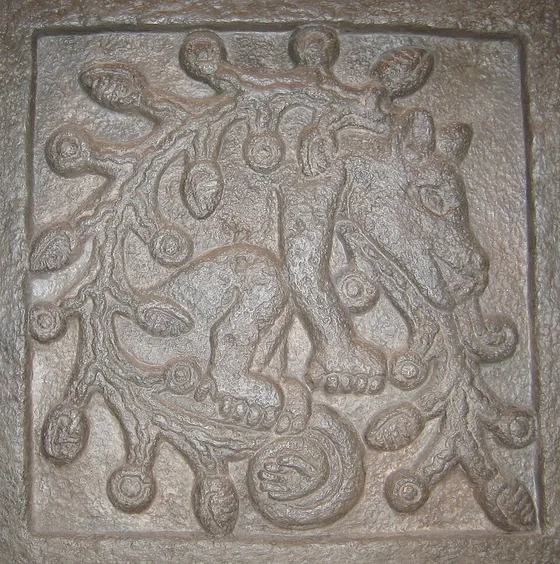
The serpent inhabits submerged caves and springs, with a body as thick as a man can embrace, a large head, barbel-like appendages and emberlike eyes. In the account it collects fish in a small pool near the shore, looking around before leaving to gather more. Someone who steals the catch is pursued: the serpent rises on its tail to look, follows scent if necessary, and moves rapidly over grass and bushes. It coils around the thief and uses the divided tail against the victim’s nostrils.
A prepared thief can escape into a hollow made in a nearby tree. The serpent mistakes the trunk for the person, tightens around it and dies, leaving the thief alive. Another episode gives it a spitting poison and breath that pulls a disabled passer-by into the water. Acóatl also names ordinary water snakes in the following paragraph; this profile concerns the extraordinary tlilcoatl narrative.
Origins & earliest records
Sahagún’s sixteenth-century animal corpus preserves the selected narrative in Book XI, chapter IV, paragraph 3. The directly inspected Spanish printing is volume III, dated 1830. Manuel A. Hermann Lejarazu’s 2025 discussion connects it with the acóatl or tlilcóatl image on Florentine Codex XI, folio 74v; neither witness establishes a first telling.
Records & interpretation
Printed pages 207–209 supply the detailed fish-store pursuit, hollow-tree escape and second hunting method. Lejarazu independently explains the names as water serpent and black serpent and discusses their sacred character. The next paragraph’s ordinary snakes show why a single translated name should not merge every animal description into this particular being.
Selected bibliography
Documented works and useful reading. This is not a list of every appearance.
- 01
Historia general de las cosas de Nueva España, tomo III
Book XI.IV.3, pp. 207–209; Spanish primary narrative inspected directly.
- 02
Acóatl: serpiente de agua
Arqueología Mexicana, especial 121 (May–June), pp. 40–42; public article excerpt inspected, not the full paid edition.
Family & connections
A source-supported family tree or inspiration record has not yet been compiled for this profile. Related reading below indicates a connection in subject matter, not a proven lineage or creative influence.
References
Sources supporting this profile. Linked pages have their own scope and editorial standards.
- ResearchSahagún, tomo III (1830), XI.IV.3Research access: 2026-10-05
- ResearchAcóatl: serpiente de aguaResearch access: 2026-10-05
Image credits
A sourced illustration has not yet been added. This gap is included in the coverage record.