A sourced illustration has not yet been added. This gap is included in the coverage record.
Overview
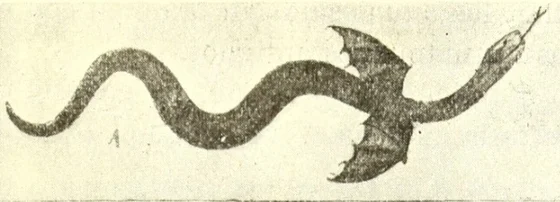
The Enciclopedia Chilena distinguishes two Culebrón designs. One lacks an ordinary tail and carries a cartilage-like membrane along its back, allowing short, awkward flights. The other has a head at each end of the body and wings for longer, faster movement. Both are described as heavy serpents with grey, black-spotted scales. Their stare holds goats or sheep still while they drink the animals’ milk.
The entry centres its historical distribution in Coquimbo, particularly the Choapa and Elqui valleys, with less frequent reports farther south. It explicitly distinguishes this account from Piguchén traditions, even though both may involve winged serpents. Its suggestion of a Diaguita-mediated relationship with distant feathered-serpent beliefs is an old speculative interpretation. The body variants and livestock encounter can be described without adopting that unproven history of cultural transmission.
Manuel Longuitie of Pillanlevun supplies a different Culebrón in Guevara’s 1908 collection. A man kills the serpent with difficulty and finds eggs containing different small creatures, including lizards, toads and snakes. A drop of its blood touches his hand and his arm swells painfully. A healer recognizes the connection without first being told the story.
The serpent’s surviving heart becomes the means of restoring both lives: after the prescribed act in the narrative, a new Culebrón forms and the man’s swelling subsides. The conclusion reveals that he killed it hoping its heart would bring gambling success and courage. This complete account links bodily injury, regeneration and the motive for taking the animal; it does not describe wings or a milk-drinking gaze. Those features belong to the separate northern Chilean encyclopedia witness. The healing sequence is reported as story action, not medical advice.
The complete 1915 appendix quotation from Latcham locates the northern variants more precisely. At El Palqui near Ovalle, a truncated-tailed serpent spreads its long back mane to fly. Elqui instead supplies a second head and wings, with night flight and sluggish daytime movement. A further unnamed elderly woman at Angostura de Paine describes heads at both ends, sometimes additional small heads along its sides, and bristles on its back. These locally attributed descriptions expand the encyclopedia’s two-part summary. Latcham’s proposed archaeological identification and transmission route remain his interpretation, not independently established history.
Origins & earliest records
The directly inspected account is encyclopedia document ECH-519/21 from the Biblioteca del Congreso Nacional’s 1948–1971 project. It cites Vicuña Cifuentes’s 1915 collection as its bibliography, but no separately matching original Culebrón passage has yet been verified. The historical entry dates documentation rather than establishing the tradition’s first telling or geographic origin.
Records & interpretation
The encyclopedia transcription supplies the two designs, milk-taking action, and specific valley references. Its proposed remote cultural ancestry is not supported here by an independently inspected transmission study. The entry’s geographic wording is a historical assessment, and should not be read as a current census of belief or a zoological range map. Original Guevara pp.353–354 visually inspected; the regenerative-heart narrative is independently attributed and does not inherit the encyclopedia’s anatomy.
Selected bibliography
Documented works and useful reading. This is not a list of every appearance.
- 01
El Culebrón
Document ECH-519/21; direct historical witness, individual article date unknown.
- 02
Mitos y supersticiones recogidos de la tradición oral chilena
Complete appendix A, XLI, El Culebrón, pp. 326–327, now independently read. Vicuña quotes Latcham’s Sobre algunos mitos zoológicos chilenos; original Latcham work remains indirect. El Palqui, Elqui and unnamed Angostura de Paine woman distinguished.
- 03
Psicolojía del pueblo araucano
La sangre de un culebrón, Manuel Longuitie of Pillanlevun, pp.353–354; complete narrative.
Family & connections
A source-supported family tree or inspiration record has not yet been compiled for this profile. Related reading below indicates a connection in subject matter, not a proven lineage or creative influence.
References
Sources supporting this profile. Linked pages have their own scope and editorial standards.
- ReferenceEnciclopedia Chilena ECH-519/21: El CulebrónResearch access: 2026-10-05
- Primary textGuevara 1908: La sangre de un culebrón, Manuel Longuitie of Pillanlevun, pp.353–354; complete narrative.Research access: 2026-10-05
- Primary textVicuña Cifuentes 1915: complete regionally differentiated Culebrón entryResearch access: 2026-10-05
Image credits
A sourced illustration has not yet been added. This gap is included in the coverage record.