A sourced illustration has not yet been added. This gap is included in the coverage record.
Overview
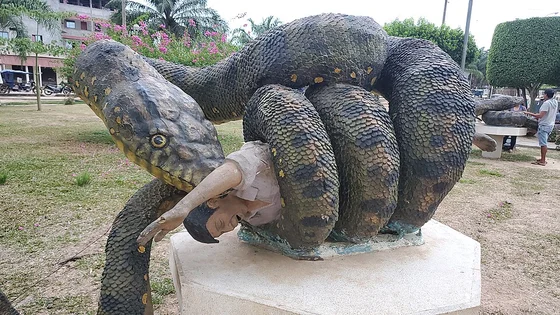
The Los Andes Lampalagua in Vicuña Cifuentes's collection is a huge reptile armed with strong claws. It travels just below the surface, opening passageways that resemble tunnels. At intervals its head rises into a pasture or at a village entrance. When hungry it devours the people, animals and crops around that opening, then continues its underground journey. This creature makes agricultural ground dangerous from beneath: the visible head is only a temporary appearance of a much larger, moving threat. A Santiago report gives a different power to a snake-shaped Lampalagua. It holds toads through its gaze; even if they escape when it looks away, finding them again at a distance restores its hold.
A second Santiago account magnifies the creature's appetite beyond ordinary predation. It consumes anything in its way, either as food or simply to remove an obstacle. Streams and rivers that interrupt its route can be swallowed, allowing it to cross their emptied beds and continue its devastation. Vicuña follows these reports with a comparison to the Argentine snake called ampalagua, quoting Lafone Quevedo and Mellet rather than conducting a biological identification. The later Enciclopedia Chilena names central Chilean areas including Choapa, Salamanca, Petorca, Los Andes, Talagante and Melipilla. Its description of declining belief belongs to that encyclopedia project's historical assessment. The regional stories preserve claws, underground travel, a controlling stare and river-draining appetite as distinct motifs. Those feats should not be transferred to the real boa merely because the folkloric and animal names resemble one another.
Origins & earliest records
Vicuña Cifuentes’s collection was published in 1915, and its national-library catalogue identifies the work as reusable cultural patrimony. The later Enciclopedia Chilena project ran from 1948 to 1971. These records locate printed versions of regional stories; the encyclopedia expressly leaves the chronology of its proposed connection to an Argentine snake unknown.
Records & interpretation
The inspected 1915 passage identifies Los Andes and Santiago for different reports rather than presenting one uniform creature. The encyclopedia adds a broader regional distribution and a retrospective judgment about declining belief. Its proposed derivation from the ampalagua is an interpretation; this profile does not claim that the oral narrative’s historical transmission has been demonstrated.
In the literature
“un formidable reptil provisto de fuertes garras”
XXV, El Lampalagua; printed pp. 75–76 (PDF 94–95); p. 75, variant a, Andes
The original Spanish description emphasizes the underground reptile’s strong claws.
Selected bibliography
Documented works and useful reading. This is not a list of every appearance.
- 01
Mitos y supersticiones recogidos de la tradición oral chilena
Printed pp75–76; variant descriptions and comparison with the Argentine ampalagua.
- 02
El Lampalagua
Historical encyclopedia document ECH-519/42; no individual article year supplied in the inspected transcription.
- 03
Mitos y supersticiones: recogidos de la tradición oral chilena — XXV, El Lampalagua
Santiago de Chile: Imprenta Universitaria, 1915. Original Spanish edition; no translator. Biblioteca Nacional de Chile, Memoria Chilena, catalogue MC0008702 labels the item patrimonio cultural común and expressly permits use and reproduction.
Family & connections
A source-supported family tree or inspiration record has not yet been compiled for this profile. Related reading below indicates a connection in subject matter, not a proven lineage or creative influence.
Located primary passages
Specific passages supporting details in this entry, grouped by their published witness.
Mitos y supersticiones recogidos de la tradición oral chilena
Santiago de Chile: Imprenta Universitaria, 1915. Original Spanish edition; no translator. Biblioteca Nacional de Chile, Memoria Chilena, catalogue MC0008702 labels the item patrimonio cultural común and expressly permits use and reproduction.
- An Andes report describes a clawed reptile tunnelling underground and surfacing to devour people, animals and crops. Two Santiago versions instead concern a serpent mesmerizing toads and an enormous reptile drinking rivers to continue its destructive route.
XXV, El Lampalagua; printed pp. 75–76 (PDF 94–95); p. 75, variants a–c
- Vicuña explicitly compares the Chilean legendary form with Argentine Ampalagua, quoting Lafone Quevedo’s dictionary and Mellet’s travel narrative. Their older zoological claims remain reported historical comparisons rather than modern animal facts.
XXV, El Lampalagua; printed pp. 75–76 (PDF 94–95); p. 76, compiler’s comparison and quoted sources
Historical collection, not current zoology or universal Indigenous belief. Geographic source labels are those printed by the collector. Comparative quotations have not been independently verified against the original Guevara, Lenz, Lafone Quevedo or Mellet editions.
References
Sources supporting this profile. Linked pages have their own scope and editorial standards.
- Primary textMitos y supersticiones — Biblioteca Nacional de ChileResearch access: 2026-10-05
- ReferenceEnciclopedia Chilena, ECH-519/42: El LampalaguaResearch access: 2026-10-05
Image credits
A sourced illustration has not yet been added. This gap is included in the coverage record.