Nguruvilu
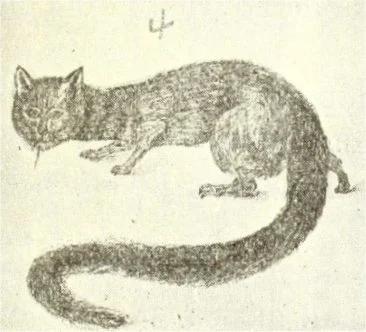
Named1908 published Nguruvilu drawing, showing a long-tailed feline form. Commons provides the exact book, page and figure source; publication attribution does not separately establish the original draughtsman.
Overview
Saunière’s collected commentary compares several aquatic Nguruvilu designs. One is a water fox; another has a doglike body and an exceptionally long tail. A serpent with a fox’s head and a small cat-headed creature occur in the cited literature. Guevara’s descriptions, quoted in the collection, place the sharp claw on the tail and associate attacks with river crossings and lake shores. The long tail supplies power, but head and body remain unsettled. In an episode discussed by Saunière, cutting the dangerous animal’s tail ends its threat. She compares it with Huaillepen and suggests that a narrator may have mixed features; that remains her explanation, rather than an instruction to rewrite the narrator’s story.
Vicuña Cifuentes’s 1915 chapter adds identifiable regional reports under Guirivilo and Nirivilo spellings. In Coinco, the water fox is fierce, irritable, and likely to retaliate against people who throw stones. The Coihueco de Chillán description gives it a doglike body and long tail; when it rarely emerges from the river, it shivers as though intensely cold. Older passages quoted on the next page broaden the disagreement further: Vidaurre contrasts a fox-headed serpent with a nearly circular, hide-shaped being, while Vicuña Mackenna discusses a creature wrapping around victims like a sheet. Vicuña Cifuentes also records his own change of preferred spelling between editions. The printed history therefore preserves both different bodies and different names, rather than one design gradually becoming more complete.
Guevara’s original, now independently read, includes two Maquehua tellings credited to Melivilu. On p.335 a strong swimmer caught during a canoe overturning cuts off the gripping tail. He carries away a long, saw-like appendage with forward hooks, and boats cease overturning there. The animal is small and fox-coloured, with the very long tail doing the work of dragging prey.
The p.351 narrative instead has a paid male machi enter a dangerous crossing and bring a dog-sized animal to the surface. He threatens its body with a knife and returns beneath the water with it, then announces that it will kill no more people. Before the year ends, the whirlpool disappears and the crossing becomes shallow. The first teller’s physical removal of the tail and the second encounter’s negotiated threat are different resolutions; neither is silently substituted for the other.
Origins & earliest records
Saunière's inspected periodical collection appeared across 1916–1918 and quotes older descriptions from Vidaurre, Vicuña Cifuentes and Guevara. Their appearances in her commentary are indirect witnesses for this profile. The series documents an existing narrative tradition, but neither its publication nor one translated compound name establishes the earliest telling or a universally original form.
Records & interpretation
Saunière’s printed pp259–261 and Vicuña Cifuentes’s printed pp65–66 were inspected for this profile. The latter directly identifies Coinco and Coihueco de Chillán reports, while its older quotations remain indirect witnesses. The autonomous Mapuche commission’s public report supplies a contemporary warning against treating translated labels as complete territorial or religious accounts. Both original Melivilu narratives now visually read; former indirect-only status of Guevara is superseded.
Selected bibliography
Documented works and useful reading. This is not a list of every appearance.
- 01
Cuentos populares araucanos y chilenos recogidos de la tradición oral
Printed pp. 259–261, PDF pp. 141–143; quoted appearances and the collector's possible-confusion hypothesis.
- 02
Psicolojía del pueblo araucano
Original now independently inspected: general p.322; Melivilu/Maquehua stories pp.335 and351, complete. Earlier Saunière quotation distinguished.
- 03
Mitos y supersticiones recogidos de la tradición oral chilena
Printed pp65–66; Coinco and Coihueco de Chillán reports and discussion of spelling and quoted older forms.
Family & connections
A source-supported family tree or inspiration record has not yet been compiled for this profile. Related reading below indicates a connection in subject matter, not a proven lineage or creative influence.
References
Sources supporting this profile. Linked pages have their own scope and editorial standards.
- Primary textSaunière's collected stories, Biblioteca Nacional de ChileResearch access: 2026-10-05
- CommunityAutonomous Mapuche commission: limits of translated glossesResearch access: 2026-10-05
- Primary textVicuña Cifuentes 1915, Guirivilo / Nirivilo, pp65–66Research access: 2026-10-05
- Primary textGuevara 1908: Nguruvilu narratives, pp.335 and351Research access: 2026-10-05
Image credits
Historical illustrationNguruvilu
Named1908 published Nguruvilu drawing, showing a long-tailed feline form. Commons provides the exact book, page and figure source; publication attribution does not separately establish the original draughtsman.