A sourced illustration has not yet been added. This gap is included in the coverage record.
Overview
Saunière's commentary distinguishes Huaillepen from Nguruvilu while noting that some recorded features may overlap. One description gives it a calf's head, a sheep's body and twisted legs, with the rear pair unable to move. A second describes a small, glossy, beautiful bovine. An amphibious version becomes dangerous to people and animals in the water. These are alternatives in a comparative record, not a single creature seen successively changing forms.
Guevara’s separate narrative, Un huaillepeñ, names Manqueo of Metrenco as its source. The speaker encounters a sheep-bodied, calf-headed being beside a stream, with twisted forelegs and dragging hindlegs. Frightened, the speaker runs home for his father; on their return it has vanished. The telling then connects the later birth of lambs with twisted legs to that encounter. This supplies a situated encounter and disappearance, distinct from the general description’s catalogue of forms. Its broader claims about human bodily differences are narrative attributions, not established causes or medical evidence.
The reproductive motif links encounters with domestic herds: an uncanny animal fathers young whose mixed appearance and abnormal legs resemble it. Such an explanation belongs to the collected story world. Saunière suggests that a particular narrator combined Huaillepen and Nguruvilu, but this remains her interpretation. The record supplies an ominous animal association without proving a natural cause of bodily difference.
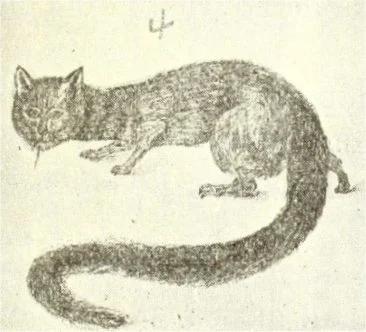
Guevara explains his collection procedure at the start of this chapter: oral narration, a written Mapuche-language version and then Spanish translation, with repetitions reduced. He says the original-language texts were omitted for space. The published Spanish account is therefore a mediated witness, not a verbatim bilingual transcript. Figure 42 also includes a sheep-like, calf-headed illustration labelled Huaillepeñ; the drawing documents this edition’s visual presentation rather than proving that every teller used the same body.
Origins & earliest records
Saunière’s 1916–1918 commentary quotes earlier Vicuña Cifuentes and Guevara descriptions. Guevara’s 1908 original has now been independently inspected: general account p. 324, illustration p. 323, named Manqueo/Metrenco narrative pp. 330–331 and collection-method note p. 329. These dates establish written witnesses, not the beginning of the oral tradition.
Records & interpretation
The complete Manqueo account was visually read in the scanned original, including the encounter, failed return and subsequent reproductive explanation. Its harmful claims about people with disabilities and twins are not accepted as historical causation. The original’s general summary and illustration were separately inspected; Saunière’s comparative identifications remain her commentary.
Selected bibliography
Documented works and useful reading. This is not a list of every appearance.
- 01
Cuentos populares araucanos y chilenos recogidos de la tradición oral
Printed pp. 260–261, PDF pp. 142–143; variants quoted from Vicuña Cifuentes and Guevara.
- 02
Psicolojía del pueblo araucano
Original independently inspected: p. 323 figure 42, p. 324 general description, pp. 330–331 Un huaillepeñ (Manqueo, Metrenco); p. 329 explains collection/translation procedure.
Family & connections
A source-supported family tree or inspiration record has not yet been compiled for this profile. Related reading below indicates a connection in subject matter, not a proven lineage or creative influence.
References
Sources supporting this profile. Linked pages have their own scope and editorial standards.
- Primary textSaunière's collected stories, Biblioteca Nacional de ChileResearch access: 2026-10-05
- Primary textGuevara 1908: Huaillepeñ description and Manqueo narrativeResearch access: 2026-10-05
Image credits
A sourced illustration has not yet been added. This gap is included in the coverage record.