A sourced illustration has not yet been added. This gap is included in the coverage record.
Overview
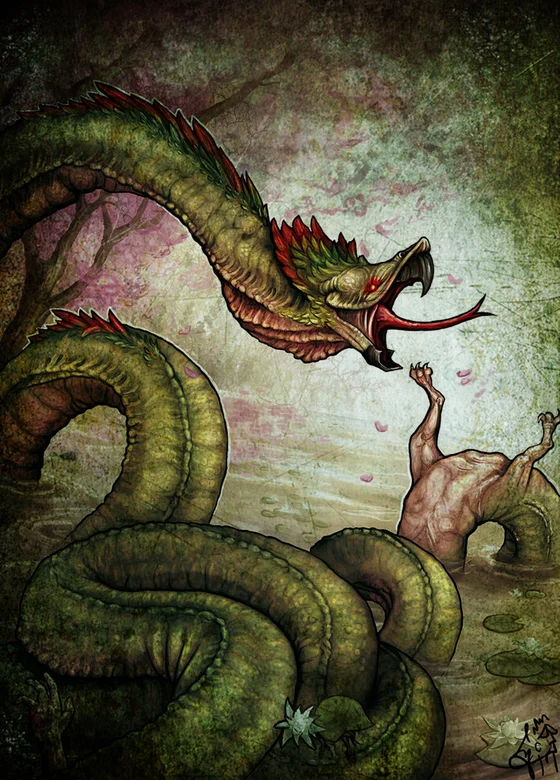
Dionisio González Torres describes an Alto Paraná version as a gigantic lizard with a doglike or jaguarlike head and shining eyes. It inhabits woodland, yerba-growing places or deep water and devours those it captures. A Guairá variant places it in deep mountain caves, whose night howls announce the same danger. These are attributed regional accounts, with a single hybrid head rather than an obligatory set of seven.
The same writer contrasts Rosicrán's enormous seven-headed creature, whose eyes emit flames but whose role is harmless protection of caves and fruit. Changing head count also changes narrative function: a consuming danger becomes a guarded presence. Yacyretá's 2017 interpretive trail includes a sandstone Teju Jagua sculpture in its presentation of the later sibling cycle. That modern public setting documents circulation of one organized mythology, while the Alto Paraná and Guairá witnesses preserve competing local forms.
Origins & earliest records
González Torres' account is reproduced in Francisco Pérez-Maricevich's 1998 anthology, and explicitly labels the areas where versions were collected or verified. Rosicrán's contrasting literary cycle appeared in 1929. Neither witness establishes the first oral appearance of the hybrid; chronology of the inspected publications is firmer than claims about a uniform precolonial origin.
Records & interpretation
The reproduced González Torres passage supports the one-headed predator and the Guairá cave variant, while distinguishing the seven-headed literary form. Yacyretá's dated programme confirms modern sculptural reception. The sources support variation, but their brief passages do not document every locality or provide enough informant history to equate national popular mythology with all Indigenous Guaraní religions.
Selected bibliography
Documented works and useful reading. This is not a list of every appearance.
- 01
Tejú-Jaguá
Attributed passage in Mitos y leyendas del Paraguay, El Lector, 187 pages.
- 02
El sendero “Akuti Po’i” incorpora senda mitológica
Dated public sandstone-sculpture interpretation programme; modern reception.
Family & connections
A source-supported family tree or inspiration record has not yet been compiled for this profile. Related reading below indicates a connection in subject matter, not a proven lineage or creative influence.
References
Sources supporting this profile. Linked pages have their own scope and editorial standards.
- Primary textGonzález Torres: Tejú-Jaguá regional variantsResearch access: 2026-10-05
- ReferenceYacyretá: sandstone sculpture trail, 2017Research access: 2026-10-05
Image credits
A sourced illustration has not yet been added. This gap is included in the coverage record.