Þrymr
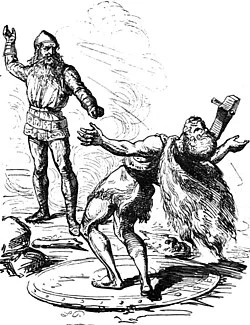
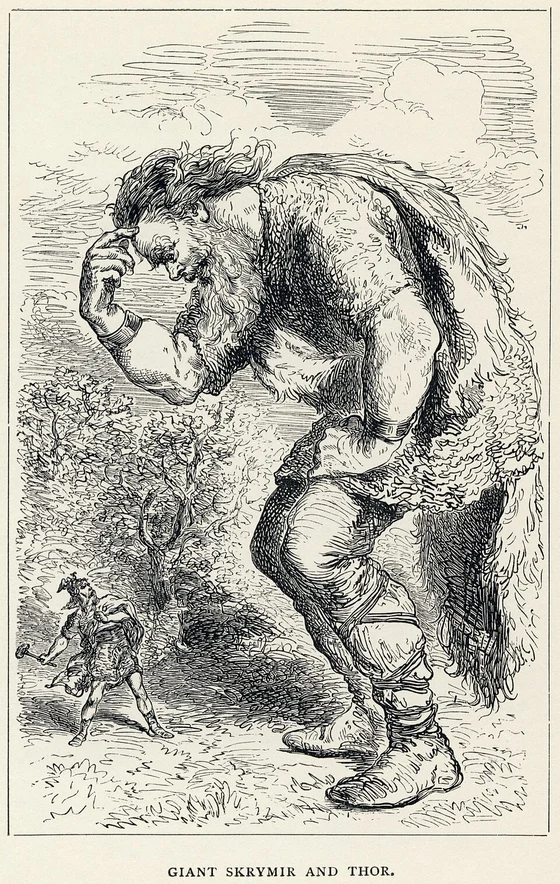
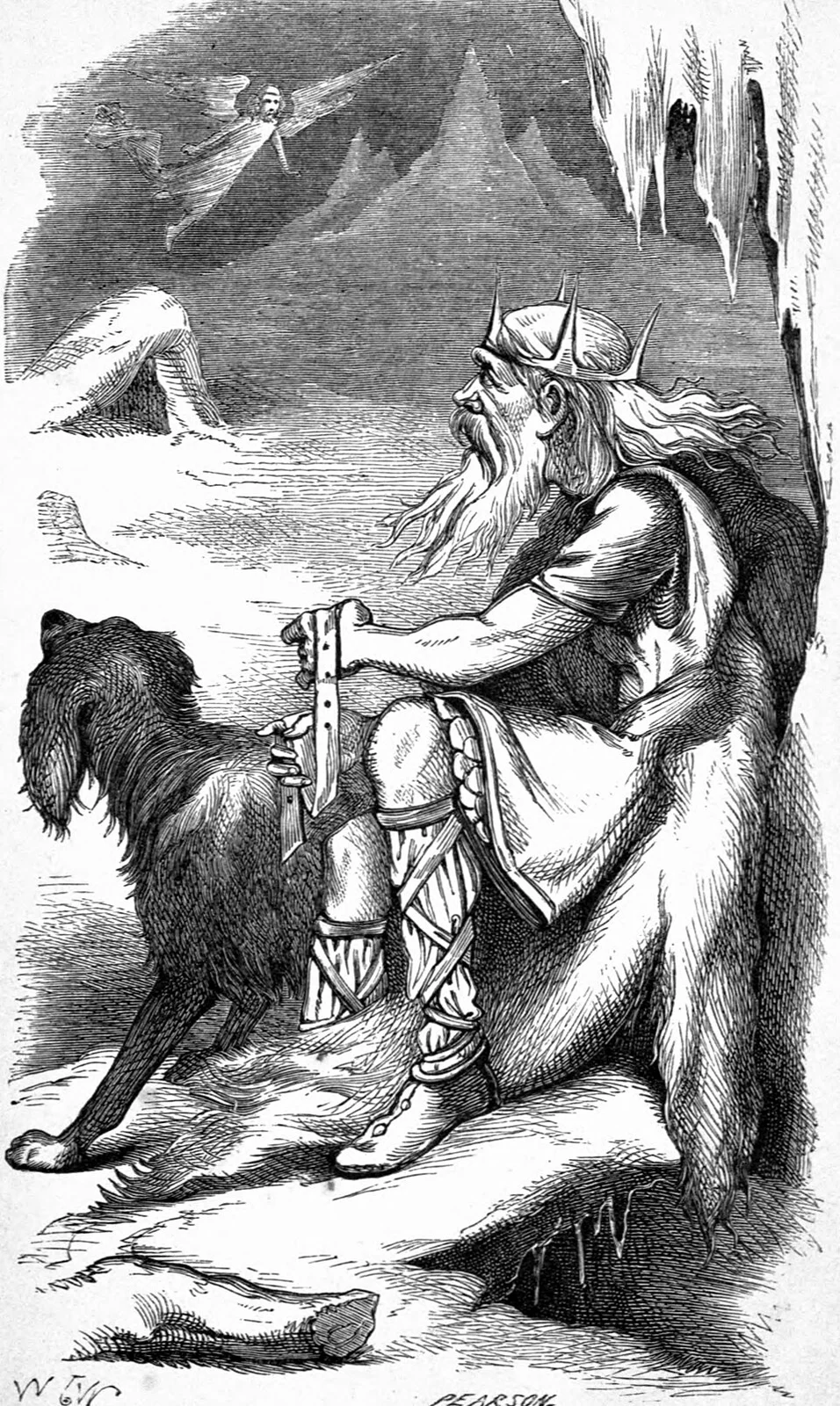
Named historical illustration to the exact Northern tale, credited through its published source and Commons public-domain declaration. Later artistic representation, not universal traditional anatomy.
Overview
The Lay of Thrym introduces the giant on a mound, braiding golden bands for his greyhounds and tending his horses' manes. He tells Loki that the missing hammer lies eight rasts beneath the earth and will be returned only if Freyja becomes his wife. When she refuses, the gods prepare Thor in bridal clothes, while Loki accompanies him as a serving woman.
Þrymr welcomes the supposed bride with cattle, beer and a feast. Thor eats an ox, eight salmon and the sweetmeats, then drinks three salds of mead. His appetite and fiery eyes make Þrymr suspicious, but Loki says Freyja has neither eaten nor slept for eight nights in anticipation of the marriage. Finally Þrymr brings the hammer to the bride's lap to consecrate the union. Thor seizes it and kills him and the other giants, including Þrymr's sister, who had demanded the bride's rings. The poem gives Þrymr a wealthy household, desire and poor judgment. Its humour depends on disguise and mistaken interpretation.
Origins & earliest records
The selected witness is Þrymskviða, presented as The Lay of Thrym in Benjamin Thorpe's translation within the inspected Norroena Society volume dated 1906. The poem belongs to medieval Eddic transmission. Its exact oral composition date is not inferred from either the manuscript tradition or this later English publication.
Records & interpretation
The poem directly provides the giant's household, bargain, feast and fatal presentation of the hammer. Those actions are literary evidence for a specific named jötunn. The translation does not supply zoological measurements or the modern fantasy anatomy sometimes assigned to giants; its obsolete title attribution is not adopted as verified authorship.
In the literature
“I have Hlorridi's hammer hidden eight rasts beneath the earth”
stanza 9; printed p. 54 · Benjamin Thorpe
Thrym tells Loki where he has hidden the hammer before stating his marriage demand.
Selected bibliography
Documented works and useful reading. This is not a list of every appearance.
- 01
The Lay of Thrym, or the Hammer Recovered
In The Elder Eddas and The Younger Eddas, printed pp. 53–57, stanzas 1–33. Historical Sæmund attribution on the volume's title is not asserted as authorship.
Family & connections
A source-supported family tree or inspiration record has not yet been compiled for this profile. Related reading below indicates a connection in subject matter, not a proven lineage or creative influence.
Located primary passages
Specific passages supporting details in this entry, grouped by their published witness.
Primary source witness
Norroena Society, 1906 selected edition, The Elder Eddas section, Benjamin Thorpe translation, The Lay of Thrym, or the Hammer Recovered, printed pp. 53–57, numbered stanzas 1–33. Historical Sæmund attribution on the volume title is not adopted as authorship of this poem.
- Loki discovers that Thrym has buried Thor’s hammer eight rasts underground and demands Freyja in marriage; she rejects the demand.
- Heimdall proposes disguising Thor as the bride and Loki accompanies him as a servant; at the feast Loki explains away Thor’s extraordinary appetite and fiery eyes.
- Thrym orders the hammer brought to consecrate the wedding; Thor recognizes it, kills Thrym and the assembled giants, and recovers the weapon.
Complete 33-stanza poem read. Exact earliest composition date and title-page attribution to Sæmund are not inferred.
References
Sources supporting this profile. Linked pages have their own scope and editorial standards.
- Primary textThorpe: The Lay of ThrymResearch access: 2026-10-05
Image credits
Historical illustrationÞrymr
Named historical illustration to the exact Northern tale, credited through its published source and Commons public-domain declaration. Later artistic representation, not universal traditional anatomy.