Tesso
Image associated with the exact linked encyclopedia article; consult credited file description for its interpretation.
Overview
Tesso, the iron rat, belongs to the legend of the monk Raigō and to accounts in which grievance becomes a destructive rat presence. Sekien's caption explicitly connects the figure with Raigō's spirit. The story is also represented by later artists, including Yoshitoshi, while Bakin and Hokusai used the material in illustrated fiction. Its identity is therefore anchored in a named narrative rather than in generic tales of oversized rodents.
Versions differ in whether emphasis falls on a single transformed being, a plague of rats or exaggerated visual scale. Temple rivalries and an unfulfilled promise give the supernatural revenge its narrative setting. An illustration of a gigantic rat should not be treated as a literal measurement supplied by every text. Comparing the sources reveals how an individual grievance becomes a collective threat and how later artists intensify the spectacle.
Two museum records give Yoshitoshi’s treatment a concrete place in the visual history. The Spencer Museum catalogs Priest Raigō of Mii Temple Transformed into a Rat as an 1891 color woodcut from Shinkei sanjūrokkaisen, accession 1984.0036. Its label describes a large rat chewing a sutra amid smaller rats consuming sacred texts. LACMA catalogs another Raigō print under The Wicked Thoughts of the Priest Raigō of Miidera Transform Him into a Rat, dated January 1891, accession M.84.31.124. These records substantiate the later artist and dated subject without requiring every account to share one scale or number of rats. Spencer’s archived labels differ over which temple suffers the attack, so that detail needs comparison with the actual literary passage rather than silent harmonization.
The Smithsonian catalogs an earlier woodblock print by Utagawa Kuniyoshi, Rat (Ne): Raigō, around 1840, accession S2004.3.168.1. Its label describes Raigō holding an unrolled sutra that he magically changes into rats. The museum explicitly distinguishes this treatment from versions in which the monk himself becomes a rat or a colony that devours sacred texts. This is a museum interpretation of a particular artwork, preserving different transformations rather than assigning one mechanism to every telling.
Origins & earliest records
Selected illustrated witness: Toriyama Sekien's Gazu Hyakki Yagyō (1776). This is an attestation of the named representation, not a claim that the belief began in that year.
Records & interpretation
Historical prints and textual references establish an imagined being and its representation. The linked contextual article distinguishes the pictured form from regional accounts; these sources do not establish zoological existence.
Selected bibliography
Documented works and useful reading. This is not a list of every appearance.
- 01
Gazu Hyakki Yagyō
Selected historical witness; individual illustration now checked in the separately linked primary scan. This edition is not a claim of the earliest oral attestation.
Family, evolution & connections
Rats
The inspected caption associates Tesso with Raigō’s spirit, while the creature’s rat form anchors the visual comparison. A real brown rat is a representative rodent reference, not an identification of the legendary being’s species. The connection preserves the grievance narrative rather than reducing the figure to a large animal.
Primary records and illustrations
Gazu Hyakki Yagyō
Volume 2, Yang (陽); NDL 1805 edition bound in catalog record 百鬼夜行 3巻拾遺3巻. [1]. NDL canvas 23, right page of photographed opening
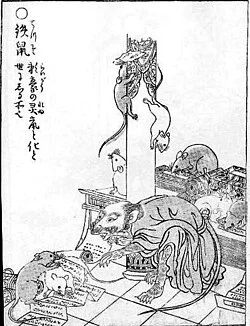
Printed 鉄鼠; rats surround a central pillar and a monk with a ratlike head sits among them. Printed name and illustration inspected together. Canvas numbering identifies the digitized opening, not an original printed page number.
The Tesso illustration combines a monk's seated posture with the anatomy of a rat. The central figure wears a loose garment, has a pointed animal muzzle and visible whiskers, and sits beside a vertical pillar. Smaller rats occupy several levels of the scene: one climbs the column, others gather near the seated figure, and another rests among objects in the foreground. Blocks, a floor surface and a sheet or tablet bearing writing establish a furnished setting. The printed label 鉄鼠 identifies the plate. This composition directly supports a rat-associated religious figure and a surrounding rat multitude. It should be distinguished from the historical and literary account of Raigō, which requires the textual sources cited elsewhere in the profile.
Encyclopedia background
An additional attributed reference, separate from the editorial profile above.
Read the open encyclopedia overview
Tesso (鉄鼠) is a Japanese yōkai related to the vengeful spirit (onryō) of the Heian period monk Raigō and a mouse. The name "tesso" is a name given by Toriyama Sekien in the Edo period collection of yōkai pictures, the Gazu Hyakki Yagyō, and this yōkai can also be called the Raigo-derived name Raigō-nezumi (頼豪鼠) as from the Enkyōhon (延慶本, alternatively read Enkeihon), a yomihon version of the Heike Monogatari, or Mii-dera-nezumi (三井寺鼠) derived from Mii-dera in Ōtsu, Shiga Prefecture as in the Edo period yōkai themed kyōka picture book, the Kyōka Hyaku Monogatari. They became known starting in the Heisei period from its adoption in the mystery novel Tesso no Ori (The Tesso's Cage) by Natsuhiko Kyogoku.
Text from Wikipedia contributors, “Tesso”. CC BY-SA 4.0. Extracted introduction; formatting changed. Retrieved 5 October 2026. The source article may have changed since retrieval.
References
Sources supporting this profile. Linked pages have their own scope and editorial standards.
- Primary illustrated book / national-library recordNocturnal Procession of the Hundred Demons — historical editionResearch access: 2026-10-05
- National library / primary illustration contextTORIYAMA Sekien’s Illustrated Night Parade of the Demon HordeResearch access: 2026-10-05
- Secondary referenceTesso — contextual overview and bibliographyResearch access: 2026-10-05
- Primary illustrated plate / institutional digitizationGazu Hyakki Yagyō — directly inspected NDL canvas 23, right page of photographed openingResearch access: 2026-10-05
- Museum / primary artwork recordSpencer Museum: Yoshitoshi, Priest Raigō, 1891;1984.0036Research access: 2026-10-05
- Museum / primary artwork recordLACMA: Yoshitoshi, Raigō print, January1891;M.84.31.124Research access: 2026-10-05
- Museum artwork record and interpretive labelSmithsonian: Kuniyoshi, Rat (Ne): Raigō, ca. 1840; S2004.3.168.1Research access: 2026-10-05
Image credits
Historical illustrationTesso
Image associated with the exact linked encyclopedia article; consult credited file description for its interpretation.