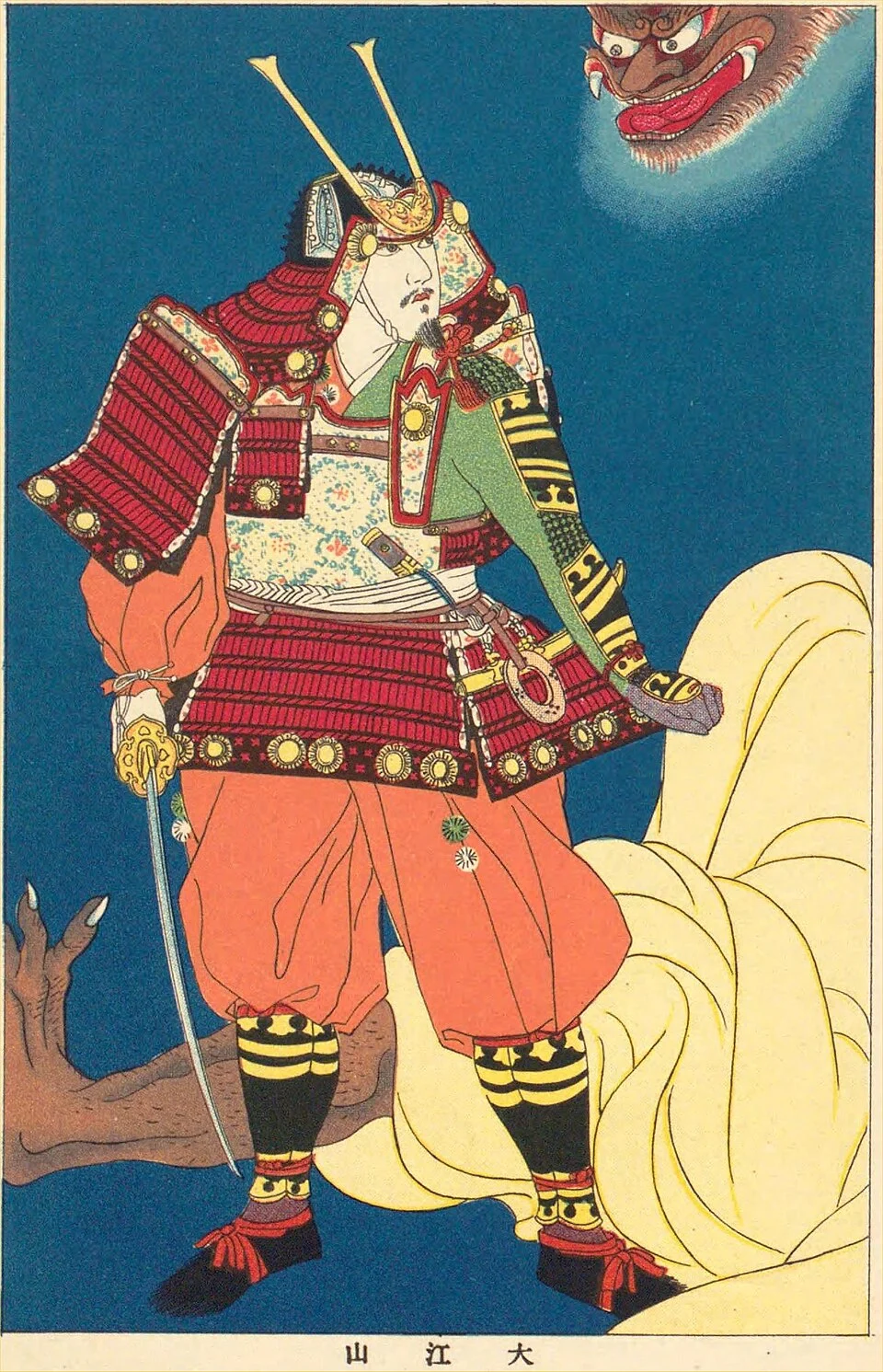
Shuten-dōji
Image associated with the exact linked encyclopedia article; consult credited file description for its interpretation.
Overview
Shuten-doji is a named oni leader whose defeat is preserved in narrative paintings and printed books, rather than a generic label for every horned demon. Smithsonian records describe a mountain-fortress giant who abducts and eats young noblewomen from Kyoto. The tale is set in the tenth century and celebrates the warrior Raiko, or Minamoto Yorimitsu. That narrative setting is distinct from the dates of the surviving artworks cited here: a seventeenth-century scroll does not establish a contemporary tenth-century eyewitness account.
In the Smithsonian’s seventeenth-century paper scroll F 1998.303.2, the warriors persuade the fortress guardians to admit them. Disguised as travelling Buddhist priests, they receive Shuten-doji’s hospitality and offer the strong sake they carry. The museum’s account explains that the potion sedates the monster and that he changes from human into demonic form while drinking. Admission, feasting, transformation, and incapacitation form a specific sequence; they should not be reduced to an unexplained duel against a permanently gigantic body.
A separate silk-scroll set, represented by F 1998.26.2, is dated 1700 and credits Kano Shoun as painter and Nakayama Atsuchika as calligrapher. Its museum record describes the disguised warriors entering the fortress and killing the sleeping giant. These named makers belong to this luxurious set, not automatically to every illustrated telling. Silk, metallic pigments, and prestigious calligraphic participation identify a particular commissioned object rather than the materials of an ordinary printed edition.
The Smithsonian’s exhibition account continues the action through Raiko’s beheading of the demon, fighting the remaining horde, rescuing surviving women, and returning to Kyoto. It also emphasizes how scrolls and screens unfold an episode across space through clouds, mist, and changes in scale. Sekien’s separately verified named plate provides another later visual witness, but a single portrait cannot independently establish all the narrative events. The profile therefore keeps each object’s date, medium, and credited narrative interpretation distinct while presenting the shared defeat story.
Griffis’s English chapter calls the leader Shi-ten dōji and initially presents him as red-bodied, round and childlike, with short black hair and two small horns. Captive young women serve the feasting demons. In this version Raiko brings sake mixed with a sleeping potion bought from druggists in the capital; the chapter does not give that preparation a divine donor. The warriors first kill the sleeping attendants and then approach the leader.
When Raiko measures his sword against the enormous neck, its blade lengthens by itself. After the beheading, the severed head rises, its horns grow, and it circles the room seven times before biting through Raiko’s straw hat into the iron helmet beneath. The effort exhausts it and it falls; Raiko is unhurt. The rescuers burn the stronghold, bury the victims’ bones and return the surviving captives to their families. This animated-head ending and the expanding blade are specific details of Griffis’s complete telling, complementing rather than replacing the separately attributed museum-scroll accounts.
Origins & earliest records
Selected historical witness: Konjaku Gazu Zoku Hyakki (1779) by Toriyama Sekien. The linked library record identifies a surviving printed edition; it does not establish when the belief first arose.
Records & interpretation
Verified Sekien primary plate supplemented by explicitly attributed museum object records and narrative interpretation; no full historical manuscript transcription claimed.
Selected bibliography
Documented works and useful reading. This is not a list of every appearance.
- 01
Konjaku Gazu Zoku Hyakki
Selected historical witness; individual illustration now checked in the separately linked primary scan. This edition is not a claim of the earliest oral attestation.
- 02
Japanese Fairy World: Stories from the Wonder-Lore of Japan
XXII, Raiko and the Shi-ten Doji, pp.190–200; complete chapter and collection preface read.
Family & connections
A source-supported family tree or inspiration record has not yet been compiled for this profile. Related reading below indicates a connection in subject matter, not a proven lineage or creative influence.
Primary records and illustrations
Konjaku Gazu Zoku Hyakki
Volume 1; Smithsonian Libraries digitized copy. IIIF canvas index 16 (zero-based); Konjakuzokuhyak1Tori_0017.jp2
Printed label 酒顛童子; a massive severed head with fangs lies before an armed figure and containers. Label and composition directly inspected; no transcription of cursive explanatory text is claimed. Additional complete English narrative: XXII, Raiko and the Shi-ten Doji, pp.190–200, https://www.gutenberg.org/cache/epub/29337/pg29337-images.html#RAIKO_AND_THE_SHI-TEN_DOJI. Version-specific anatomy, action and ending separated from existing visual/institutional witnesses; original-language source not independently collated.
Encyclopedia background
An additional attributed reference, separate from the editorial profile above.
Read the open encyclopedia overview
Shuten-dōji (酒呑童子, also sometimes called 酒顛童子, 酒天童子, or 朱点童子) is a mythical oni or demon leader of Japan, who according to legend was killed by the hero Minamoto no Raikō. Although decapitated, the demon's detached head still took a bite at the hero, who avoided death by wearing multiple helmets stacked on his head.
Shuten-dōji had his lair at Mount Ōe (大江山) northwest of the city of Kyoto, or Mount Ibuki, depending on the version. It has also been theorized that the original mountain was Mount Ōe (大枝山) on the western edge of the city of Kyoto.
Text from Wikipedia contributors, “Shuten-dōji”. CC BY-SA 4.0. Extracted introduction; formatting changed. Retrieved 5 October 2026. The source article may have changed since retrieval.
References
Sources supporting this profile. Linked pages have their own scope and editorial standards.
- Primary illustration / library recordKonjaku Gazu Zoku Hyakki — historical library editionResearch access: 2026-10-05
- Secondary referenceShuten-dōji — contextual overview and bibliographyResearch access: 2026-10-05
- Primary illustrated plate / institutional digitizationKonjaku Gazu Zoku Hyakki — directly inspected IIIF canvas index 16 (zero-based); Konjakuzokuhyak1Tori_0017.jp2Research access: 2026-10-05
- Museum object interpretation or living institutional narrativeSmithsonian seventeenth-century paper scroll F 1998.303.2Research access: 2026-10-05
- Museum object interpretation or living institutional narrativeSmithsonian Kano Shoun silk scroll F 1998.26.2,1700Research access: 2026-10-05
- Museum object interpretation or living institutional narrativeSmithsonian Tale of Shuten Doji exhibition narrativeResearch access: 2026-10-05
- Historical English literary retellingGriffis, Japanese Fairy World (1887), XXII, Raiko and the Shi-ten Doji, pp.190–200Research access: 2026-10-05
Image credits
Reference illustrationShuten-dōji
Image associated with the exact linked encyclopedia article; consult credited file description for its interpretation.