Tsuchigumo
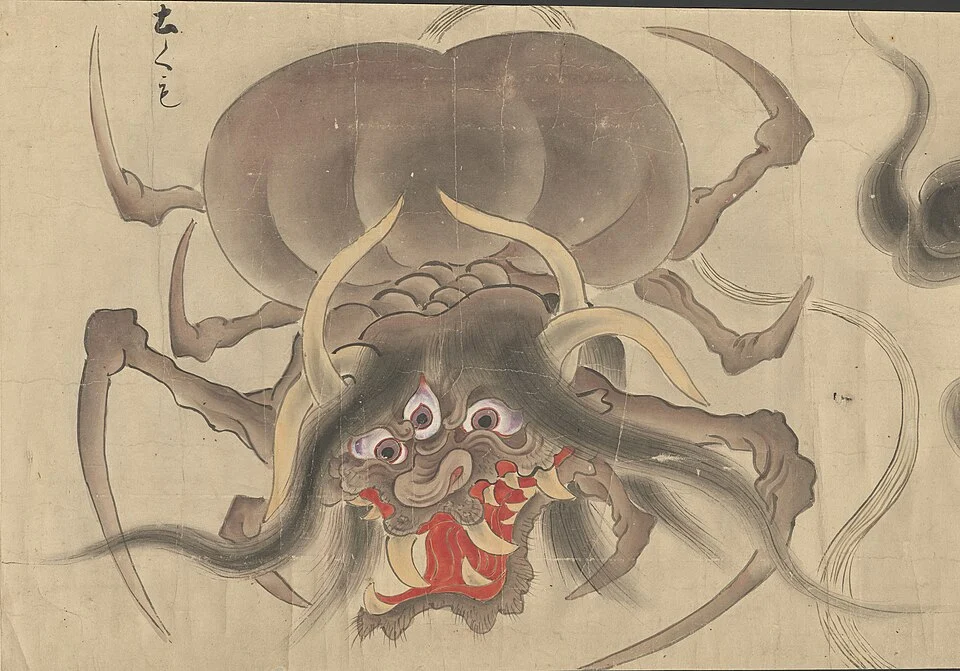
Image associated with the exact linked encyclopedia article; consult credited file description for its interpretation.
Overview
Tsuchigumo is a spider-associated adversary in tales and performances about Raikō, frequently pictured as a great spider confronting or entangling warriors. The term also occurs in early chronicles as a hostile label for human groups resisting central authority. Those uses must be kept distinct: treating the people named in a chronicle as literal monsters would reproduce the dehumanizing language of the source rather than explain it.
The later supernatural creature has its own literary and visual history, including Sekien and dramatic representations. The web supplies a clear device for confinement and revelation, while enormous size intensifies the conflict. This profile concerns that narrative monster, with the chronicle terminology retained only as a historical distinction. It does not claim that later spider anatomy describes the bodies of any actual ancient population or that all usages share one uninterrupted origin.
The Tokyo National Museum’s Tsuchigumo no Sōshi Emaki, accession A-18, supplies an earlier narrative object than Sekien’s encyclopedia. Its institutional catalog dates the color-on-paper scroll to the Kamakura period, specifically the thirteenth century. The description follows Yorimitsu and Watanabe no Tsuna as they chase a flying skull to Kaguraoka in Kyoto and enter a dilapidated house filled with strange beings. Their defeated adversary is revealed as a giant ground spider. This specific encounter should remain distinct from other warrior tales and Noh performances. The catalog identifies the scroll as a precursor of the illustrated popular tales flourishing in the Muromachi period. Its dated object record does not independently settle every scholarly dating proposal or establish the earliest use of the name.
Griffis’s Watanabe Kills the Great Spider offers a separately identifiable Raikō spider encounter. While Raikō is ill, a tormentor called Mitsumé Kozo approaches his bed. It has a hog-like snout, three blue eyes and tusks. Raikō conceals his readiness, draws the sword kept under his pillow and wounds its nose. Tsuna and his companions follow the blood to a cavern, where a spider six feet high bears a matching snout wound. This form has two yellow eyes and very long, thick legs; the different eye counts are part of the successive descriptions rather than an error silently standardized here.
Tsuna cuts down a tree, keeping its roots, and uses it to knock down and pin the spider. His companions bind its legs and kill it with their swords. Returning to the city, they find Raikō recovered. He rewards them and shows an imperial commission for a subsequent expedition against the oni; the chapter ends with the warriors disguising themselves as travelling priests. It does not end with the spider escaping or merely being exorcised.
The chapter does not use the name Tsuchigumo. It is presented here as a related Raikō spider narrative, not as proof that every detail belongs to the named figure on the thirteenth-century museum scroll. The wounded bedside visitor, matching spider wound and tree used as a weapon also distinguish this account from the scroll’s flying-skull pursuit. Establishing the exact Japanese source behind Griffis’s retelling requires further work.
Origins & earliest records
Selected historical witness: Konjaku Gazu Zoku Hyakki (1779) by Toriyama Sekien. The linked library record identifies a surviving printed edition; it does not establish when the belief first arose.
Records & interpretation
The historical illustration and individual contextual reference support this profile. Named motifs, local narratives and later explanations are distinguished; image-to-plate matching still needs review.
Selected bibliography
Documented works and useful reading. This is not a list of every appearance.
- 01
Konjaku Gazu Zoku Hyakki
Selected historical witness; individual illustration now checked in the separately linked primary scan. This edition is not a claim of the earliest oral attestation.
- 02
Tokyo National Museum, Tsuchigumo no Sōshi Emaki, A-18
Selected surviving object; catalog dating attributed, not an earliest-attestation claim.
- 03
Japanese Fairy World: Stories from the Wonder-lore of Japan — XXI: Watanabe Kills the Great Spider, pp.185–189
Complete named chapter and collection preface read. Comparative Raikō spider witness; Tsuchigumo is not the chapter’s own name for the creature.
Family & connections
A source-supported family tree or inspiration record has not yet been compiled for this profile. Related reading below indicates a connection in subject matter, not a proven lineage or creative influence.
Primary records and illustrations
Konjaku Gazu Zoku Hyakki
Volume 3; Smithsonian Libraries digitized copy. IIIF canvas index 10 (zero-based); Konjakuzokuhyak3Tori_0011.jp2
Printed label 土蜘蛛; a large spider lies across a mountainous landscape above a small building. Illustration directly inspected; no complete transcription of cursive explanatory text is claimed.
Encyclopedia background
An additional attributed reference, separate from the editorial profile above.
Read the open encyclopedia overview
Tsuchigumo (土蜘蛛; also written 土雲, literally "dirt/earth spider") is a historical Japanese derogatory term for renegade local clans, primarily during the Asuka, Nara, and early Heian periods, and also the name for a race of spider-like yōkai in Japanese folklore. Alternative names for the historical groups include kuzu (国栖), and for the mythological Tsuchigumo, yatsukahagi (八握脛; roughly "eight-grasp shins," referring to their long legs) and ōgumo (大蜘蛛; "giant spider"). In the Kojiki and Nihon Shoki, the name was phonetically spelled with the four kanji 都知久母 (for the four morae tsu-chi-gu-mo). References to "tsuchigumo" appear in the chronicles associated with Emperor Jimmu, Emperor Keiko, and Empress Jingū, and these words were frequently used in the Fudoki (ancient reports on provincial culture, geography, and oral tradition) of various provinces, including Mutsu, Echigo, Hitachi, Settsu, Bungo, and Hizen.
The term "Tsuchigumo" (earth/dirt spider) is believed to be derived from an older derogatory term, tuchigomori (土隠), meaning "those who hide in the ground". This name likely referred to the fact that many of these clans utilized existing cave systems or built fortified dugouts and earthworks (Japanese: 土窟; tsuchi-muro or iwa-muro) in which to live and defend themselves. The term was used by the Yamato court as a generalized pejorative against chieftains and clans who would not submit to Imperial authority, regardless of their ancestry or location. They were often described in official records like the Nihon Shoki and various Fudoki as possessing "the nature of a wolf, the heart of an owl", being violently resistant, and dwelling in mountain caves or earthen fortifications. Some descriptions portrayed them as having abnormal physical characteristics; the "Jimmu" chapter of the Nihon Shoki describes them as "short in stature but long in limbs, similar to pygmies (侏儒)", while an excerpt from the lost Echigo Fudoki mentions Tsuchigumo with "shins eight 'tsuka' [hand-breadths] long, and possessing great strength." These descriptions likely served to dehumanize these groups and emphasize their "otherness" from the perspective of the Yamato state.
Historian Sōkichi Tsuda (ja) pointed out that, unlike terms like Kumaso and Emishi which referred to distinct groups, "Tsuchigumo" as used in the Fudoki often appears as the designation for specific individuals rather than entire peoples. Historian Yoshiyuki Takioto (ja) further suggests that these individuals were likely local chieftains whose power stemmed from shamanistic authority. This is supported by accounts in the Kyushu Fudoki where certain Tsuchigumo figures appear as priests or mediums involved in agricultural rituals or appeasing angered deities (kami).
The transformation of the Tsuchigumo into a monstrous, giant spider-like yōkai occurred during the Japanese medieval period (late 12th to early 17th centuries). One of the earliest and most influential depictions is found in variant texts of The Tale of the Heike, particularly the "Sword Scroll" (tsurugi-no-maki), which was compiled in the early 13th century. In this version, the creature is called a yamagumo (山蜘蛛, "mountain spider"), and its defeat by the hero Minamoto no Yorimitsu gives rise to the legend of his sword, Kumo-kiri ("Spider-Cutter"). As depictions evolved through later periods, the Tsuchigumo became increasingly bizarre and monstrous. The 14th-century emakimono (picture scroll) Tsuchigumo Sōshi portrays it as a colossal monster, and stories involving its extermination often feature Yorimitsu and his legendary retainer Watanabe no Tsuna, heroes also famous for defeating the powerful oni Shuten-dōji. The yōkai Tsuchigumo became a popular subject in Noh theatre, Jōruri puppet plays, and Kabuki. The historical Tsuchigumo have no direct connection to the actual ground spider species Jigumo (Antrodiaetus japonicus). Similarly, the modern Japanese common name for tarantulas (Ōtsuchigumo-ka, オオツチグモ科, Theraphosidae) which was inspired by the mythological creature has no historical link, as tarantulas are not native to Japan.
Text from Wikipedia contributors, “Tsuchigumo”. CC BY-SA 4.0. Extracted introduction; formatting changed. Retrieved 5 October 2026. The source article may have changed since retrieval.
References
Sources supporting this profile. Linked pages have their own scope and editorial standards.
- Primary illustration / library recordKonjaku Gazu Zoku Hyakki — historical library editionResearch access: 2026-10-05
- Secondary referenceTsuchigumo — contextual overview and bibliographyResearch access: 2026-10-05
- Primary illustrated plate / institutional digitizationKonjaku Gazu Zoku Hyakki — directly inspected IIIF canvas index 10 (zero-based); Konjakuzokuhyak3Tori_0011.jp2Research access: 2026-10-05
- Museum / primary object recordTokyo National Museum, Tsuchigumo no Sōshi Emaki, A-18Research access: 2026-10-05
- Historical English literary retellingGriffis, Japanese Fairy World, XXI: Watanabe Kills the Great Spider, pp.185–189Research access: 2026-10-05
Image credits
Reference illustrationTsuchigumo
Image associated with the exact linked encyclopedia article; consult credited file description for its interpretation.