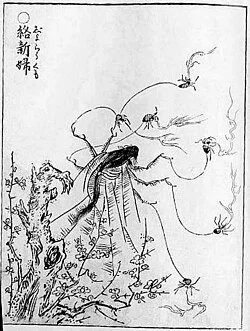
Jorōgumo
Image associated with the exact linked encyclopedia article; consult credited file description for its interpretation.
Overview
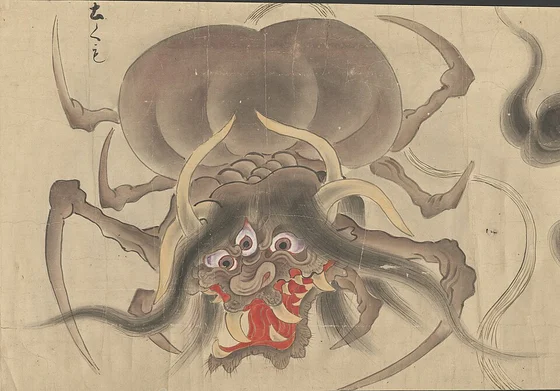
Jorōgumo is a spider-associated yōkai that can appear as a woman in Japanese tales. The transformation makes an apparently human encounter dangerous and often turns attraction or hospitality into a trap. Sekien's picture presents a spider woman with smaller spiders, while prose stories explore disguise and recognition through different incidents. These sources should not be combined into a single universal life cycle or a precise account of magical abilities.
The same spoken name can also refer to a real spider, notably the species now called Trichonephila clavata. Entomological usage and supernatural narrative must remain distinct. Historical tales in collections such as Tonoigusa are evidence for how the deception motif circulated, while the prints reveal its visual treatment. An actual spider photograph can illustrate a linguistic association, but cannot be captioned as a portrait of the legendary being.
Origins & earliest records
Selected illustrated witness: Toriyama Sekien's Gazu Hyakki Yagyō (1776). This is an attestation of the named representation, not a claim that the belief began in that year.
Records & interpretation
Historical prints and textual references establish an imagined being and its representation. The linked contextual article distinguishes the pictured form from regional accounts; these sources do not establish zoological existence.
Selected bibliography
Documented works and useful reading. This is not a list of every appearance.
- 01
Gazu Hyakki Yagyō
Selected historical witness; individual illustration now checked in the separately linked primary scan. This edition is not a claim of the earliest oral attestation.
Family, evolution & connections
Spiders
Sekien’s plate combines a woman and spider features with smaller spiders. Comparing this hybrid with real spiders explains the visible animal element, while preserving its supernatural transformation and deception motif. The historical illustration does not establish a real spider species that can assume human form or dictate one universal tale.
Primary records and illustrations
Gazu Hyakki Yagyō
Volume 2, Yang (陽); NDL 1805 edition bound in catalog record 百鬼夜行 3巻拾遺3巻. [1]. NDL canvas 19, left page of photographed opening
Printed 絡新婦, with reading; an enormous spider and smaller suspended spiders occupy the opening plate. Printed name and illustration inspected together. Canvas numbering identifies the digitized opening, not an original printed page number.
Sekien's opening illustration gives the spider a dominant position rather than introducing it through a human disguise. Its swollen body and several jointed legs occupy much of the left page. Smaller spiders hang or move around the larger creature, while thin curving lines link them to the open space above. Vegetation gathers near the lower margin, leaving the main body easy to distinguish. The printed name 絡新婦 appears at the upper left with a reading beside it. On the facing page is the volume's list of creatures. This pairing places the spider at the beginning of the illustrated Yang sequence; the inspected image itself does not depict a seduced traveller or a narrated attack.
Encyclopedia background
An additional attributed reference, separate from the editorial profile above.
Read the open encyclopedia overview
Jorōgumo (Japanese: 絡新婦 (kanji), じょろうぐも (hiragana)) is a type of yōkai, a creature of Japanese folklore. It can shapeshift into a beautiful woman, so the kanji that represent its actual meaning are 女郎蜘蛛 (lit. 'woman-spider'); the kanji which are used to write it instead, 絡新婦 (lit. 'entangling newlywed woman') have a jukujikun pronunciation that is related to the meaning, but not the sound of the word. In Toriyama Sekien's Gazu Hyakki Yagyō, it is depicted as a spider woman manipulating small fire-breathing spiders.
Jorōgumo can also refer to some species of spiders, such as the Nephila and Argiope spiders. Japanese-speaking entomologists use the katakana form of jorōgumo (ジョロウグモ) to refer exclusively to the spider species Trichonephila clavata, and this has been adopted into English as "Joro spider".
Text from Wikipedia contributors, “Jorōgumo”. CC BY-SA 4.0. Extracted introduction; formatting changed. Retrieved 5 October 2026. The source article may have changed since retrieval.
References
Sources supporting this profile. Linked pages have their own scope and editorial standards.
- Primary illustrated book / national-library recordNocturnal Procession of the Hundred Demons — historical editionResearch access: 2026-10-05
- National library / primary illustration contextTORIYAMA Sekien’s Illustrated Night Parade of the Demon HordeResearch access: 2026-10-05
- Secondary referenceJorōgumo — contextual overview and bibliographyResearch access: 2026-10-05
- Primary illustrated plate / institutional digitizationGazu Hyakki Yagyō — directly inspected NDL canvas 19, left page of photographed openingResearch access: 2026-10-05
Image credits
Historical illustrationJorōgumo
Image associated with the exact linked encyclopedia article; consult credited file description for its interpretation.