Nure-onna
Image associated with the exact linked encyclopedia article; consult credited file description for its interpretation.
Overview
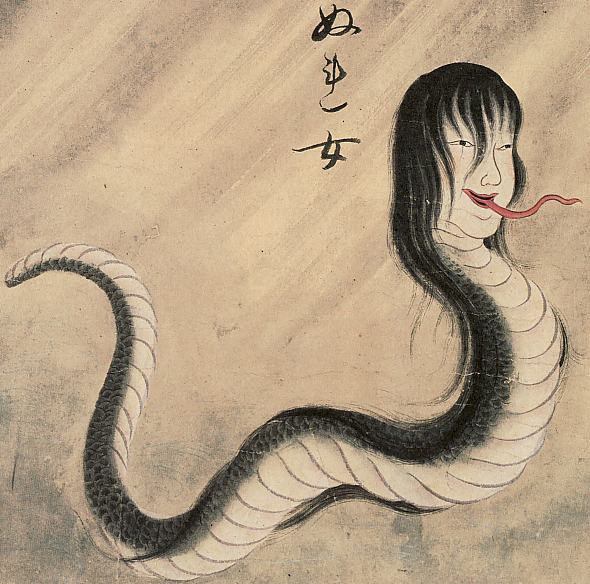
Nure-onna, the wet woman, is represented in Edo-period illustrations with a woman's head and a serpent-like body. The name and wet hair connect her with waterside unease. Local narratives can describe frightening women near rivers or coasts, but their relation to the snake-bodied print is not always secure. This distinction prevents the familiar image from absorbing every account of a dangerous female presence beside water.
Sekien's plate and related illustrated scrolls demonstrate the hybrid body directly. Detailed stories of carrying a child, imposing a burden or attacking a traveller need their own witnesses rather than automatic attribution to that image. The profile therefore begins with the visual evidence and acknowledges the wider narrative associations cautiously. It is a historical supernatural representation, not an identification of a sea snake or a description of an independently observed human-animal organism.
Origins & earliest records
Selected historical witness: Gazu Hyakki Yagyō (1776) by Toriyama Sekien. The linked library record identifies a surviving printed edition; it does not establish when the belief first arose.
Records & interpretation
The historical illustration and individual contextual reference support this profile. Named motifs, local narratives and later explanations are distinguished; image-to-plate matching still needs review.
Selected bibliography
Documented works and useful reading. This is not a list of every appearance.
- 01
Gazu Hyakki Yagyō
Selected historical witness; individual illustration now checked in the separately linked primary scan. This edition is not a claim of the earliest oral attestation.
Family & connections
A source-supported family tree or inspiration record has not yet been compiled for this profile. Related reading below indicates a connection in subject matter, not a proven lineage or creative influence.
Primary records and illustrations
Gazu Hyakki Yagyō
Volume 3, Wind (風); digitized Smithsonian Libraries copy, 1805 edition. IIIF canvas index 12 (zero-based); GazuHyakkiyagyo3Tori_0013.jp2
Named 濡女; a long scaled serpentine body coils beneath a woman's head and flowing hair beside water. Visual inspection of the digitized plate and its printed label; image URL is copied from the actual IIIF manifest, not a guessed leaf reference.
Encyclopedia background
An additional attributed reference, separate from the editorial profile above.
Read the open encyclopedia overview
Nure-onna (濡女; "wet woman") is a Japanese yōkai which resembles a reptilian creature with the head of a woman and the body of a snake. They are also seen as a paranormal phenomenon at sea under the name of nureyomejo. In legends, they are often said to consume humans, but they have no single appearance or personality.
Text from Wikipedia contributors, “Nure-onna”. CC BY-SA 4.0. Extracted introduction; formatting changed. Retrieved 5 October 2026. The source article may have changed since retrieval.
References
Sources supporting this profile. Linked pages have their own scope and editorial standards.
- Primary illustration / library recordGazu Hyakki Yagyō — historical library editionResearch access: 2026-10-05
- Secondary referenceNure-onna — contextual overview and bibliographyResearch access: 2026-10-05
- Primary illustrated plate / institutional digitizationGazu Hyakki Yagyō — directly inspected IIIF canvas index 12 (zero-based); GazuHyakkiyagyo3Tori_0013.jp2Research access: 2026-10-05
Image credits
Reference illustrationNure-onna
Image associated with the exact linked encyclopedia article; consult credited file description for its interpretation.