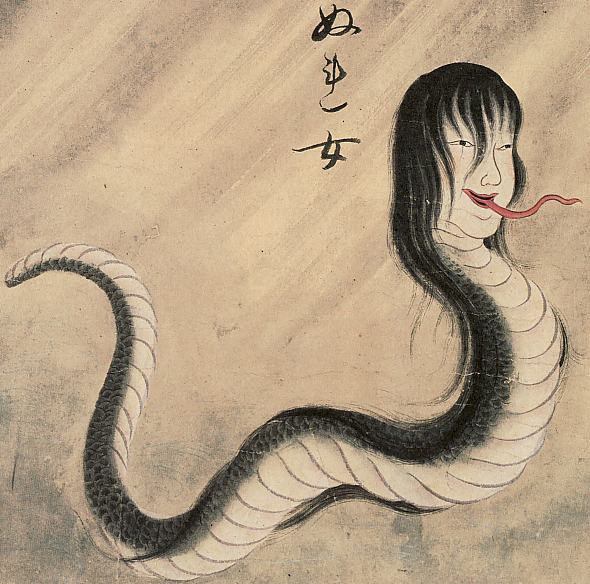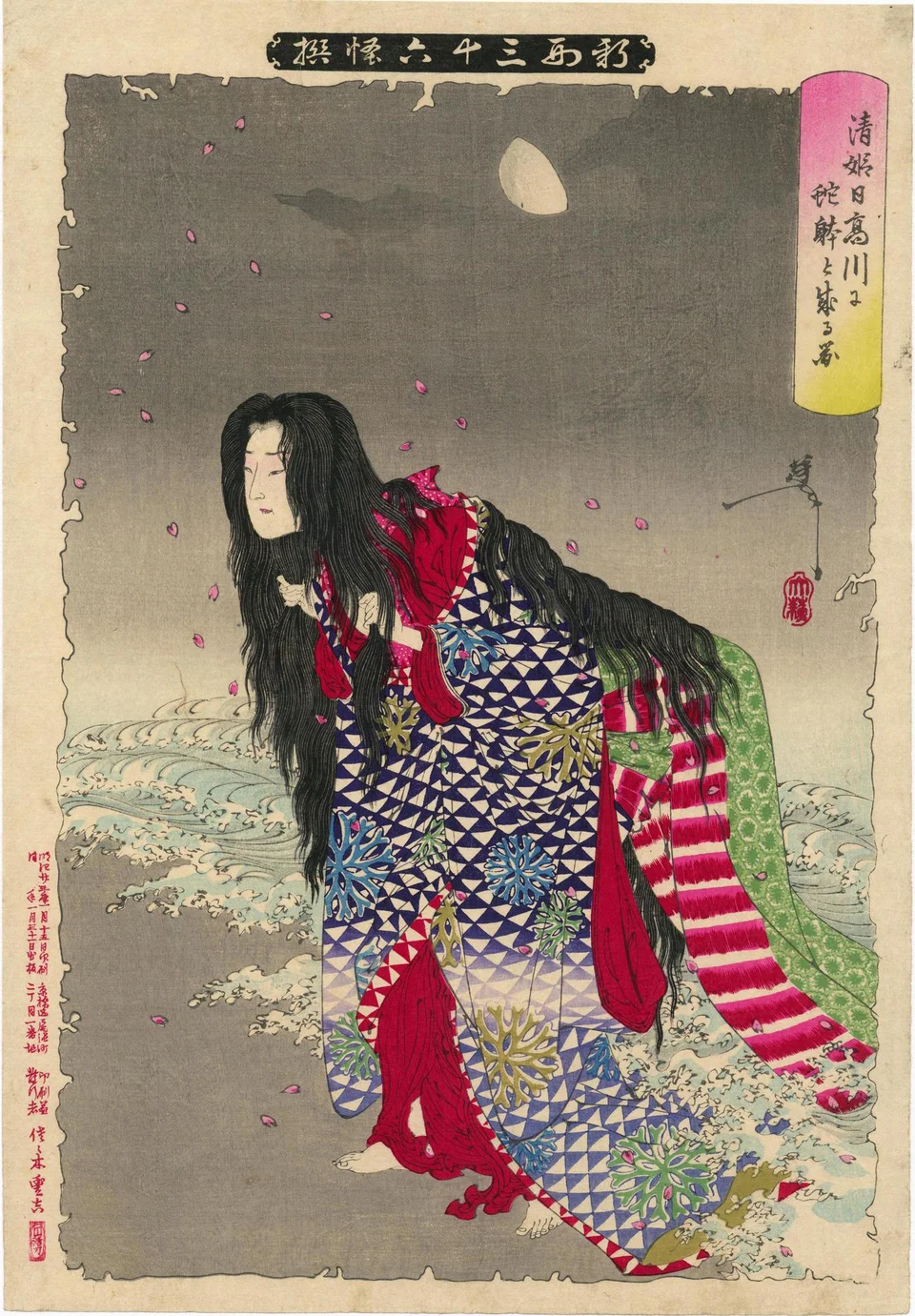
Kiyohime
Image associated with the exact linked encyclopedia article; consult credited file description for its interpretation.
Overview
Kiyohime belongs to the Anchin-and-Kiyohime narrative associated with Dojoji in Wakayama. The temple’s own account says that Anchin, a pilgrim monk, stays at her family’s home and promises to return after visiting Kumano. He passes without keeping that promise. Her pursuit culminates in transformation into a great snake and the burning of the monk beneath the temple bell. The temple gives 928 as the story’s traditional setting; this is a reported legendary date, not a securely witnessed historical killing.
The Hyogo Prefectural Museum’s picture-tale retelling supplies a more detailed pursuit. It places an earlier river crossing before the encounter at Kirime Shrine, then describes fiery breath, a boatman refusing passage at the Hidaka River, and serpent transformation during the crossing. At Dojoji, she locates Anchin under the bell, coils around it, and releases flame. These geographical and bodily stages give the transformation an unfolding narrative context, rather than presenting Kiyohime as a snake with no prior human identity.
That museum retelling continues beyond Anchin’s death. Both lovers subsequently appear as suffering serpents in a monk’s dream; a Lotus Sutra memorial service releases them, and a later dream shows their heavenly rebirth. This Buddhist conclusion changes how the destruction is framed: the account includes posthumous suffering and religious release. The profile attributes this ending to the cited retelling instead of assuming that every play or print reproduces its whole sequence.
The Met’s Torii Kiyomitsu print The Curfew at Dojoji, around 1763, presents an actor performing Kiyohime’s female role on a platform beneath a suspended bell. The museum describes dance as expressing the pain of rejection. This is evidence of theatrical adaptation, not an image of the historical girl herself. The temple likewise identifies Dojoji-themed Noh, puppet theatre, and Kabuki works. Sekien’s verified creature plate and the stage print thus preserve different artistic treatments of a narrative that combines pursuit, bodily change, violence, and subsequent Buddhist interpretation.
Griffis’s 1887 retelling substantially changes the lovers’ history. Kiyo is the eighteen-year-old daughter of a tea-house keeper named Kojima, and her lover is a young monk called Lift-the-Kettle in English. They conduct a mutual affair for months before he withdraws in remorse over his vows. She petitions Fudo and Kampira and learns sorcery from mountain spirits. Her earlier description as a fox at heart is figurative: the actual bodily change comes after she pronounces a taught spell and raises a T-shaped wand.
She becomes a fiery serpent, crosses the river and finds the monk beneath the temple bell. Her coils break the belfry’s supports, and their pressure and friction heat the bronze until it melts. Griffis ends with both monk and serpent reduced to ashes, without the subsequent serpent dreams and Buddhist release preserved in the museum retelling above. The learned incantation, sustained affair and mutually fatal ending must therefore remain attached to this English adaptation. Its moral judgments about the woman and its descriptions of Buddhist practice are the reteller’s framing, not a substitute for the temple’s account.
Origins & earliest records
The National Diet Library documents this named narrative episode and its illustrated transmission. The traditional setting is not treated as a verified date of the episode or the beginning of the story.
Records & interpretation
Verified Sekien primary plate supplemented by explicitly attributed museum object records and narrative interpretation; no full historical manuscript transcription claimed.
Selected bibliography
Documented works and useful reading. This is not a list of every appearance.
- 01
Dōjōji engi
National Diet Library's illustrated discussion identifies this specific episode. A full narrative edition is not asserted.
- 02
Japanese Fairy World: Stories from the Wonder-Lore of Japan
XXIX, Kiyohime, or the Power of Love, pp.250–263; complete chapter and collection preface read.
Family & connections
A source-supported family tree or inspiration record has not yet been compiled for this profile. Related reading below indicates a connection in subject matter, not a proven lineage or creative influence.
Primary records and illustrations
Konjaku Hyakki Shūi
Volume 1; Smithsonian Libraries digitized copy. IIIF canvas index 17 (zero-based); HyakkishuYiV1Tori_0018.jp2
Printed label 道成寺鐘; a serpent-woman coils around a decorated temple bell. This plate is matched to the Kiyohime narrative by the NDL exhibition's discussion of Dōjōji, rather than claiming Kiyohime is the printed title. Illustration directly inspected; no complete transcription of cursive explanatory text is claimed. Additional complete English narrative: XXIX, Kiyohime, or the Power of Love, pp.250–263, https://www.gutenberg.org/cache/epub/29337/pg29337-images.html#KIYOHIME_OR_THE_POWER_OF_LOVE. Version-specific anatomy, action and ending separated from existing visual/institutional witnesses; original-language source not independently collated.
Encyclopedia background
An additional attributed reference, separate from the editorial profile above.
Read the open encyclopedia overview
Kiyohime (清姫) (or just Kiyo) in Japanese folklore is a character in the story of Anchin and Kiyohime, which dates back to the 11th century. In this story, she fell in love with a Buddhist monk named Anchin, but after her interest in the monk was rejected, she chased after him and transformed into a serpent in a rage, before killing him in a bell where he had hidden in the Dōjō-ji temple.
Text from Wikipedia contributors, “Kiyohime”. CC BY-SA 4.0. Extracted introduction; formatting changed. Retrieved 5 October 2026. The source article may have changed since retrieval.
References
Sources supporting this profile. Linked pages have their own scope and editorial standards.
- National-library interpretation of primary illustrationsNational Diet Library: illustrated Kiyohime episodeResearch access: 2026-10-05
- Secondary referenceKiyohime — contextual overview and bibliographyResearch access: 2026-10-05
- Primary illustrated plate / institutional digitizationKonjaku Hyakki Shūi — directly inspected IIIF canvas index 17 (zero-based); HyakkishuYiV1Tori_0018.jp2Research access: 2026-10-05
- Museum object interpretation or living institutional narrativeDojoji Temple: Anchin and Kiyohime accountResearch access: 2026-10-05
- Museum object interpretation or living institutional narrativeHyogo Prefectural Museum: Dojoji engi picture-tale retellingResearch access: 2026-10-05
- Museum object interpretation or living institutional narrativeMet JP694, Torii Kiyomitsu: The Curfew at DojojiResearch access: 2026-10-05
- Historical English literary retellingGriffis, Japanese Fairy World (1887), XXIX, Kiyohime, or the Power of Love, pp.250–263Research access: 2026-10-05
Image credits
Reference illustrationKiyohime
Image associated with the exact linked encyclopedia article; consult credited file description for its interpretation.