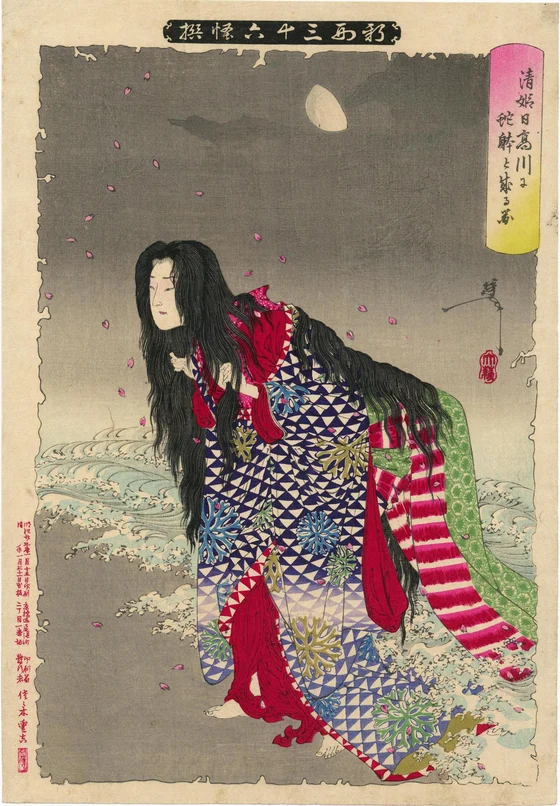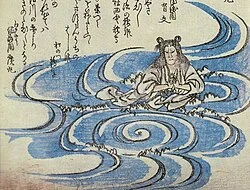
Hashihime
Image associated with the exact linked encyclopedia article; consult credited file description for its interpretation.
Overview
Hashihime, the bridge princess or maiden, has several overlapping identities in Japanese literature and belief. She can be associated with a bridge's guardianship, with a woman's waiting and longing, or with jealousy transformed into demonic force. Uji is a particularly important setting, but a bridge spirit should not be assumed to have the same biography in every locality. The structure itself supplies an enduring place for the tradition.
Literary appearances, worship and dramatic retellings preserve different emphases. Sekien's illustration is one later witness within that broader history. A useful comparison asks whether a source presents protection, erotic grief or dangerous vengeance, rather than assigning all three as permanent powers. This entry retains the ambiguity that makes the figure significant: a crossing can be protected by a presence that is also imagined as possessive or threatening.
The Metropolitan Museum’s Shino tea bowl known as Bridge of the Gods, object 2015.300.271, dates to the late sixteenth or early seventeenth century. An arching bridge and a shrine appear on opposite sides, painted with iron oxide beneath a white glaze. The museum connects comparable Shino bowls with The Tale of Genji’s Hashihime chapter and with a female guardian venerated beside the Uji crossing. The wording is comparative: it does not identify this particular bowl as a portrait of a named woman or prove one narrative interpretation. A bridge motif on a functional ceramic therefore offers a different medium to examine alongside a monster-book illustration. Guarding a crossing and the jealousy developed in other retellings need their own literary witnesses.
Origins & earliest records
Selected historical witness: Konjaku Gazu Zoku Hyakki (1779) by Toriyama Sekien. The linked library record identifies a surviving printed edition; it does not establish when the belief first arose.
Records & interpretation
The historical illustration and individual contextual reference support this profile. Named motifs, local narratives and later explanations are distinguished; image-to-plate matching still needs review.
Selected bibliography
Documented works and useful reading. This is not a list of every appearance.
- 01
Konjaku Gazu Zoku Hyakki
Selected historical witness; individual illustration now checked in the separately linked primary scan. This edition is not a claim of the earliest oral attestation.
- 02
Metropolitan Museum, Shino tea bowl, Bridge of the Gods,2015.300.271
Selected surviving object; catalog dating attributed, not an earliest-attestation claim.
Family & connections
A source-supported family tree or inspiration record has not yet been compiled for this profile. Related reading below indicates a connection in subject matter, not a proven lineage or creative influence.
Primary records and illustrations
Konjaku Gazu Zoku Hyakki
Volume 1; Smithsonian Libraries digitized copy. IIIF canvas index 17 (zero-based); Konjakuzokuhyak1Tori_0018.jp2
Printed label 橋姫; a woman stands near a bridge over water under strong diagonal rain. Label and composition directly inspected; no transcription of cursive explanatory text is claimed.
Encyclopedia background
An additional attributed reference, separate from the editorial profile above.
Read the open encyclopedia overview
Hashihime (橋姫, 'Bridge Princess' or 'Bridge Maiden') is a character appearing in Japanese folklore and literature. She first appeared in Japanese Heian literature, initially represented as a woman spending lonely nights waiting for her lover. Later legends depicted her as a guardian spirit of bridges, or alternatively as a fierce kijo (female demon) fueled by jealousy. She is most famously associated with a bridge in Uji.
Text from Wikipedia contributors, “Hashihime”. CC BY-SA 4.0. Extracted introduction; formatting changed. Retrieved 5 October 2026. The source article may have changed since retrieval.
References
Sources supporting this profile. Linked pages have their own scope and editorial standards.
- Primary illustration / library recordKonjaku Gazu Zoku Hyakki — historical library editionResearch access: 2026-10-05
- Secondary referenceHashihime — contextual overview and bibliographyResearch access: 2026-10-05
- Primary illustrated plate / institutional digitizationKonjaku Gazu Zoku Hyakki — directly inspected IIIF canvas index 17 (zero-based); Konjakuzokuhyak1Tori_0018.jp2Research access: 2026-10-05
- Museum / primary object recordMetropolitan Museum, Shino tea bowl, Bridge of the Gods,2015.300.271Research access: 2026-10-05
Image credits
Reference illustrationHashihime
Image associated with the exact linked encyclopedia article; consult credited file description for its interpretation.