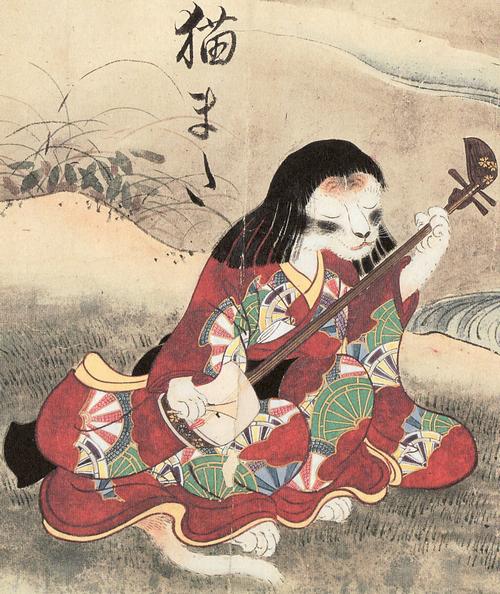
Nekomata
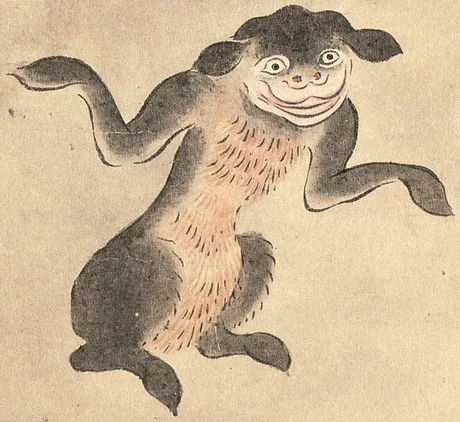
Image associated with the exact linked encyclopedia article; consult credited file description for its interpretation.
Overview
Nekomata traditions include both formidable mountain beasts and household cats that become supernatural with age. Later pictures frequently give the creature divided or multiple tails, but the history cannot be reduced to that one visual marker. Medieval literary references and Edo-period illustrations preserve changing ideas about dangerous cats, deception and the uncertainty of familiar animals when removed from ordinary domestic roles.
The related term bakeneko overlaps with nekomata in popular use, yet not every cat apparition is the same being. Sekien's image belongs to a recognizable illustrated repertoire rather than to a zoological classification. Accounts of human disguise or threatening behaviour should be attached to their particular narratives. The best comparison is between textual and visual witnesses, asking when the cat is a mountain threat and when it is an unsettling household presence.
Hearn’s “In a Japanese Garden” (1894), section10, gives the name a local setting in Izumo. A long-tailed cat that steals from his garden has acquired a reputation as a nekomata. Hearn observes the animal’s ordinary behaviour but does not witness it transform. The passage then records the belief that cats tend to become goblins and that shortening a kitten’s tail prevents the change. This is evidence of a historical belief and its effect on treatment of animals, not a biological explanation or a practice endorsed here. Notably, the suspicion attaches to a long tail; the account does not require a tail visibly split in two.
The surrounding remarks combine several different kinds of evidence: a cat’s alleged power to make a corpse dance, a proverb contrasting feline and canine gratitude, and a religious story about the cat and serpent failing to mourn the Buddha. Hearn reports these together as explanations for attitudes towards cats, but they are not successive events in the garden animal’s life. His broad claims about how cats are treated in Izumo remain his period generalizations. This witness adds a named household reputation and associated local beliefs to Sekien’s illustration without turning every ordinary long-tailed cat into a demonstrated supernatural being.
Origins & earliest records
Selected illustrated witness: Toriyama Sekien's Gazu Hyakki Yagyō (1776). This is an attestation of the named representation, not a claim that the belief began in that year.
Records & interpretation
Historical prints and textual references establish an imagined being and its representation. The linked contextual article distinguishes the pictured form from regional accounts; these sources do not establish zoological existence.
Selected bibliography
Documented works and useful reading. This is not a list of every appearance.
- 01
Gazu Hyakki Yagyō
Selected historical witness; individual illustration now checked in the separately linked primary scan. This edition is not a claim of the earliest oral attestation.
- 02
Glimpses of Unfamiliar Japan, Second Series — In a Japanese Garden
HostedI/originalXVI: all14sections and40endnotes read; particular section identified in evidence.
Family, evolution & connections
Domestic cat
Sekien’s nekomata belongs to a changing history of supernatural cats, including divided-tail imagery. Domestic cats provide the familiar body against which such transformations appear uncanny. A multiple tail is a narrative or pictorial marker here, not a zoological trait, and the connection does not explain every mountain-beast version.
Primary records and illustrations
Gazu Hyakki Yagyō
Volume 1, Yin (陰); digitized Smithsonian Libraries copy, 1805 edition. IIIF canvas index 16 (zero-based); GazuHyakkiyagyo1Tori_0017.jp2
Named 猫また; an upright cat with a divided tail appears near a domestic wooden veranda. Visual inspection of the digitized plate and its printed label; image URL is copied from the actual IIIF manifest, not a guessed leaf reference. Hearn1894 complete In a Japanese Garden§10/all40chapter notes: long-tailed ordinary cat has nekomata reputation; no observed transformation or divided-tail requirement. https://www.gutenberg.org/cache/epub/8133/pg8133.html#id00017
Encyclopedia background
An additional attributed reference, separate from the editorial profile above.
Read the open encyclopedia overview
Nekomata (original form: 猫また, later forms: 猫又, 猫股, 猫胯) are a kind of cat yōkai described in Japanese folklore, classical kaidan, essays, etc. There are two very different types: those that live in the mountains and domestic cats that have grown old and transformed into yōkai.
Nekomata are often confused with bakeneko. Nekomata have multiple tails, while bakeneko have one. Additionally, while bakeneko are often seen as mischievous and playful, nekomata are considered far more malicious in their behaviour.
Text from Wikipedia contributors, “Nekomata”. CC BY-SA 4.0. Extracted introduction; formatting changed. Retrieved 5 October 2026. The source article may have changed since retrieval.
References
Sources supporting this profile. Linked pages have their own scope and editorial standards.
- Primary illustrated book / national-library recordNocturnal Procession of the Hundred Demons — historical editionResearch access: 2026-10-05
- National library / primary illustration contextTORIYAMA Sekien’s Illustrated Night Parade of the Demon HordeResearch access: 2026-10-05
- Secondary referenceNekomata — contextual overview and bibliographyResearch access: 2026-10-05
- Primary illustrated plate / institutional digitizationGazu Hyakki Yagyō — directly inspected IIIF canvas index 16 (zero-based); GazuHyakkiyagyo1Tori_0017.jp2Research access: 2026-10-05
- Historical English essay, reported beliefs and literary narrativesHearn, complete In a Japanese GardenResearch access: 2026-10-05
Image credits
Reference illustrationNekomata
Image associated with the exact linked encyclopedia article; consult credited file description for its interpretation.