Tarasque
Image associated with the exact linked encyclopedia article; consult credited file description for its interpretation.
Overview
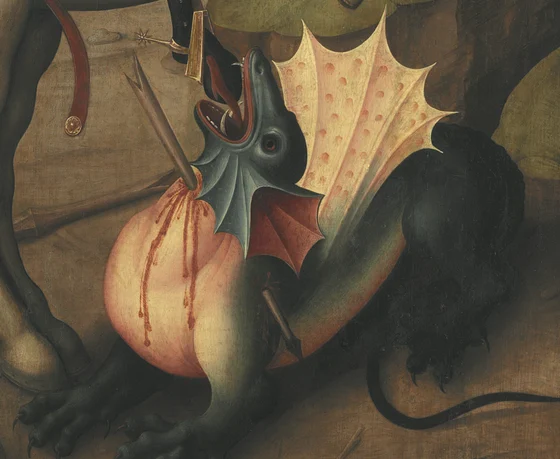
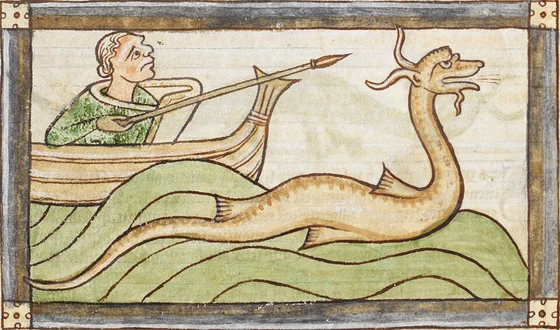
The Golden Legend places the dragon near the Rhône between Arles and Avignon, where it attacks travellers and wrecks ships. Its body combines beast and fish, with a lion-like head, serpent-like tail, horns, wings and formidable teeth. The text describes it as larger than familiar livestock and resistant to ordinary attacks. These features belong to the hagiographic portrayal, rather than a measured animal or one unchanging festival costume.
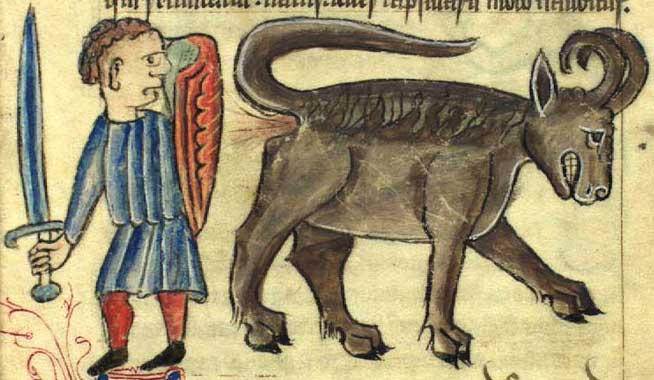
Martha approaches at the people’s request and finds the dragon consuming a man. Holy water and the cross make it submissive; she binds it with her girdle, after which the people kill it with weapons. The narrative links the creature to Tarascon’s name and gives it monstrous parentage involving Leviathan and Bonacho. The latter’s burning excrement recalls the bonnacon tradition, but the genealogy remains this text’s account. Martha’s authority and the community’s response are as important as the hybrid anatomy.
Origins & earliest records
The selected witness is the life of Saint Martha in Jacobus de Voragine’s thirteenth-century Golden Legend, read through William Caxton’s 1483 English translation. This dates one transmitted hagiographic account, not the saint’s lifetime or the first local story. The text’s place-name explanation is retained as narrative tradition rather than independently established etymology.
Records & interpretation
The chapter supports the Rhône setting, composite anatomy, restraint with a girdle and subsequent killing by the people. It is literary evidence for a public Christian saint’s legend. It does not verify a biological dragon, prove the proposed parentage or establish that all later Provençal representations used precisely the same physical form.
Selected bibliography
Documented works and useful reading. This is not a list of every appearance.
- 01
Golden Legend, chapter105: Life of Saint Martha
Selected primary passage inspected; publication and transmission dates are distinguished from oral origins.
Family & connections
A source-supported family tree or inspiration record has not yet been compiled for this profile. Related reading below indicates a connection in subject matter, not a proven lineage or creative influence.
Encyclopedia background
An additional attributed reference, separate from the editorial profile above.
Read the open encyclopedia overview
The Tarasque (Occitan: Tarasca) is a creature from French mythology. According to the Golden Legend, the beast had a lion-like head, a body protected by turtle-like carapace(s), six feet with bear-like claws, a serpent's tail, and could expel a poisonous breath.
Medieval iconography such as renditions in church sculpture did not necessarily conform to this description in the earlier Gothic period, and examples which seemed to were assigned later, in the 14th century. The six-footed, turtle-shelled tarasque was the form depicted on the city seal of Tarascon around the 15th century, and this held to be the norm in 16th- and 17th-century paintings. As St. Martha purportedly encountered the beast in the act of swallowing a human victim, it has become a stock motif in art to portray the monster swallowing a human (e.g. head first, with the victim's legs still dangling).
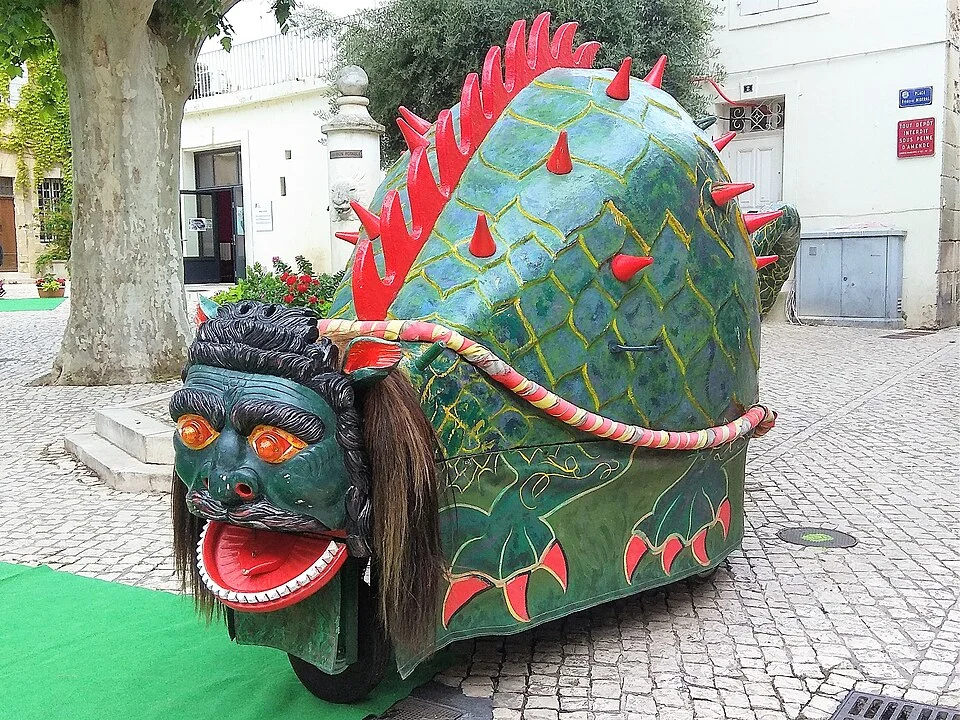
According to tradition, in 1474, René of Anjou initiated the use of the tarasque in the Pentecostal festival, and later used also on the saint's feast day of July 29. Yearly celebration in the last weekend of June was added in the modern day. The effigy or float (French: char) of the tarasque has been built over the years for parading through town for the occasion, carried by four to a dozen men concealed inside.
Text from Wikipedia contributors, “Tarasque”. CC BY-SA 4.0. Extracted introduction; formatting changed. Retrieved 5 October 2026. The source article may have changed since retrieval.
References
Sources supporting this profile. Linked pages have their own scope and editorial standards.
- Primary textGolden Legend, chapter105: Life of Saint MarthaResearch access: 2026-10-05
Image credits
Reference illustrationTarasque
Image associated with the exact linked encyclopedia article; consult credited file description for its interpretation.