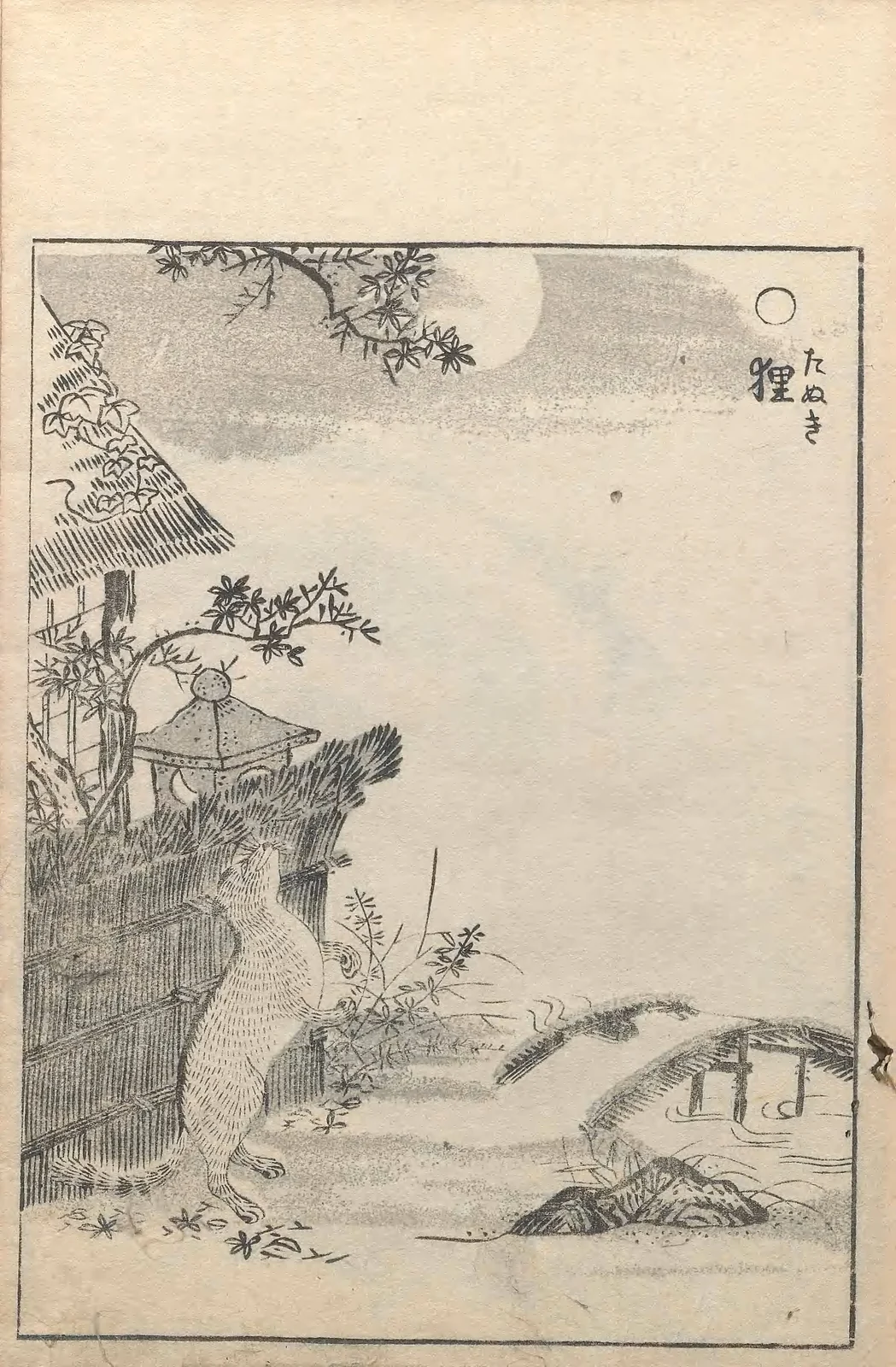
Tanuki, named plate by Toriyama Sekien
Printed name 狸 and complete composition individually inspected at enlarged resolution. Actual URL copied from the IIIF manifest.
Overview
Sekien’s Tanuki stands upright next to a reed fence under a shaded night sky. The small furry animal turns its head upward and holds its front limbs close to its body. A narrow stream crosses the foreground, with a small bridge to the right. Behind the fence are a building and a lantern-like garden structure. Overhanging branches and the moon organize the upper part of the composition.
The plate names the subject with 狸 and a phonetic reading. It gives the animal no obvious human costume or magic instrument. That ordinary-looking representation matters beside later narratives: inclusion in an illustrated supernatural collection establishes a folkloric context, but it does not make every feature of a later story visible on this page. The plate alone supplies neither a transformation sequence nor the identity of a person tricked by the animal.
Griffis’s “The Wonderful Tea-Kettle,” printed pages 55–61, presents the being in English as a badger. A kettle develops a nose, tail and hairy legs, mixing metal vessel and animal body. Sold to a tinker, it becomes an entertainer whose transformations and performance bring prosperity. The story ends with the kettle retained at the temple. These details document this English adaptation of the animated tea-kettle narrative rather than the natural behavior of any living mammal.
In “The Fox and the Badger,” pages 72–76, transformation supports a harsher story. Animals cooperate in a selling trick, but betrayal leads to the fox’s death. Her surviving cub takes revenge by making the badger mistake an actual lord’s procession for another supernatural disguise. This narrative emphasizes judgment and deception, contrasting with the successful partnership between animal entertainer and human exhibitor in the tea-kettle story.
The illustrated animal and these adapted tales are complementary witnesses, not one composite biography. They show an ordinary-looking body, an animated utensil and deceptive human appearances under related animal folklore. English badger terminology must be retained as the translator’s wording rather than silently equated with a modern scientific identification. Independent regional accounts, older textual witnesses and the relationship between tanuki and mujina naming require further documentation beyond the selected plate and retellings.
Hearn’s “Common Sense” in Kottō (1903) supplies another distinct badger-deception episode. A priest on Atagoyama near Kyoto believes that Fugen Bosatsu visits his remote temple nightly. A hunter joins the priest and his acolyte and sees a bright figure riding a white elephant with six tusks. He shoots the apparent holy visitor; the light disappears, leaving darkness. At dawn a trail of blood leads to a large badger killed by the arrow. The elephant and rider are therefore the deceptive apparition, not a separately encountered sacred being or proof that an ordinary animal has six tusks.
The hunter reasons that his own occupation of killing animals would make such a religious vision unlikely, whereas the learned priest trusts the appearance. That argument and the praise of practical judgment belong to the tale’s moral construction, not a general rule about who can experience Buddhist visions. Hearn calls the corpse a badger without giving a Japanese animal name in this passage, so the episode is retained as a comparative English witness rather than zoological proof that every translated badger is a tanuki.
An earlier Hearn witness explicitly uses the Japanese name Tanuki-Bozu. In “Of Ghosts and Goblins” (1894), he and Kinjuro visit a festival exhibition of life-size figures. Kinjuro identifies an unusually tall priest as the form in which a goblin-badger deceives late travellers. When Hearn approaches its alarming face, the figure reaches over a hedge towards him, moans, and falls back creaking. Hearn explains that hidden strings move it: this is an observed theatrical representation of a frightening priest-disguise, not a claim that he encountered a transformed animal.
The setting also limits what can be inferred about belief. Asked afterwards whether people believe in the displayed goblins, Kinjuro says that city people no longer do, while allowing that the countryside may differ. His answer is one interlocutor’s assessment, not a survey of Japan. Unlike the English “badger” passages in the other selected tales, this account explicitly supplies tanuki as the animal term; it still provides no modern zoological determination or proof that every priest-shaped apparition belongs to this category.
Mitford’s earlier “The Accomplished and Lucky Tea-Kettle,” first collected in1871, supplies a distinct version of the kettle’s introduction and final status. At Morinji in Jôshiu, the vessel suddenly acquires a badger’s head, tail and fur, then flies about the room. The priest and novices catch it and force it into a box. Once it looks like an ordinary kettle again, the priest sells it to a visiting tinker for twenty copper coins. At its new home it repeatedly grows fur and walks on four legs during the night, then resumes its utensil appearance. The text narrates flight without supplying wings.
A friend recommends exhibiting it with music, dancing and tightrope performances. Its success attracts noble patrons and enriches the tinker, who eventually returns it to the temple. Mitford explicitly says it is then preserved as a treasure and venerated as a saint. That devotional ending belongs to this translated fairy tale; it is not independent confirmation of an actual object’s powers or a description of current temple practice. The collection’s framing identifies such tales as drawn from illustrated Japanese pamphlets, distinguishing this printed-source mediation from Hearn’s personally described festival display.
Origins & earliest records
Toriyama Sekien includes the named illustration in Gazu Hyakki Yagyō, first published in 1776. The inspected Smithsonian Libraries copy is the 1805 edition; publication is distinguished from the age of an oral tradition.
Records & interpretation
Printed title and composition individually inspected at enlarged resolution in the institutional digitization. Observations describe the historical image rather than an uncited encounter story.
In the literature
“the spout of the kettle turned into a badger's nose with its big whiskers,”
“The Wonderful Tea-Kettle”; paragraph beginning “"What does this mean?" said the old bonze. " Naru hodo ,"…” · William Elliot Griffis (translations and retellings)
Griffis’s Bunbuku Chagama retelling calls the transformation animal a badger; this historical English label does not settle modern zoological terminology.
“the kettle ran around on four legs, half badger and half iron,”
“The Wonderful Tea-Kettle”; paragraph beginning “Then the tinker, dressed up in his wide ceremonial clothes, with a…” · William Elliot Griffis (translations and retellings)
The magical kettle performs in an animal-and-metal form.
“The next week the badger took human form,”
“The Fox and the Badger”; paragraph beginning “The next week the badger took human form, and going to town…” · William Elliot Griffis (translations and retellings)
Griffis’s transformed badger takes human form to sell the fox.
Selected bibliography
Documented works and useful reading. This is not a list of every appearance.
- 01
Gazu Hyakki Yagyō
Volume 1; IIIF canvas index 20 (zero-based); printed name 狸.
- 02
Japanese Fairy World: Stories from the Wonder-Lore of Japan
“The Wonderful Tea-Kettle,” pp.55–61; “The Fox and the Badger,” pp.72–76. English badger wording retained as translation evidence.
- 03
Kottō: Being Japanese Curios, with Sundry Cobwebs
Common Sense, complete tale and Fugen/Samantabhadra footnote; Macmillan edition. English badger terminology retained.
- 04
Glimpses of Unfamiliar Japan, Second Series — Of Ghosts and Goblins
Hosted chapter X, sections1–7 and all4 endnotes read; original two-volume numbering XXV, beginning p.637 in Nichibunken catalogue. No unverified subsection pagination assigned.
- 05
Tales of Old Japan — The Accomplished and Lucky Tea-Kettle
Completepp.138–140 and FairyTalesframing133–134; noattachedtalenotes.
Family & connections
A source-supported family tree or inspiration record has not yet been compiled for this profile. Related reading below indicates a connection in subject matter, not a proven lineage or creative influence.
Primary records and illustrations
Gazu Hyakki Yagyō
Volume 1; Smithsonian Libraries 1805 edition. IIIF canvas index 20 (zero-based)
Printed name 狸 and complete composition individually inspected at enlarged resolution. Actual URL copied from the IIIF manifest. Depth enrichment: named narrative sections directly read, with differences between witnesses retained. Additional complete Hearn Kottō1903 Common Sense comparison read in hearn-kotto-Common_Sense.txt: apparent Fugen/six-tusk elephant resolves into arrow-killed badger; no modern taxonomic identification inferred. https://www.gutenberg.org/files/55473/55473-h/55473-h.htm#Common_Sense Additional complete Hearn1894 Of Ghosts and Goblins II.X§2–3 distinguishes named Tanuki-Bozu festival string-operated figure from an actual encounter; all7 sections and4 notes read. https://www.gutenberg.org/cache/epub/8133/pg8133.html#id00932 Complete MitfordTeaKettle138–140 adds boxcapture/twentycoins/flyingthenfourlegform/finalsaintveneration; no inventedwings/currenttempleclaim. https://www.gutenberg.org/cache/epub/13015/pg13015-images.html
Located primary passages
Specific passages supporting details in this entry, grouped by their published witness.
Japanese Fairy World: Stories from the Wonder-Lore of Japan
Exact contiguous excerpt checked against the linked primary e-text on 2026-10-05; only whitespace normalized. London: Trübner, 1887 title-page edition; preface dated 1880.
- Griffis’s Bunbuku Chagama retelling calls the transformation animal a badger; this historical English label does not settle modern zoological terminology.
- The magical kettle performs in an animal-and-metal form.
- Griffis’s transformed badger takes human form to sell the fox.
The passage documents this literary version, not zoological existence, earliest attestation or a universal statement of living tradition.
References
Sources supporting this profile. Linked pages have their own scope and editorial standards.
- Institutional primary-book recordSmithsonian Libraries — historical illustrated volumeResearch access: 2026-10-05
- Direct primary illustrationNamed primary plate: 狸Research access: 2026-10-05
- Primary literary adaptation / named sectionJapanese Fairy World — directly read named narrative witnessesResearch access: 2026-10-05
- Complete historical literary retellingHearn, Kottō (1903), Common SenseResearch access: 2026-10-05
- Historical English account of performances and attributed oral narrativesHearn, complete Of Ghosts and GoblinsResearch access: 2026-10-05
- Historical English translation of a printed Japanese fairy taleMitford, complete Accomplished and Lucky Tea-KettleResearch access: 2026-10-05
Image credits
Historical illustrationTanuki, named plate by Toriyama Sekien
Printed name 狸 and complete composition individually inspected at enlarged resolution. Actual URL copied from the IIIF manifest.