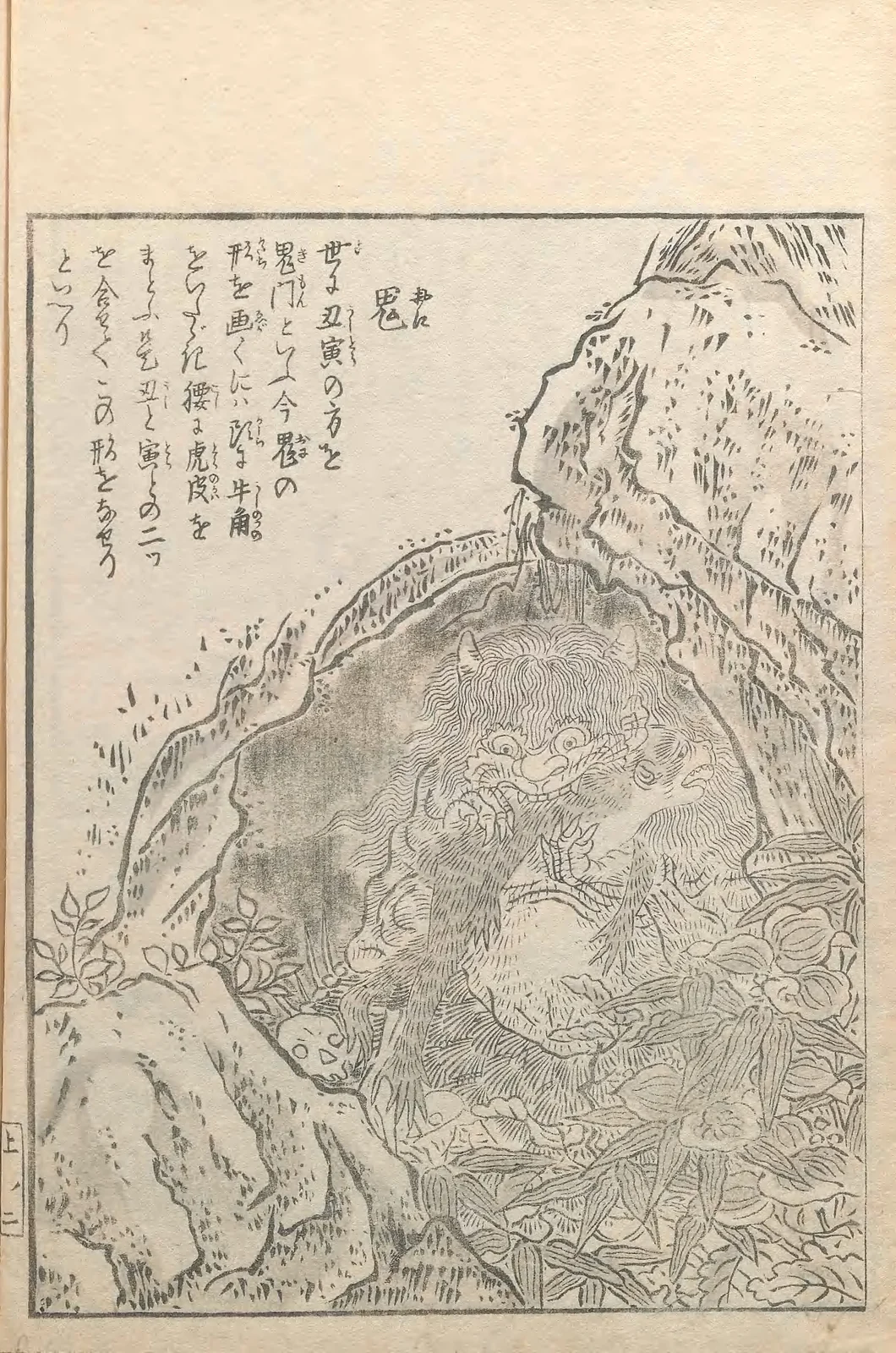
Shokuin / Zhuyin, named plate by Toriyama Sekien
Printed title燭陰 and actual illustration inspected. Description records visible composition, not an unchecked translation of cursive text.
Overview
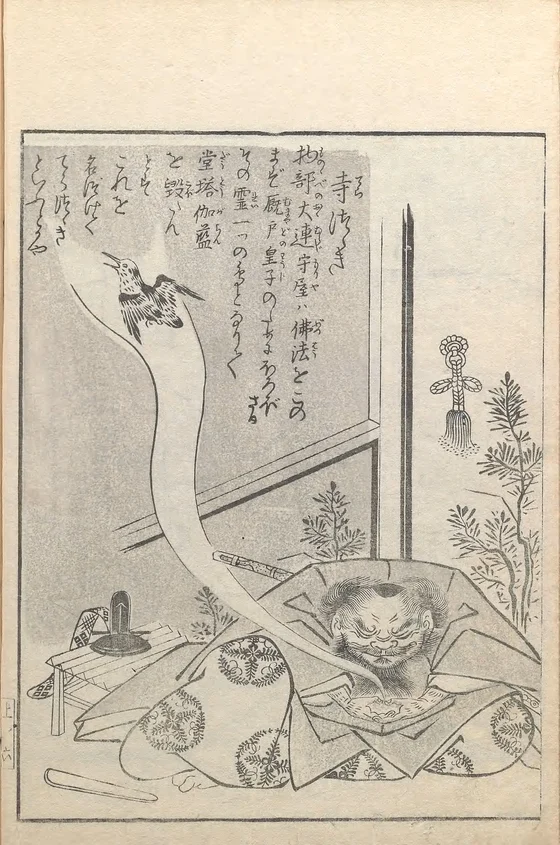
Shokuin is Toriyama Sekien’s Japanese illustrated treatment of the Chinese being named Zhuyin, 燭陰. His inspected plate shows an enormous serpent with a humanlike face. Its long body follows a mountain edge and curves beside vegetation, while its head emerges from a rocky hollow. The printed name identifies the creature; the proportions and small landscape details make its scale conspicuously larger than an ordinary snake.
The Northern Overseas section of the Shanhaijing gives Zhuyin a more explicitly cosmic description. It calls him the spirit of Zhong Mountain, with a human face, a serpent’s body, and red colour. Looking produces day, and closing the eyes produces night. Blowing and calling are associated with winter and summer. The text says that he neither drinks nor eats, and gives his body a length of a thousand li. These are statements of literary cosmology, rather than observations of a zoological creature.
A second account occurs near the end of the Great Wilderness North section. There a red, human-faced, serpent-bodied spirit inhabits Zhangwei Mountain beyond the northwestern seas. The account again links darkness and brightness to closing and opening the eyes, and names the being Zhulong, 燭龍, while also using the expression Zhu Jiuyin. Its wording includes not eating, sleeping, or breathing. The geographical and naming differences should remain visible instead of being silently replaced with a single modern summary.
The two Chinese passages provide a sound basis for discussing the cosmic functions behind Sekien’s image. They do not establish which exact edition he consulted, and the illustration alone would not justify those functions. Conversely, Sekien’s landscape supplies visual choices absent from the compact Chinese descriptions. This profile presents the linked named traditions together while preserving the distinction between ancient received text and an Edo-period Japanese representation. Its first composition date, religious observance, and modern scientific identity are not settled by these witnesses.
Origins & earliest records
Toriyama Sekien includes the named illustration in Konjaku Gazu Zoku Hyakki, first published 1779. The inspected Smithsonian copy is a later historical edition; the first book appearance is not a claim of the earliest oral tradition.
Records & interpretation
Directly inspected historical illustration and printed name. Pictorial observations are distinguished from narrative claims that would require a separate checked text.
Selected bibliography
Documented works and useful reading. This is not a list of every appearance.
- 01
Konjaku Gazu Zoku Hyakki
Volume 1, IIIF canvas index 11 (zero-based); printed title 燭陰 directly inspected.
- 02
Shanhaijing, Northern Overseas: Zhong Mountain Zhuyin
Exact named passage directly read; bracketed commentary distinguished from base text.
- 03
Shanhaijing, Great Wilderness North: Zhangwei Mountain Zhulong
Exact named passage directly read; bracketed commentary distinguished from base text.
Family & connections
A source-supported family tree or inspiration record has not yet been compiled for this profile. Related reading below indicates a connection in subject matter, not a proven lineage or creative influence.
Primary records and illustrations
Shan hai jing: er shi san juan (Smithsonian digitized edition)
Physical volume 1; Shan hai jing tu illustration sequence. IIIF canvas index 81 (zero based), labelled 燭陰; no printed page number asserted
Actual 1000-pixel labelled image directly inspected and text compared. Human-faced serpent; caption names red colour, thousand-li body and Zhong Mountain. This is the Chinese Shanhaijing illustration of Zhuyin, compared with the already verified Japanese Sekien Shokuin plate. Smithsonian physical volume catalog 1667, public domain. Earlier primary witness, including any Japanese plate, retained under additionalNarrativeSources.
References
Sources supporting this profile. Linked pages have their own scope and editorial standards.
- Institutional primary-book recordSmithsonian Libraries — historical illustrated volumeResearch access: 2026-10-05
- Direct primary illustrationNamed primary plate: 燭陰Research access: 2026-10-05
- Primary-text transcriptionShanhaijing, Northern Overseas: Zhong Mountain ZhuyinResearch access: 2026-10-05
- Primary-text transcriptionShanhaijing, Great Wilderness North: Zhangwei Mountain ZhulongResearch access: 2026-10-05
- Primary illustrated bookSmithsonian illustrated Shan hai jing v.1, canvas 81: 燭陰Research access: 2026-10-05
Image credits
Historical illustrationShokuin / Zhuyin, named plate by Toriyama Sekien
Printed title燭陰 and actual illustration inspected. Description records visible composition, not an unchecked translation of cursive text.