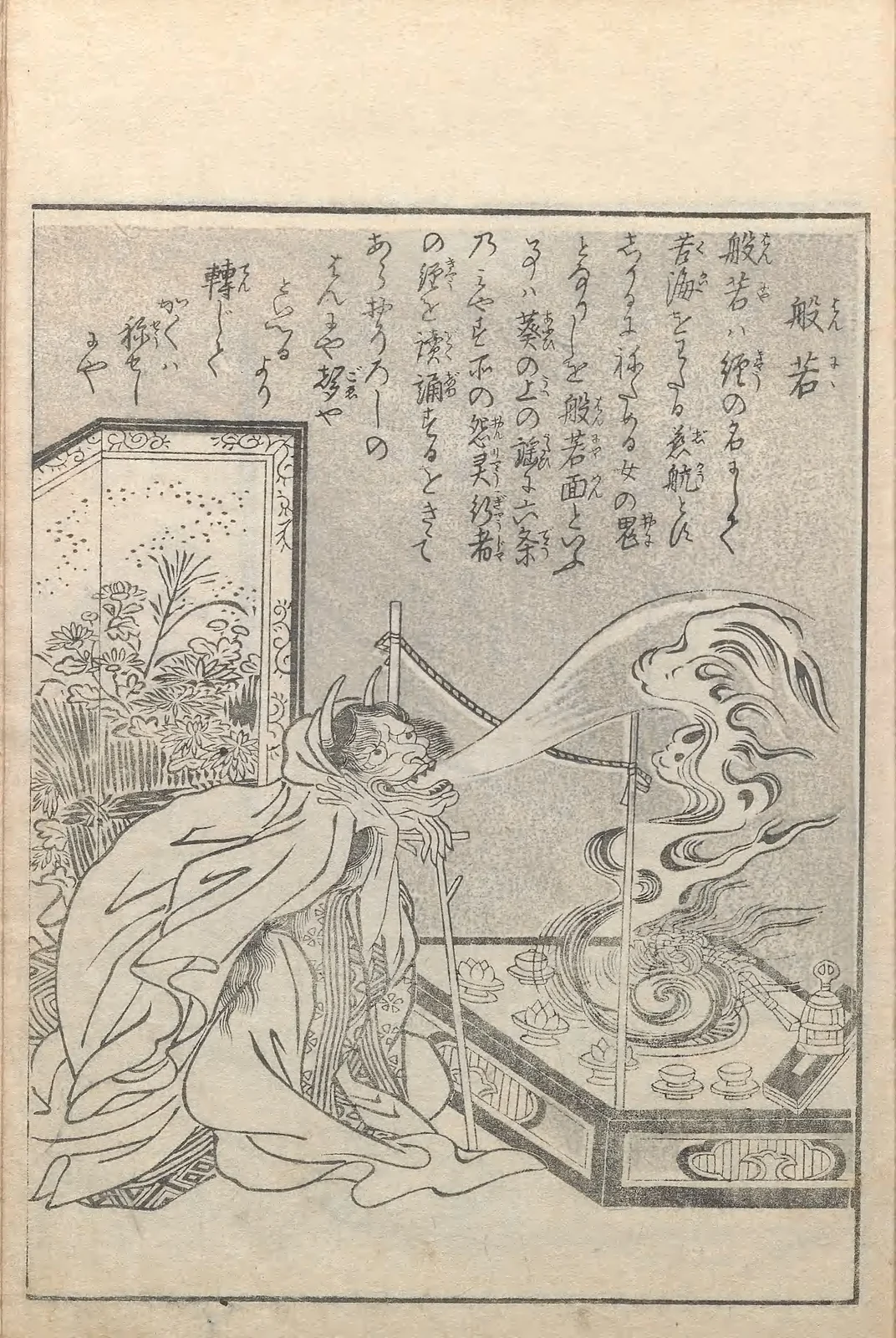
Hannya, named plate by Toriyama Sekien
Printed title般若 and actual illustration inspected. Description records visible composition, not an unchecked translation of cursive text.
Overview
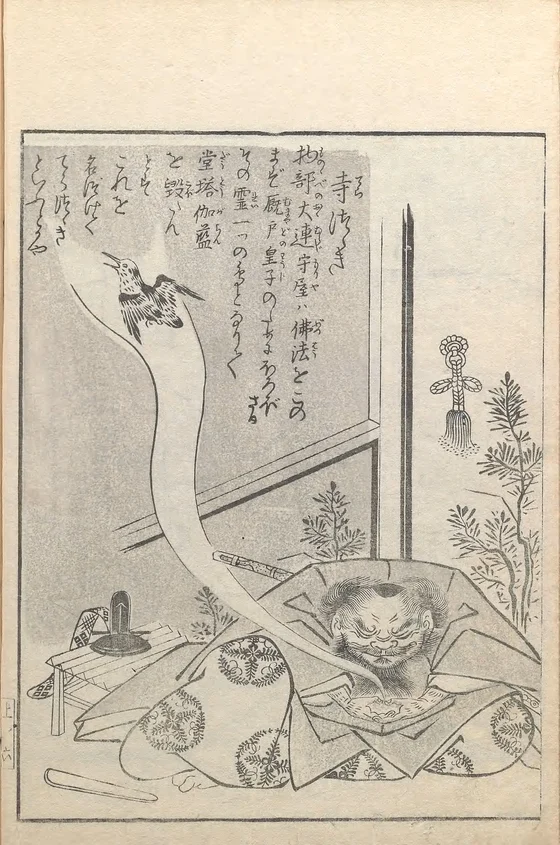
Hannya appears in Sekien's plate as a kneeling, elaborately robed figure with horns and a fierce face. An extraordinary projection extends from the mouth toward a curling, face-shaped form over a low stand. Bowls, suspended cords and a decorated screen establish an interior setting. The figure's garment fills much of the lower page, making the transformed head and mouth the composition's main disturbance.
The printed label 般若 connects this image with the demonic Hannya name. Its particular pictorial arrangement should be kept distinct from every stage use of a Hannya mask. This record documents the inspected book illustration; it does not treat the picture as a complete plot of a noh play or as proof that all jealousy narratives share one anatomy.
A separate theatre context comes from the University of Bologna’s project on the Museum of Oriental Art in Venice collection. Its Hannya entry describes a female demonic spirit associated with jealousy and obsession, represented by a horned mask with staring eyes and an open, menacing mouth. The expression also suggests a plea for compassion, complicating a reading of the face as anger alone. The project names Aoi no Ue, Dōjōji and Momijigari among its theatrical uses. These are examples of a mask’s repertoire, not evidence that every character wearing it is one individual or that Sekien’s illustration depicts all three plays.
Origins & earliest records
Toriyama Sekien includes the named illustration in Konjaku Gazu Zoku Hyakki, first published 1779. The inspected Smithsonian copy is a later historical edition; the first book appearance is not a claim of the earliest oral tradition.
Records & interpretation
Directly inspected historical illustration and printed name. Pictorial observations are distinguished from narrative claims that would require a separate checked text. Complete institutional Hannya mask entry supplies a separately scoped theatre comparison.
Selected bibliography
Documented works and useful reading. This is not a list of every appearance.
- 01
Konjaku Gazu Zoku Hyakki
Volume 1, IIIF canvas index 18 (zero-based); printed title 般若 directly inspected.
- 02
Figures from the theatrical repertoire
Complete Hannya entry and page scope read; a collection-based list, expressly not an exhaustive repertoire. No full play-text verification claimed.
Family & connections
A source-supported family tree or inspiration record has not yet been compiled for this profile. Related reading below indicates a connection in subject matter, not a proven lineage or creative influence.
Primary records and illustrations
Konjaku Gazu Zoku Hyakki
Volume1; Smithsonian Libraries copy. IIIF canvas index 18 (zero-based)
Printed title般若 and actual illustration inspected. Description records visible composition, not an unchecked translation of cursive text. Added complete University of Bologna collection-project Hannya entry, cached unibo-noh-characters.html; theatre examples and mixed anger/compassion expression distinguished from Sekien plate. All prior evidence retained. No full-play claim.
Encyclopedia background
An additional attributed reference, separate from the editorial profile above.
Read the open encyclopedia overview
The hannya (般若) is a mask used in a traditional Japanese Noh theater, representing a jealous female demon. It is characterized by two sharp bull-like horns, metallic eyes, and a leering mouth. In Noh plays, the type of mask changes according to the degree of jealousy, resentment, and anger of the female characters. The hannya is a mask that represents a female onryō, even more resentful, jealous, and angry than the namanari (生成), a woman on the verge of becoming a demoness.
The hannya is also called chūnari (中成). The shinjya (真蛇), also called honnari (本成), is a mask that represents the appearance of a female onryō, even more intense than the hannya. These masks, which represent the jealousy, resentment, and anger of female demons, are classified as jya (蛇, snake) masks.
It is said that there are now more than 250 types of Noh masks, but the oldest historical record of Noh masks, Sarugaku dangi, mentions only about 14 types of masks, and the name hannya is not found among them. However, the Sarugaku dangi records a performance of the Noh play Aoi no Ue, and it is possible that snake-like demoness masks such as hannya were used.
The differentiation of mask types seems to have progressed in the 16th century, and the name hannya appears in the works of Shimoma Nakataka, a monk, samurai and Noh actor active from the 1580s to the 1610s.
Text from Wikipedia contributors, “Hannya”. CC BY-SA 4.0. Extracted introduction; formatting changed. Retrieved 5 October 2026. The source article may have changed since retrieval.
References
Sources supporting this profile. Linked pages have their own scope and editorial standards.
- Institutional primary-book recordSmithsonian Libraries — historical illustrated volumeResearch access: 2026-10-05
- Direct primary illustrationNamed primary plate: 般若Research access: 2026-10-05
- Institutional collection interpretationUniversity of Bologna / Venice Museum of Oriental Art project — Hannya entryResearch access: 2026-10-06
Image credits
Historical illustrationHannya, named plate by Toriyama Sekien
Printed title般若 and actual illustration inspected. Description records visible composition, not an unchecked translation of cursive text.