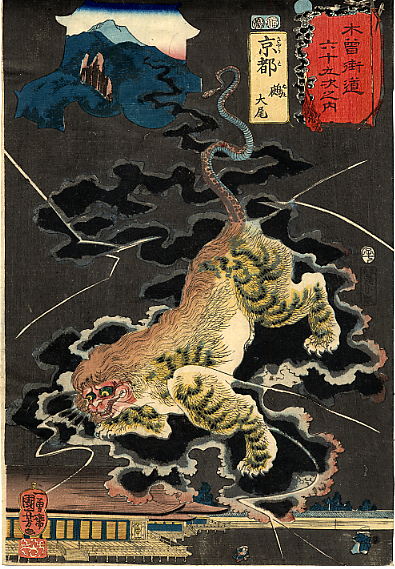
Nue
Image associated with the exact linked encyclopedia article; consult credited file description for its interpretation.
Overview
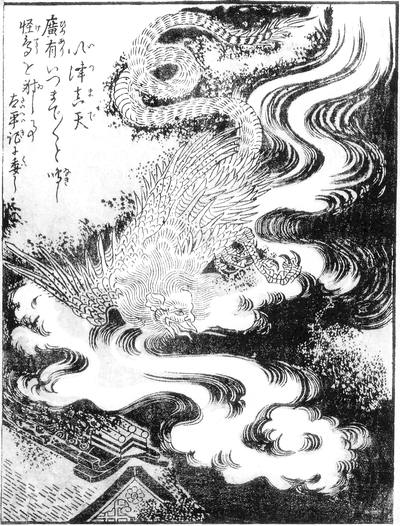
Nue is a composite monster familiar from the episode in which Minamoto no Yorimasa confronts a threatening presence at the imperial palace. Illustrations commonly combine parts associated with a monkey, tiger, snake and another mammal, but the proportions and body descriptions vary. Its cry is an important part of the tradition, joining an ominous sound to the uncertainty of a creature concealed in darkness.
The word also has a history connected with birds and nocturnal cries, so an early bird reference does not automatically attest the later composite monster. Sekien's picture offers one stage in the visual history. The palace episode belongs to literary narrative, and its traditional setting should not be mistaken for the composition date of a surviving account. This entry follows the hybrid form while keeping linguistic, ornithological and narrative evidence distinct.
Griffis’s 1887 English retelling gives the palace monster an unusually elaborate body: bird wings, a tiger’s body and claws, a monkey’s head, a serpent tail and dragon scales. It visits the roof at night, howling and scratching until the emperor loses sleep and weakens. These wings and scales belong to this telling and should not be silently added to every representation of Nue. The chapter calls it a dreadful beast rather than using the name Nue; the connection is the familiar Yorimasa palace episode.
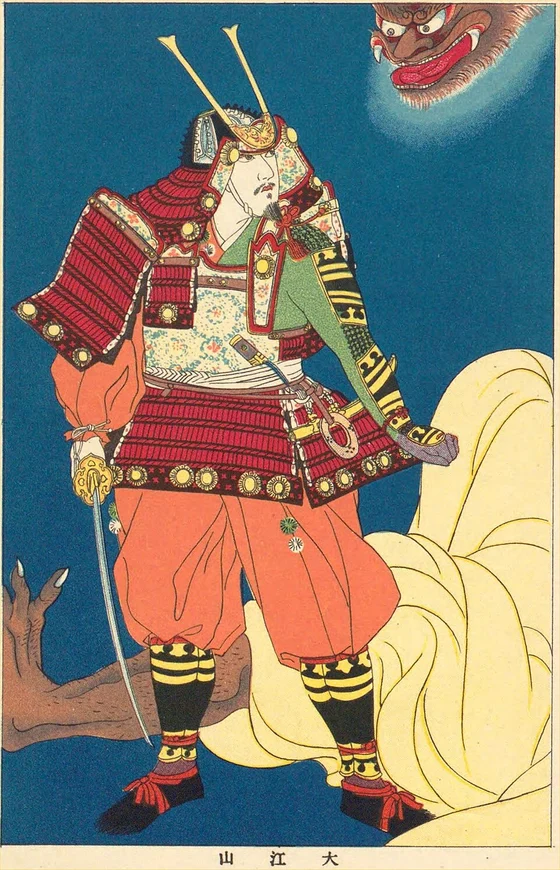
On a stormy night Yorimasa watches its eyes move across the roof, shoots beside their gleam and brings the creature down. His attendant then kills it with a blade, and its hide is shown at court the next morning. The emperor rewards Yorimasa with a named sword and a marriage. The arrow’s successful strike is therefore not the whole killing sequence. Griffis’s supplied names and ornamental details remain those of his literary witness, distinct from the earlier Japanese texts and Sekien’s later composite portrait.
Origins & earliest records
Selected historical witness: Konjaku Gazu Zoku Hyakki (1779) by Toriyama Sekien. The linked library record identifies a surviving printed edition; it does not establish when the belief first arose.
Records & interpretation
The historical illustration and individual contextual reference support this profile. Named motifs, local narratives and later explanations are distinguished; image-to-plate matching still needs review.
Selected bibliography
Documented works and useful reading. This is not a list of every appearance.
- 01
Konjaku Gazu Zoku Hyakki
Selected historical witness; individual illustration now checked in the separately linked primary scan. This edition is not a claim of the earliest oral attestation.
- 02
Japanese Fairy World: Stories from the Wonder-Lore of Japan
XIX, Yorimasa, the Brave Archer, pp.172–176; complete chapter and collection preface read.
Family, evolution & connections
Tiger
Nue images combine several animal elements, commonly including tiger-associated limbs or markings. A tiger comparison isolates one part of that composite without identifying the entire creature as a tiger. Anatomical combinations vary across accounts and images, so this link supports a visual reading rather than one mandatory body plan.
Primary records and illustrations
Konjaku Gazu Zoku Hyakki
Volume 3; Smithsonian Libraries digitized copy. IIIF canvas index 3 (zero-based); Konjakuzokuhyak3Tori_0004.jp2
Printed label 鵺; a composite clawed animal with a snake-headed tail descends above a roof. Illustration directly inspected; no complete transcription of cursive explanatory text is claimed. Additional complete English narrative: XIX, Yorimasa, the Brave Archer, pp.172–176, https://www.gutenberg.org/cache/epub/29337/pg29337-images.html#YORIMASA_THE_BRAVE_ARCHER. Version-specific anatomy, action and ending separated from existing visual/institutional witnesses; original-language source not independently collated.
References
Sources supporting this profile. Linked pages have their own scope and editorial standards.
- Primary illustration / library recordKonjaku Gazu Zoku Hyakki — historical library editionResearch access: 2026-10-05
- Secondary referenceNue — contextual overview and bibliographyResearch access: 2026-10-05
- Primary illustrated plate / institutional digitizationKonjaku Gazu Zoku Hyakki — directly inspected IIIF canvas index 3 (zero-based); Konjakuzokuhyak3Tori_0004.jp2Research access: 2026-10-05
- Historical English literary retellingGriffis, Japanese Fairy World (1887), XIX, Yorimasa, the Brave Archer, pp.172–176Research access: 2026-10-05
Image credits
Historical illustrationNue
Image associated with the exact linked encyclopedia article; consult credited file description for its interpretation.