Suttungr
Named historical illustration to the exact Northern tale, credited through its published source and Commons public-domain declaration. Later artistic representation, not universal traditional anatomy.
Overview
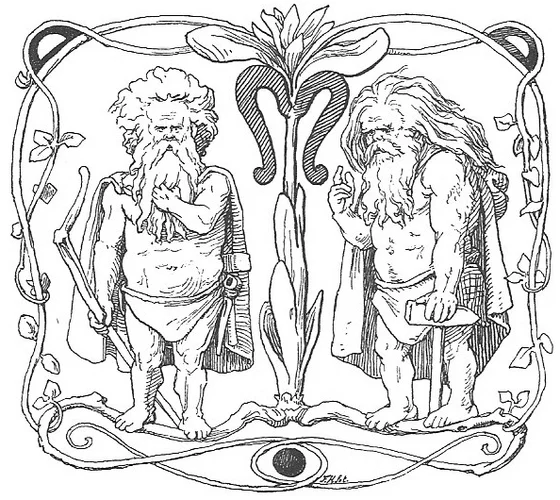
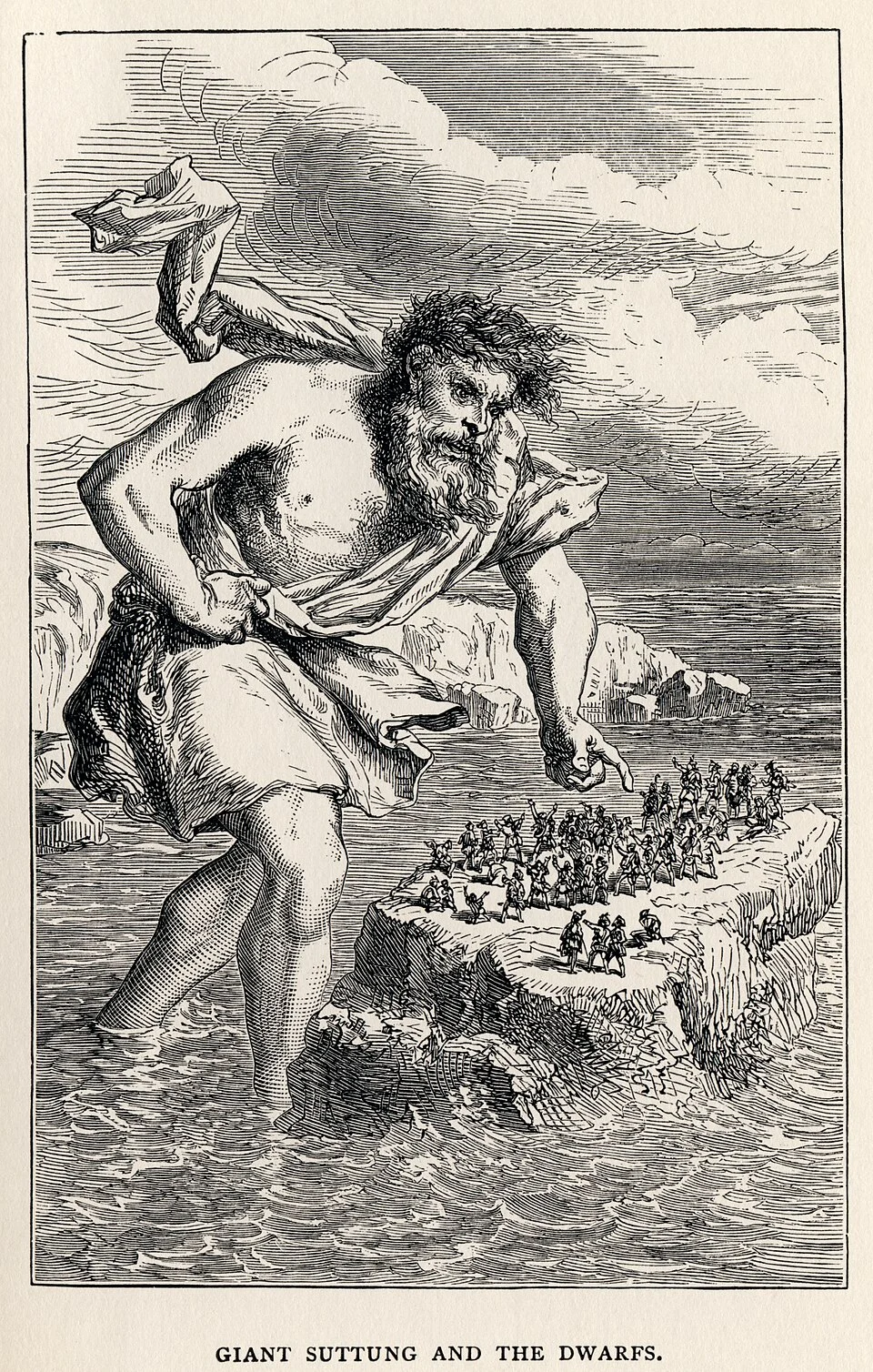
In the prose account, the dwarfs Fjalar and Galar kill Suttungr's father Gilling and then his mother. Suttungr takes the dwarfs out to an island that will flood at high tide. To save themselves, they offer the mead made from Kvasir's blood and honey. Suttungr accepts, stores it at Hnitbjörg and places his daughter Gunnlöð in charge of guarding it.
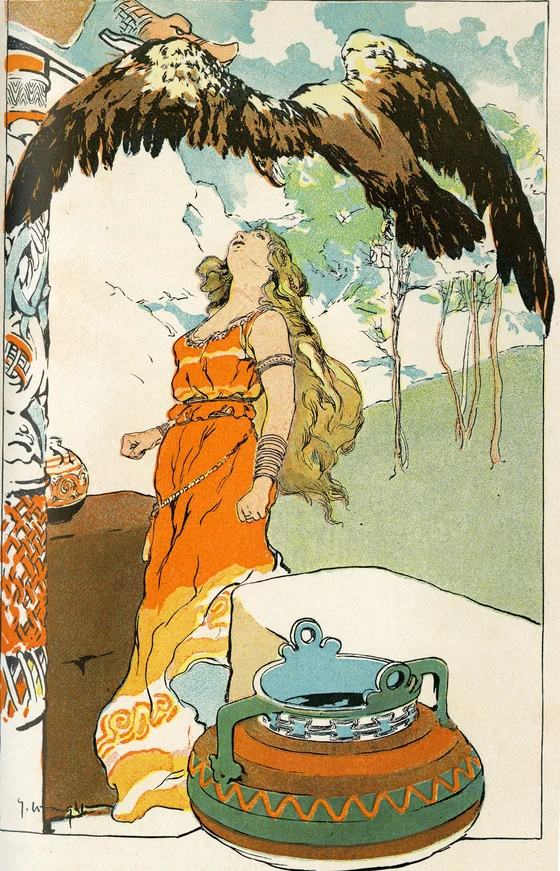
Odin works for Suttungr's brother Baugi and asks for access to the mead, but Suttungr refuses. Odin subsequently enters the mountain in serpent form, obtains the drink and leaves as an eagle. Suttungr likewise becomes an eagle and nearly catches him before the gods receive the stolen mead. Odin spits the recovered drink into the gods' waiting jars, but some escapes backwards during the close pursuit: Brage calls that unguarded portion the share of lesser poets. The prose frame explains names for poetry including Kvasir's blood, the dwarfs' ransom, Suttungr's mead and Odin's gift.
Origins & earliest records
The selected narrative belongs to the medieval Prose Edda's Skáldskaparmál material, traditionally associated with Snorri Sturluson. It is inspected through Rasmus B. Anderson's 1901 edition of his earlier translation. These are textual and edition contexts, not a claim that the story began when it was written down.
Records & interpretation
The selected translation explicitly supplies the compensation bargain, guarded mountain and eagle pursuit. It is a primary literary witness to a medieval account and its poetic terminology. The transformation is narrated, not a zoological observation, and the edition provides no specimen or evidence for a race of eagle-bodied animals.
In the literature
“he also took on the shape of an eagle”
Brage’s Talk, chapter IV, §§4–5; printed p. 164 · Rasmus B. Anderson
Suttung pursues Odin after the theft of the mead.
Selected bibliography
Documented works and useful reading. This is not a list of every appearance.
- 01
The Younger Edda
Brage's Talk, chapter IV, §§4–5, printed pp. 161–165: Suttung's mead and pursuit.
- 02
The Younger Edda — Brage’s Talk, chapter IV, §§4–5
Chicago: Scott, Foresman and Company, 1901 selected edition; translation copyright 1879 and preface September 1879 appear in the inspected text. Rasmus B. Anderson’s English translation of the medieval Prose Edda, traditionally associated with Snorri Sturluson. The edition preserves different spelling conventions and has its own chapter and numbered-section sequence.
Family, evolution & connections
Gilling
The mead episode explicitly calls Suttungr the son of Gilling. The dwarfs’ killing of Gilling leads to Suttungr’s demand for compensation; no shared father for every named giant is inferred.
Gunnlöð
Suttungr explicitly appoints his daughter Gunnlöð to guard the mead at Hnitbjörg. Her mother is not supplied in this passage, so the relation records only the named father and daughter.
Baugi
Odin seeks lodging and work with Baugi, explicitly called Suttungr’s brother. Gilling is named as Suttungr’s father, but this alone does not establish Baugi’s father.
Located primary passages
Specific passages supporting details in this entry, grouped by their published witness.
The Younger Edda — Brage’s Talk, chapter IV, §§4–5
Chicago: Scott, Foresman and Company, 1901 selected edition; translation copyright 1879 and preface September 1879 appear in the inspected text. Rasmus B. Anderson’s English translation of the medieval Prose Edda, traditionally associated with Snorri Sturluson. The edition preserves different spelling conventions and has its own chapter and numbered-section sequence.
- Suttung avenges the dwarfs’ killing of Gilling and his wife by marooning them on a tide-covered rock; they buy their lives with the poetic mead, which he stores under Gunlad’s guard.
Brage’s Talk, chapter IV, §§4–5; §4, pp. 161–162; vengeance and ransom
- Odin works for Bauge under the name Bolverk, but Suttung refuses even a drop. After testing Bauge’s drilled hole, Odin enters as a serpent and obtains Gunlad’s three draughts.
Brage’s Talk, chapter IV, §§4–5; §5, pp. 162–164; refused payment and entry into the rock
- Odin empties the three mead vessels and escapes as an eagle. Suttung follows in eagle shape, but Odin reaches Asgard and distributes the recovered mead to gods and poets, with spilled residue attributed to poetasters.
Brage’s Talk, chapter IV, §§4–5; §5, p. 164; eagle pursuit and distribution
Complete selected prose episodes read; quoted poetic extracts inspected but not used to invent earliest dates or a modern standardized taxonomy. Section numbers belong to this 1901 translation and can differ from other editions. Translator’s introductory racial and theological interpretations are not treated as source narrative.
References
Sources supporting this profile. Linked pages have their own scope and editorial standards.
- Primary textAnderson: The Younger Edda, Suttung episodeResearch access: 2026-10-05
Image credits
Historical illustrationSuttungr
Named historical illustration to the exact Northern tale, credited through its published source and Commons public-domain declaration. Later artistic representation, not universal traditional anatomy.