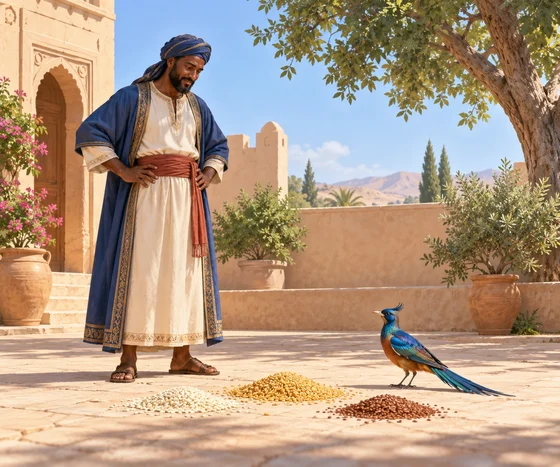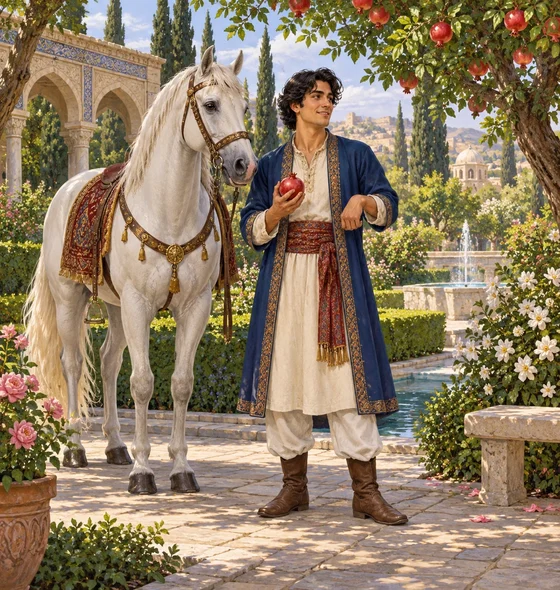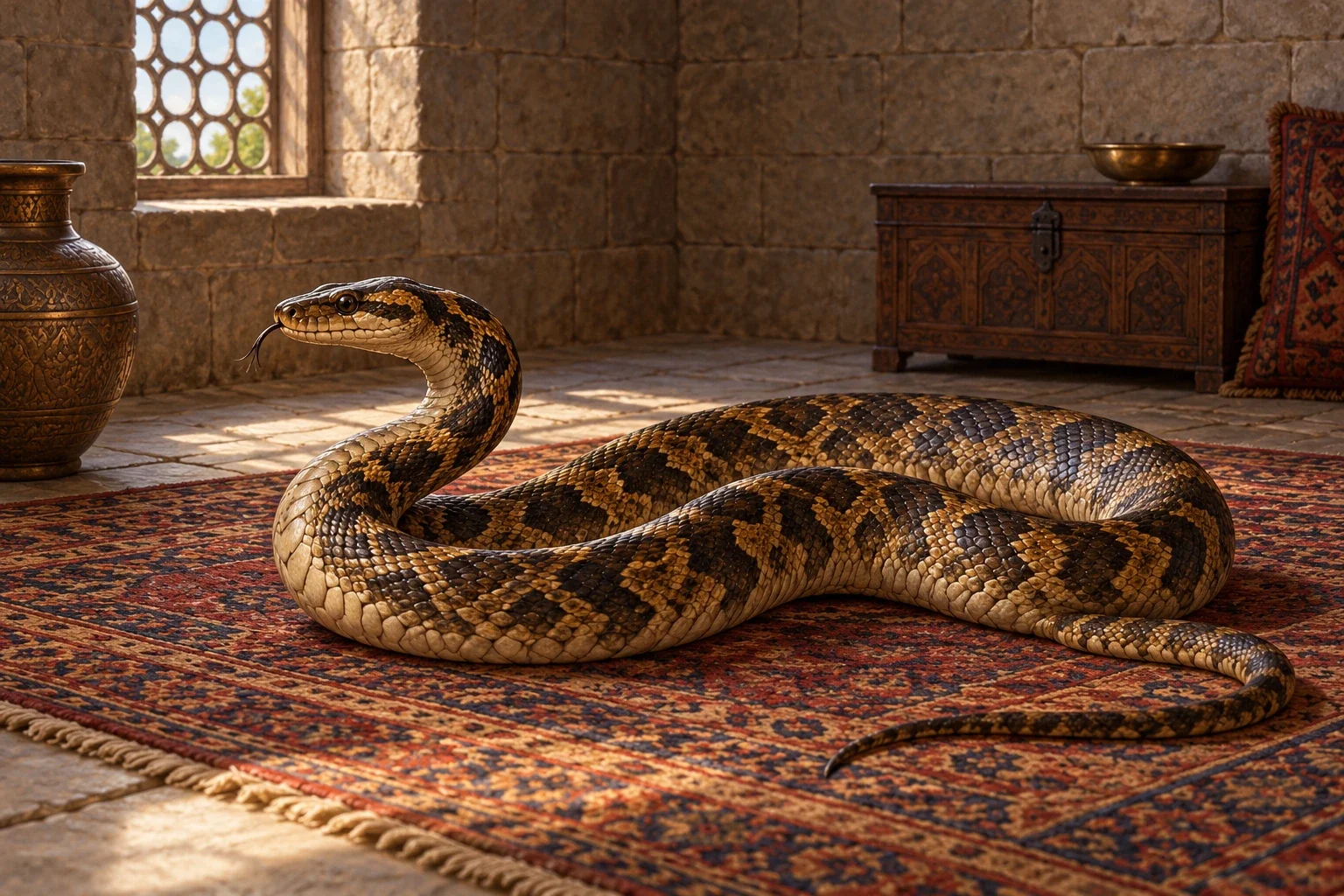
AI-generated interpretation of the serpent form in the Stigands’ selected Swahili tale. Colour, pattern and domestic furnishings are editorial choices; no snake species or authenticated setting is asserted.
Generic narrative interpretation; no authenticated ethnographic portrait, national costume or snake species.
Overview
A childless Sultan and his Wazir travel for three years seeking help. An aged woman enters a lake and returns with two slimy roots as charms. She promises that their wishes are already fulfilled at home, provided they keep the matter private and neither chirrup nor look back on the journey. The Sultan chirrups sceptically. After their month-long return, the Wazir finds a beautiful boy, while the Sultan finds a snake. He orders it discarded. Mizi, an enslaved girl in the palace, instead asks to raise it as her own child and initially carries it around her neck.
The growing snake fills the grass hut that Mizi obtains for their household. He then requests a seven-storey stone house and insists that its unafraid builders receive the wages they ask. Later he asks for a learned teacher willing to come without fear. When others refuse, one sage reasons that Mizi’s safety shows that he need not be eaten. The snake also requests a wife who comes voluntarily and receives the money she asks. The youngest of a poor man’s seven daughters agrees, referring to their poverty and expecting to be eaten. The narrative’s stated willingness therefore sits alongside her expressed desperation.
At midnight the snake leaves his skin and appears as a handsome Arab youth. He washes, prays, reads the Koran and admires his sleeping wife before returning to the skin. After seven nights, Mizi uses a thread tied to the wife’s thumb to wake her and reveal the human form. The two arrange a pit filled with firewood and oil and, while he is washing, drag the heavy cast skin into it and burn it. He protests at the destruction of what he calls his clothes and collapses. The following day he recovers; the narrator explains that he had not known the world outside his skin.
He asks his father to make an offering, but the Sultan still refuses to believe Mizi and assumes that the bride has been eaten. On Friday the youth rides a richly adorned horse to the mosque, where his father eventually recognizes him. A public wedding follows. Mizi remains central to the resolution: the former snake loves her as his mother and, on becoming Sultan, gives the kingdom to her. The closing gift recognizes her care from infancy through his education and adulthood. This selected witness has one heavy cast skin, not the successive layers of other serpent-bridegroom stories.
Origins & earliest records
A selected Swahili tale in the Stigands’ 1914 English collection, translated and arranged by C. H. Stigand and Nancy Yulee Stigand. The foreword describes stories heard in coastal towns and during journeys inland, some told and others overheard, but assigns neither an individual narrator nor a collection site to this tale. Its racial theories and distinctions between Arab and African intelligence are historical editorial claims, not adopted facts. The English arrangement is the inspected witness, not a transcription verified against a Kiswahili original.
Records & interpretation
Complete selected tale and complete foreword in the 1914 historical English collection, pp.83–92; acquired source HTTP 200 on 23 October 2026, exact HTML and selected text cached. No original Kiswahili text, named teller or character illustration inspected.
Selected bibliography
Documented works and useful reading. This is not a list of every appearance.
- 01
Black Tales for White Children
Historical title retained bibliographically. Boston and New York: Houghton Mifflin; first published 1914. Foreword by C. H. Stigand; acknowledges his mother’s arrangement of rhymes. Original language recordings/manuscripts not inspected.
Family & connections
A source-supported family tree or inspiration record has not yet been compiled for this profile. Related reading below indicates a connection in subject matter, not a proven lineage or creative influence.
References
Sources supporting this profile. Linked pages have their own scope and editorial standards.
- Historical English translation and arrangement of Swahili narrativeStigand and Stigand 1914 — complete selected narrative, pp.83–92; forewordResearch access: 2026-10-23
Image credits
AI-generated narrative interpretationAI-generated interpretation of the serpent form in the Stigands’ selected Swahili tale. Colour, pattern and domestic furnishings are editorial choices; no snake species or authenticated setting is asserted.
Generic narrative interpretation; no authenticated ethnographic portrait, national costume or snake species.