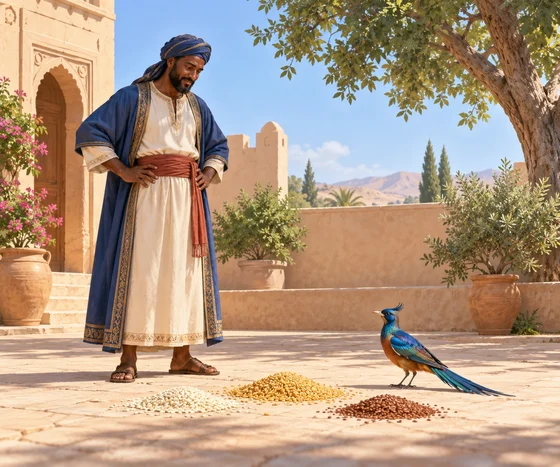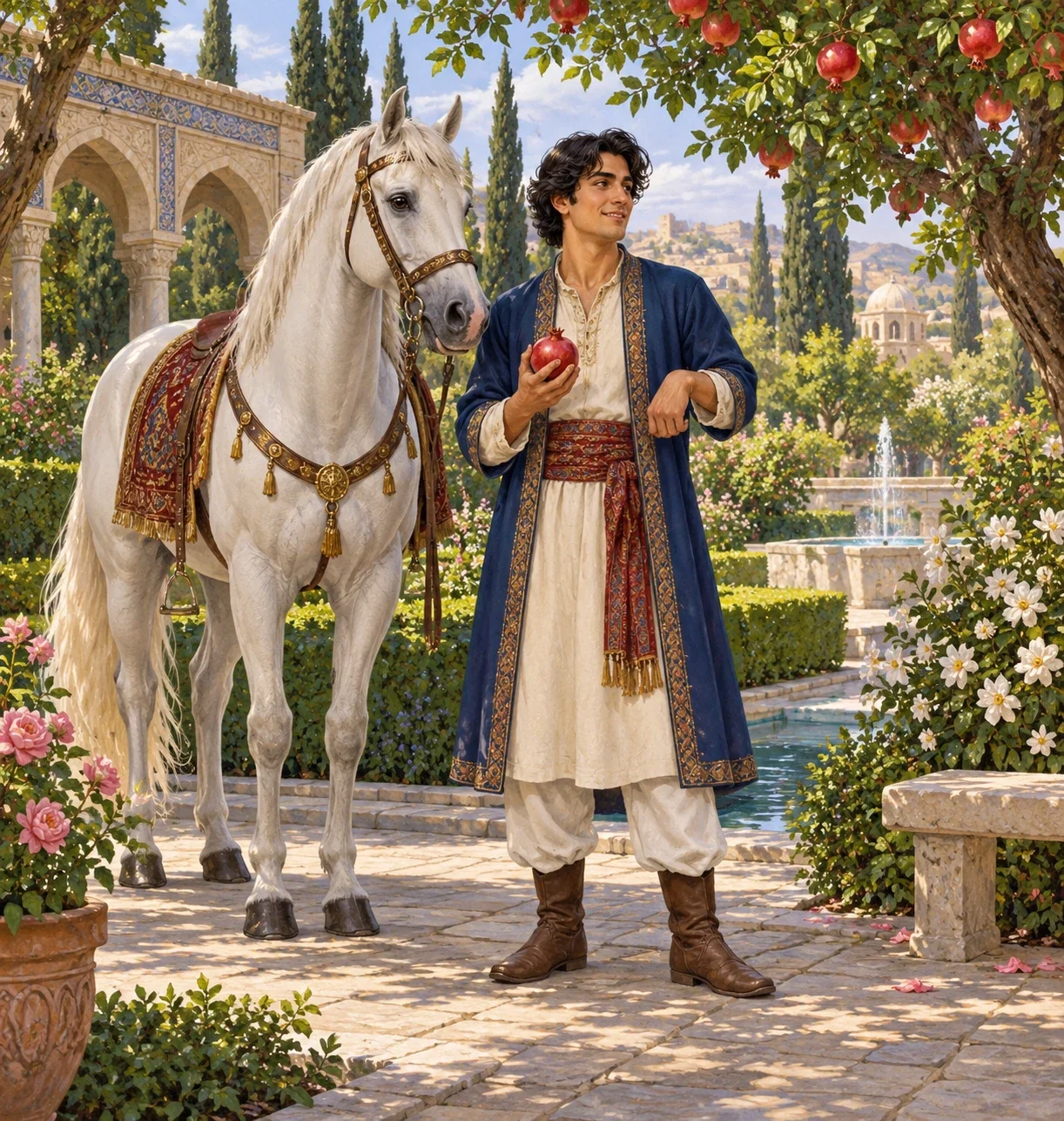
AI-generated interpretation of Ali of the Crooked Arm in the selected Stigand telling.
Human appearance, clothing and setting are editorial interpretations. No ethnographic authentication or source illustration reproduction is claimed.
Overview
Ali is the seventh son of a Wazir, raised and educated alongside the Sultan’s seven sons. The youngest prince, who has one eye, is his close companion. Ali is described as handsome and as having one crooked arm; the one-eyed character is his friend, not Ali. Each youth obtains a white horse. Their mounts leap and soar during a public race. Later the two visit a garden and pocket pomegranates before riding again. The fruit Ali picks contains the Jin of Jehan, who carries children away. Ali’s horse soars beyond his companion’s sight and brings him to the Jin’s house.
The Jin makes Ali tend a large cooking pot and gives him seven keys, permitting access to only one room. When Ali lifts the forbidden pot lid, he discovers human flesh. He accidentally cuts his finger while worrying about his own fate; the Jin later heals that cut. The next absence gives him time to open the rooms. An enormous speaking horse warns that the promised fourteen-day absence is a deception: the Jin will return on the eighth day to eat him. Another room holds seven captive maidens reading their Korans, and others contain fighting swords, treasure, grain, tack and seven bottles.
Following the horse’s instructions, Ali prepares food and water, saddles it and packs treasure and the maidens for flight. They meet the Jin and other demons coming to feast on the eight captives. At successive commands, Ali breaks bottles containing sun, rain, needles, hail, thorns, mud and sea. These obstacles delay but do not initially stop the pursuers. The sea finally drowns some and prevents the others from crossing; the horse carries its passengers safely over. The horse, rather than Ali alone, supplies the warnings and the plan for escape.
Near home, the horse tells Ali to remain silent for seven days and always seek its advice before going out or marrying, because the Jin could seize him again. Ali observes the silence despite his family’s joy. The following festivities mark his return, and he fills ninety-nine storerooms with his riches. He does not marry; he builds a seven-storey house for the rescued women, called his sisters at the ending, who continue reading their Korans. Their biological relationship is not established earlier. Both the Jin and the horse are addressed as father in dialogue; the Wazir is Ali’s stated human father. No healing of the crooked arm is narrated.
Origins & earliest records
One tale in the Stigands’ 1914 English translation and arrangement of Swahili stories. The signed foreword describes tellings heard at different times and places, in coastal towns and during inland journeys. No named teller, precise collection site or tale-specific dialect is assigned here. Its colonial racial hierarchy is editorial framing, not adopted ethnography. No Kiswahili original or recording was inspected.
Records & interpretation
Complete selected tale, pp.122–136, title page and complete signed foreword read from the preserved successful cached witness. No new acquisition or original character illustration inspected.
Selected bibliography
Documented works and useful reading. This is not a list of every appearance.
- 01
Black Tales for White Children
Historical title retained bibliographically; Boston and New York, Houghton Mifflin. Foreword signed C. H. Stigand, who credits his mother with arranging the rhymes.
Family & connections
A source-supported family tree or inspiration record has not yet been compiled for this profile. Related reading below indicates a connection in subject matter, not a proven lineage or creative influence.
References
Sources supporting this profile. Linked pages have their own scope and editorial standards.
- Historical English translation and arrangementStigand and Stigand 1914 — complete tale, pp.122–136; original title and forewordResearch access: 2026-10-23
Image credits
AI-generated contextual narrative interpretationAI-generated interpretation of Ali of the Crooked Arm in the selected Stigand telling.
Human appearance, clothing and setting are editorial interpretations. No ethnographic authentication or source illustration reproduction is claimed.