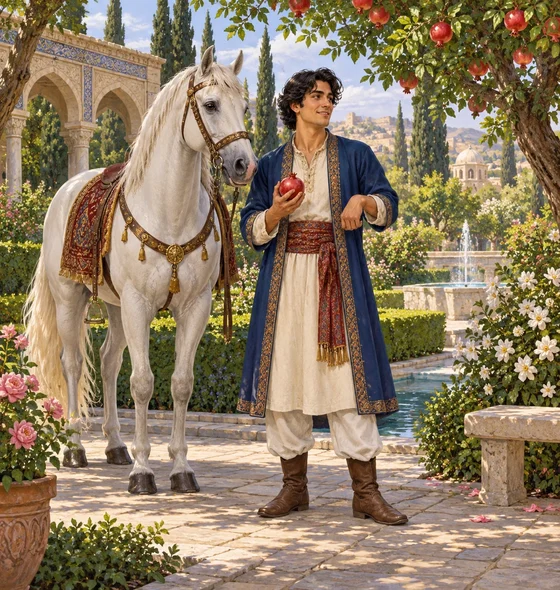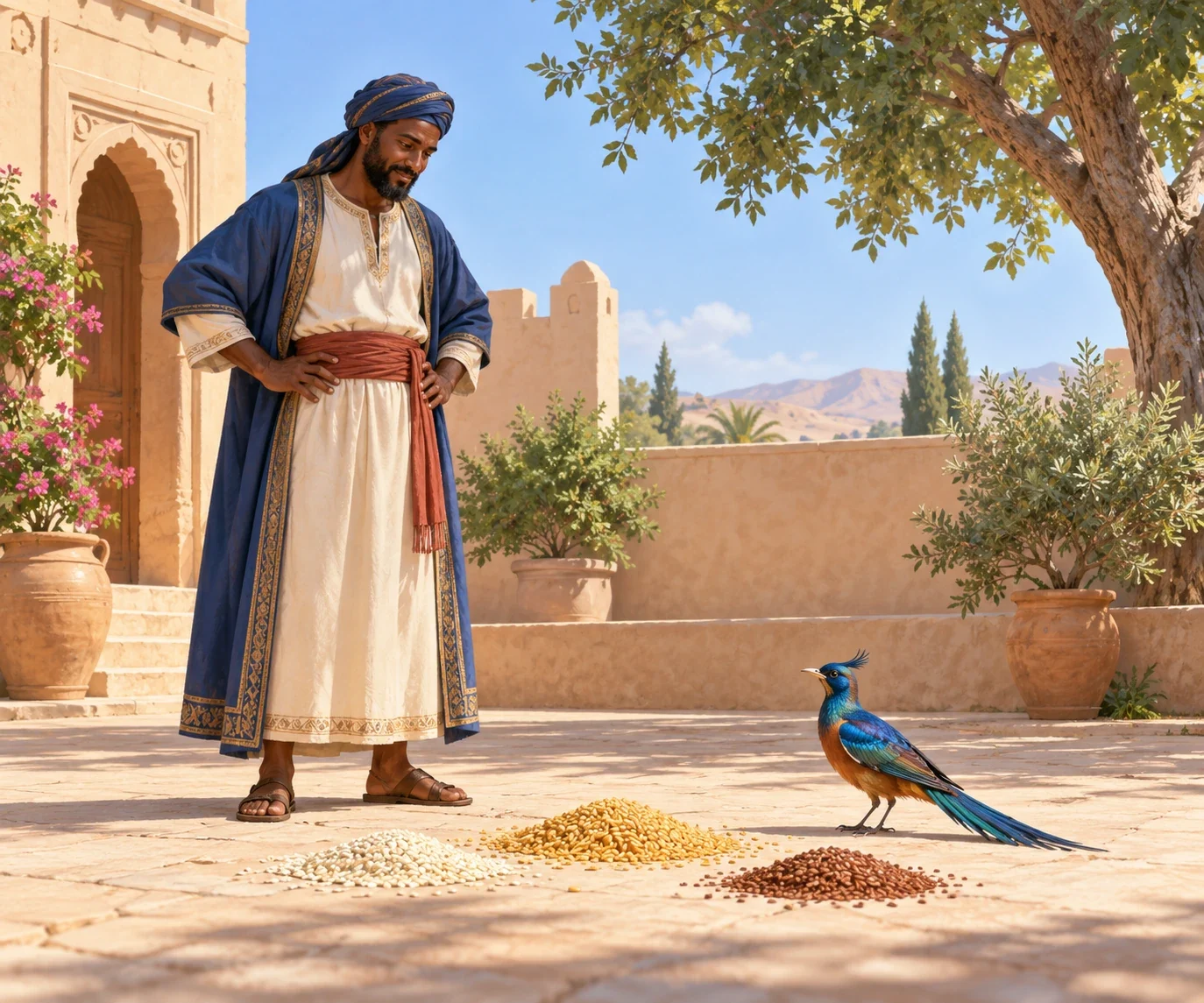
AI-generated interpretation of Kibaraka in the selected Stigand telling.
Human appearance, clothing and setting are editorial interpretations. No ethnographic authentication or source illustration reproduction is claimed.
Overview
Kibaraka begins as an enslaved attendant in a Sultan’s household. While the Sultan and his son Hasani attend noon prayers, the Sultan’s wife sorts stored grain and gives Kibaraka the kinds needing sunlight. He spreads the different grains separately to dry. A beautiful bird arrives, calls him by name and asks, in song, whether it may eat wheat, millet, rape, maize and rice. He gives permission and tells it that his master has gone to the mosque. Before flying away, the bird asks him to convey greetings to the Sultan.
The visits recur. Kibaraka tells Hasani about the bird and its remarkable song. Hasani understands it to be one of the daughters of the Jins and falls in love before seeing it. He declares Kibaraka free and asks him to catch the visitor. The prince then becomes gravely ill with longing. When the bird returns, Kibaraka makes a noose on a thin pole near its favoured millet. One wing catches as it tries to leave. The bird asks him not to injure it and offers a feather to carry to Hasani as its greeting.
Kibaraka brings the feather, but not the bird, to the prince. Addressing him as brother, Hasani asks why he did not catch its owner. Kibaraka explains that its light overwhelmed him: he fell down seven times and lost his wits. The account does not explicitly narrate how the first noose was released. Hasani then persuades the Sultan to stop ordinary work throughout the country until the bird is found. Many people bring attractive birds from their searches, but he rejects them as the wrong one.
The desired visitor finally approaches the court like a dust cloud and returns to the grain. Kibaraka recognizes it, catches it and brings it to Hasani, who sees a beautiful woman. Hasani sends Kibaraka to tell the Sultan that his wish has been fulfilled. Cannons and festivities mark the marriage; the narration extends the celebrations for nine years and ends with two wondrous sons. Kibaraka is the intermediary who reports, traps and finally delivers the bird. He is not the bridegroom, the Sultan’s son or the transforming bird. His freedom is declared before the successful capture, not offered only as a reward at the ending.
Origins & earliest records
One tale in the Stigands’ 1914 English translation and arrangement of Swahili stories. The signed foreword describes tellings heard at different times and places, in coastal towns and during inland journeys. No named teller, precise collection site or tale-specific dialect is assigned here. Its colonial racial hierarchy is editorial framing, not adopted ethnography. No Kiswahili original or recording was inspected.
Records & interpretation
Complete selected tale, pp.66–71, title page and complete signed foreword read from the preserved successful cached witness. No new acquisition or original character illustration inspected.
Selected bibliography
Documented works and useful reading. This is not a list of every appearance.
- 01
Black Tales for White Children
Historical title retained bibliographically; Boston and New York, Houghton Mifflin. Foreword signed C. H. Stigand, who credits his mother with arranging the rhymes.
Family & connections
A source-supported family tree or inspiration record has not yet been compiled for this profile. Related reading below indicates a connection in subject matter, not a proven lineage or creative influence.
References
Sources supporting this profile. Linked pages have their own scope and editorial standards.
- Historical English translation and arrangementStigand and Stigand 1914 — complete tale, pp.66–71; original title and forewordResearch access: 2026-10-23
Image credits
AI-generated contextual narrative interpretationAI-generated interpretation of Kibaraka in the selected Stigand telling.
Human appearance, clothing and setting are editorial interpretations. No ethnographic authentication or source illustration reproduction is claimed.