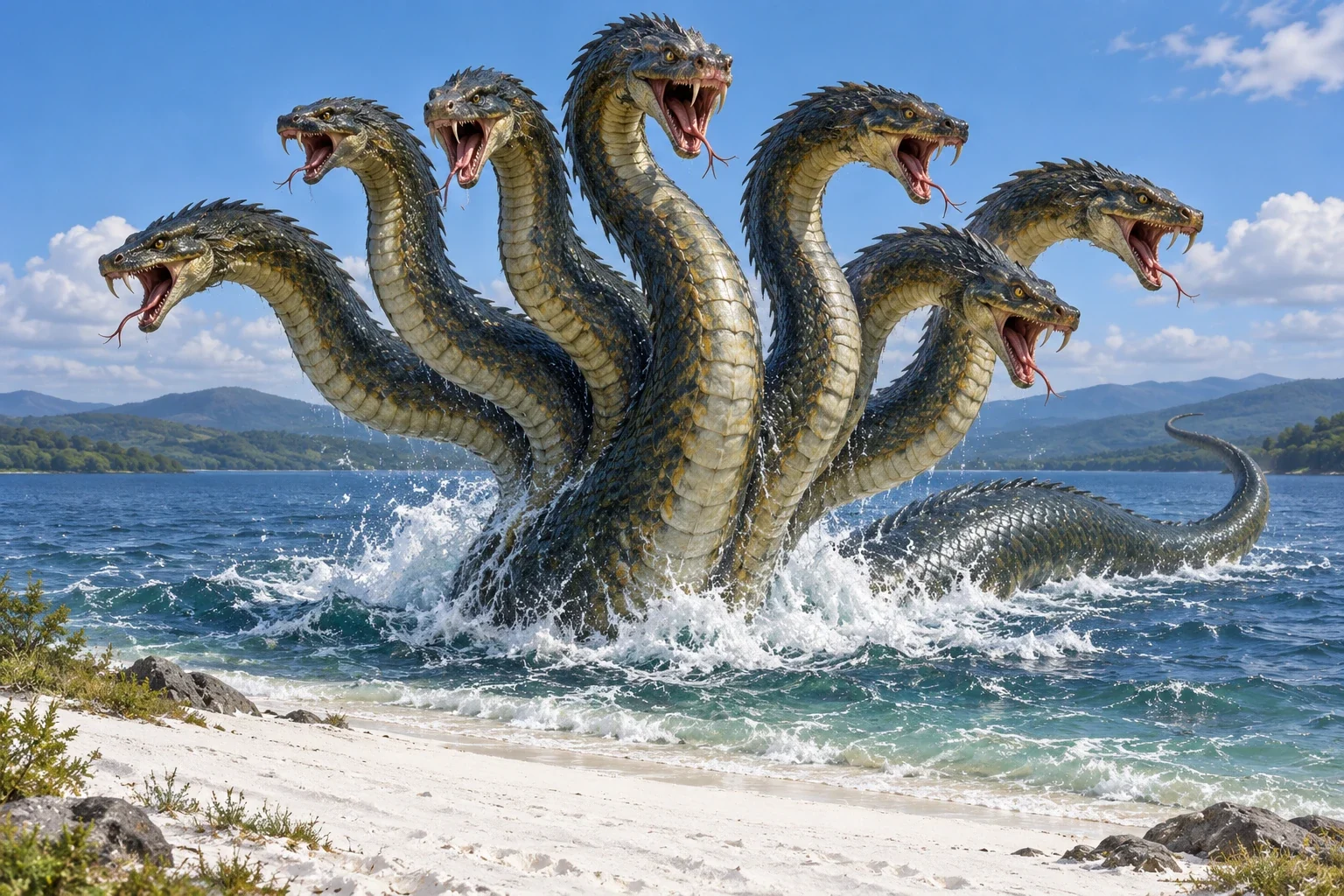
AI-generated narrative interpretation of Pemba Muhori: a seven-headed serpent emerging from a lake beside white sand.
Interpretation of the Stigands’ 1914 English arrangement. Appearance and scene details are editorial choices, not authenticated ethnographic evidence or a copy of Hargrave’s illustrations.
Overview
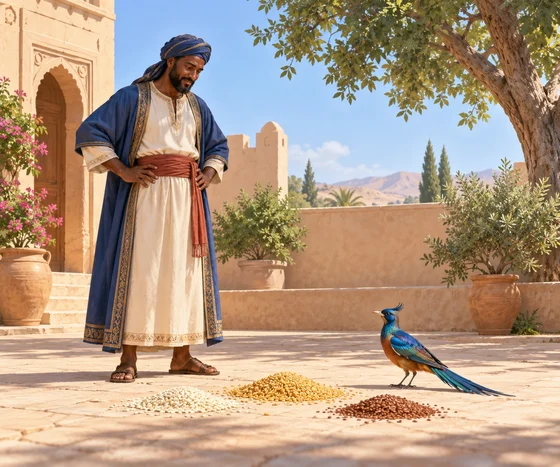
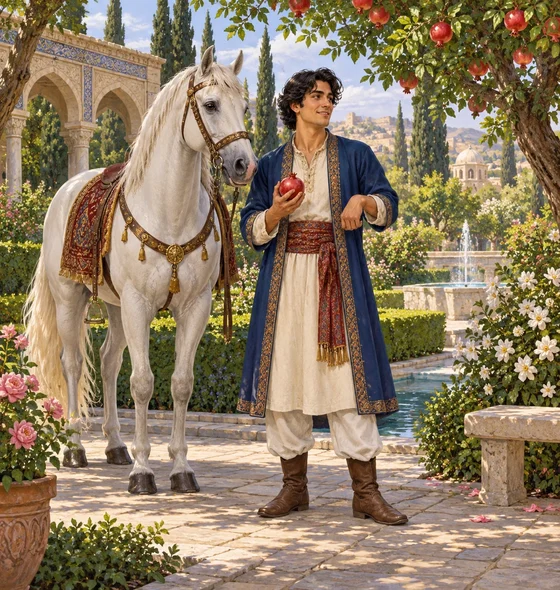
Pemba Muhori is called a great sea serpent when Hapendeki’s wife demands clothing made from its skin. Yet the encounter itself takes place in an enormous lake, reached after seven months of travel past successively larger lakes. Hapendeki is the youngest of seven brothers. He marries against his family’s advice, and his wife rejects both the best clothes available locally and costly garments he brings from Maskat. Her demand for the serpent’s skin sends him away with a sword, seven loaves, seven cigarettes and seven matches.
At each lake he eats a loaf and calls the serpent by name in a repeated song. The first six lakes give no answer. At the seventh, bordered by white sand, his final match goes out and he throws it into the water. After his song there is a thunder-like noise, foaming waves run towards the shores, and Pemba Muhori appears with seven heads. The serpent speaks, first demanding who has used its name and then belittling Hapendeki as too small for a mouthful. It also asks what witchcraft makes so small an opponent think he can kill it.
Hapendeki cuts off the heads one after another as the serpent repeatedly attacks. Once the seventh head is severed, its body twists and lashes its tail so violently that mountains fall into the lake and waves tear at the hillsides. When the water is still, Hapendeki gathers the heavy heads. On lifting the last one, he suddenly finds that he is already home. The narrative describes this abrupt return without explaining a mechanism; he attributes his arrival to God’s grace. Although the wife requested skin, the account brings back seven heads rather than describing a completed garment.
The tale continues beyond the serpent’s death. Hapendeki sets his wife a reciprocal impossible errand for water untouched by frogs, rescues her from a demon, and strikes her to dislodge a magically stuck water jar. She complains to the Sultan. Asked to substantiate his account, Hapendeki displays the serpent’s heads on the seven-storey palace, one on its roof and one at each storey. Their glittering appearance provokes astonishment, and the Sultan gives him his daughter in marriage. The narrative’s approval of the husband and its domestic violence belong to this telling; they are not advice or evidence of a universal Swahili social rule.
Origins & earliest records
A selected Swahili tale in the Stigands’ 1914 English collection. Its title page credits C. H. Stigand and Mrs C. H. Stigand as translators and arrangers. The foreword describes stories told in coastal towns and heard during inland journeys but gives this tale no named narrator, collection site or dialect. Its racial theories are historical editorial claims, not adopted facts. This English arrangement is the inspected witness; no Kiswahili original or performance recording was inspected.
Records & interpretation
Complete selected tale, pp.7–21, title page and complete foreword in the cached 1914 historical English collection. Reused successful prior acquisition without another request. No tale-specific original illustration inspected.
Selected bibliography
Documented works and useful reading. This is not a list of every appearance.
- 01
Black Tales for White Children
Historical title retained bibliographically. Boston and New York: Houghton Mifflin; first published 1914. Foreword by C. H. Stigand; acknowledges his mother’s arrangement of rhymes. Original language recordings/manuscripts not inspected.
Family & connections
A source-supported family tree or inspiration record has not yet been compiled for this profile. Related reading below indicates a connection in subject matter, not a proven lineage or creative influence.
References
Sources supporting this profile. Linked pages have their own scope and editorial standards.
- Historical English translation and arrangement of Swahili narrativeStigand and Stigand 1914 — complete selected narrative, pp.7–21; original title page and forewordResearch access: 2026-10-23
Image credits
AI-generated interpretation of a selected historical Swahili taleAI-generated narrative interpretation of Pemba Muhori: a seven-headed serpent emerging from a lake beside white sand.
Interpretation of the Stigands’ 1914 English arrangement. Appearance and scene details are editorial choices, not authenticated ethnographic evidence or a copy of Hargrave’s illustrations.