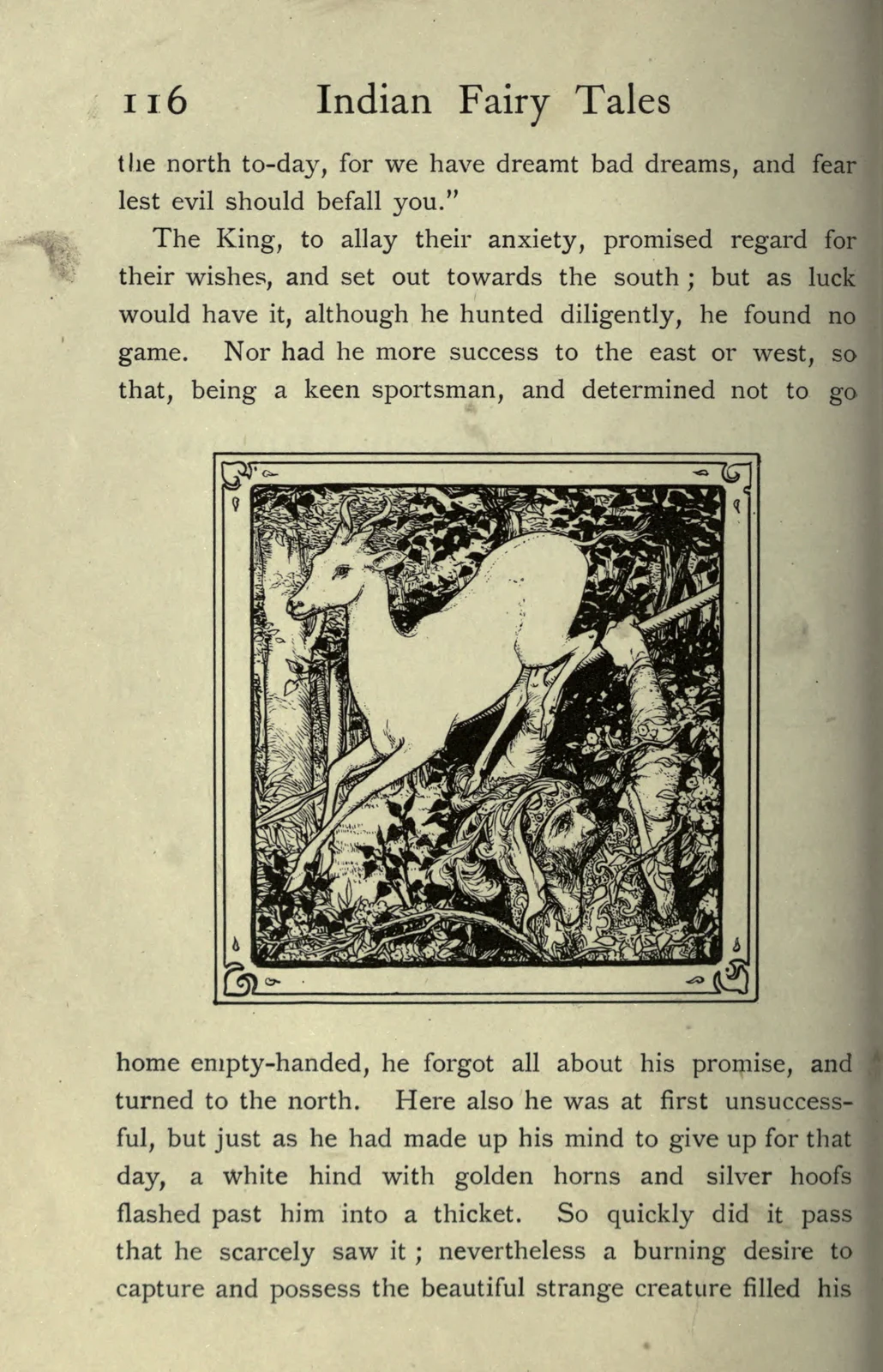
Batten: the white hind leaps above the hunter in The Son of Seven Queens
The white hind leaps above the hunter in Batten’s illustration for Jacobs’s 1892 adaptation of Steel and Temple’s tale. The adjacent text describes golden horns and silver hoofs, qualities not demonstrated by this monochrome print.
Overview
A white hind with golden horns and silver hoofs lures a king away from his hunting party. At a secluded hut he recognizes the same creature as a beautiful woman with pale skin and golden hair. She demands the eyes of his seven pregnant wives before accepting marriage; bewitched by her beauty, he blinds and imprisons them. She threads the fourteen eyes into a necklace for her own mother.
When the surviving son of the youngest queen appears, she recognizes him by witchcraft and tries three times to send him to his death through messages written on potsherds. His clever intended bride substitutes helpful instructions, turning the quests into recoveries of the eyes, a miraculous cow and multiplying rice. The bride finally exposes the deception to the king, who orders the white hind’s death. Temple records dâyan as the word used for witch; his general discussion of heart-removing spells does not mean that this character performs one.
Origins & earliest records
Punjabi storytelling collected and adapted in colonial British India
Records & interpretation
Complete named tale and Temple’s corresponding notes read; university-hosted 1894 text compared in full.
Selected bibliography
Documented works and useful reading. This is not a list of every appearance.
- 01
Tales of the Punjab, Told by the People
The Son of Seven Mothers and corresponding Temple notes; illustrations J. Lockwood Kipling
Family, evolution & connections
The white-hind witch and her mother
The Son of Seven Mothers in Steel’s 1894 collection.
Scroll sideways to see all branches. With a keyboard, focus the tree and use the arrow keys.
Explicit childbirth, kinship and family recognition in the named tale. Distinct from Day’s related Rakshasi tale. The hero’s blood revived by the old witch does not make her his biological mother.
Unnamed king in The Son of Seven Mothers
The witch in white-hind form becomes the king’s bride after demanding his seven wives’ eyes. This marriage is distinct from her own mother–daughter relationship.
Primary records and illustrations
Flora Annie Steel, Tales of the Punjab, Told by the People (Macmillan, 1894); R. C. Temple notes
The Son of Seven Mothers. Complete tale and titled notes; Gutenberg id00496/id01684; UPenn punjab-10
Complete tale and all corresponding Temple notes read. Full 1894 UPenn comparison exceeds 98% token overlap; every remaining difference inspected. Narrated events, family relationships and landscape personification distinguished from comparative commentary.
References
Sources supporting this profile. Linked pages have their own scope and editorial standards.
- Historical collected folktaleSteel, The Son of Seven Mothers, complete narrativeResearch access: 2026-10-05
- Collector’s linguistic and comparative notesTemple, Notes to The Son of Seven MothersResearch access: 2026-10-05
- University-hosted historical primary textUniversity of Pennsylvania, 1894 edition transcriptionResearch access: 2026-10-05
Image credits
Historical illustrationBatten: the white hind leaps above the hunter in The Son of Seven Queens
The white hind leaps above the hunter in Batten’s illustration for Jacobs’s 1892 adaptation of Steel and Temple’s tale. The adjacent text describes golden horns and silver hoofs, qualities not demonstrated by this monochrome print.