A sourced illustration has not yet been added. This gap is included in the coverage record.
Overview
The white hind gives her mother a necklace made from the eyes of seven blinded queens. When their surviving son arrives with a message altered by his future bride, the old woman reluctantly surrenders the necklace, admitting she has eaten one eye. Thirteen remain to restore the queens’ sight, leaving the youngest with one.
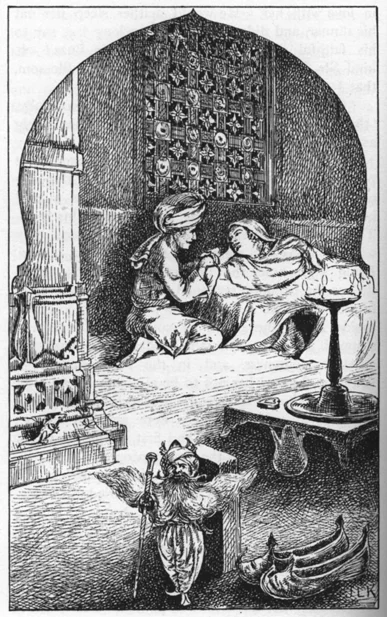
Two further substituted messages force her to explain how to obtain a prodigiously milking cow and miraculous rice. When the boy looks back after plucking the rice and becomes ashes, she fears the instruction making his blood as her own. She mixes his ashes with water, shapes them into a man, places a drop of blood from her little finger in his mouth and blows on him; he immediately revives. Her daughter is eventually executed, but the tale gives no corresponding ending for the mother.
Origins & earliest records
Punjabi storytelling collected and adapted in colonial British India
Records & interpretation
Complete named tale and Temple’s corresponding notes read; university-hosted 1894 text compared in full.
Selected bibliography
Documented works and useful reading. This is not a list of every appearance.
- 01
Tales of the Punjab, Told by the People
The Son of Seven Mothers and corresponding Temple notes; illustrations J. Lockwood Kipling
Family, evolution & connections
The white-hind witch and her mother
The Son of Seven Mothers in Steel’s 1894 collection.
Scroll sideways to see all branches. With a keyboard, focus the tree and use the arrow keys.
Explicit childbirth, kinship and family recognition in the named tale. Distinct from Day’s related Rakshasi tale. The hero’s blood revived by the old witch does not make her his biological mother.
White hind witch in The Son of Seven Mothers
The old woman calls her daughter from the hut; the white-hind witch later gives her mother the stolen eyes. Later written messages repeatedly identify the same mother.
Primary records and illustrations
Flora Annie Steel, Tales of the Punjab, Told by the People (Macmillan, 1894); R. C. Temple notes
The Son of Seven Mothers. Complete tale and titled notes; Gutenberg id00496/id01684; UPenn punjab-10
Complete tale and all corresponding Temple notes read. Full 1894 UPenn comparison exceeds 98% token overlap; every remaining difference inspected. Narrated events, family relationships and landscape personification distinguished from comparative commentary.
References
Sources supporting this profile. Linked pages have their own scope and editorial standards.
- Historical collected folktaleSteel, The Son of Seven Mothers, complete narrativeResearch access: 2026-10-05
- Collector’s linguistic and comparative notesTemple, Notes to The Son of Seven MothersResearch access: 2026-10-05
- University-hosted historical primary textUniversity of Pennsylvania, 1894 edition transcriptionResearch access: 2026-10-05
Image credits
A sourced illustration has not yet been added. This gap is included in the coverage record.