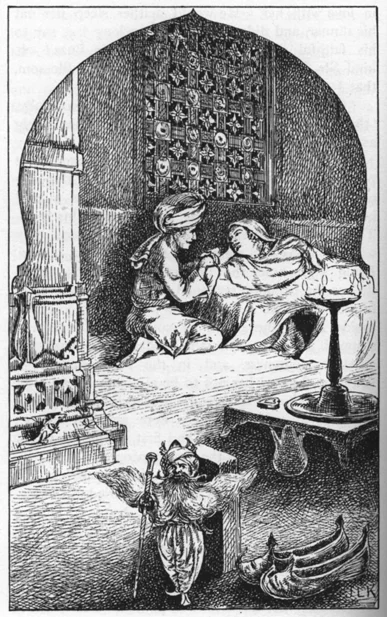
Kipling’s tiny Sir Buzz keeping guard while Princess Blossom meets the soldier’s son, 1894
The tiny bearded helper stands below the bed with wings and a weapon while the princess speaks with the soldier’s son. Wings, turban and costume are Kipling’s pictorial treatment of the flying helper.
Overview
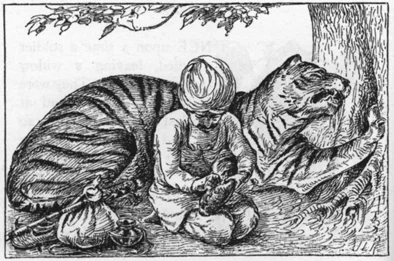
Temple’s note gives Mîyân Bhûngâ as the Punjabi name translated Sir Buzz, explaining it as Sir Beetle or Sir Bee. The little bearded man emerges from a box given by a grateful tigress. Steel’s narrative makes him one span high with a longer beard; the note says the original measure was hâth, the forearm measure, conventionally eighteen inches. He flies with a buzzing sound, carries enormous loads and eats far more than his human master.
He carries a soldier’s son to Princess Blossom, moves their whole bed to a garden and uses an uprooted tree to hold off pursuers. The tree is a weapon in his hands, not an independently fighting tree. Before departing he leaves a beard hair whose burning will summon him.
Called back against a man-eating ghûl, he counters its rain form as a storm wind, its dove form as a hawk, and follows its rose form to Indra’s court. As an old musician he earns the rose as a reward; when an escaping petal becomes a mouse, he turns into a cat and eats it. He then carries the lovers and the ghûl’s treasure safely home and disappears. The insectlike name and buzzing flight do not establish an insect body.
Origins & earliest records
Punjabi storytelling collected and adapted in colonial British India
Records & interpretation
Complete Sir Buzz and Temple’s named notes read; full preface read;1894 university-hosted text compared with Gutenberg.
Selected bibliography
Documented works and useful reading. This is not a list of every appearance.
- 01
Tales of the Punjab, Told by the People
Sir Buzz, opening tale; corresponding titled notes; illustrationsJ.LockwoodKipling
Family & connections
A source-supported family tree or inspiration record has not yet been compiled for this profile. Related reading below indicates a connection in subject matter, not a proven lineage or creative influence.
Primary records and illustrations
Flora Annie Steel, Tales of the Punjab, Told by the People (Macmillan,1894); R.C.Temple notes
Sir Buzz. Complete opening tale and titled Sir Buzz notes; Gutenberg anchorsid00028/id01612; UPenn1-1
Complete tale and fullnotes read, plus fullpreface and ToTheLittleReader.1894 title/credits verified in UPenn transcription; token comparison of entire SirBuzz with Gutenberg showed98.8% overlap, remaining spelling/punctuation/OCR/illustration-caption differences inspected. Punjabi names and ghul/bhut distinctions from Temple’s notes, no invented original script.
References
Sources supporting this profile. Linked pages have their own scope and editorial standards.
- Historical collected folktaleSteel, Sir Buzz, complete narrativeResearch access: 2026-10-05
- Collector’s linguistic and comparative notesTemple, Notes to Sir BuzzResearch access: 2026-10-05
- University-hosted historical primary textUniversity of Pennsylvania,1894 edition transcriptionResearch access: 2026-10-05
Image credits
Historical illustrationKipling’s tiny Sir Buzz keeping guard while Princess Blossom meets the soldier’s son, 1894
The tiny bearded helper stands below the bed with wings and a weapon while the princess speaks with the soldier’s son. Wings, turban and costume are Kipling’s pictorial treatment of the flying helper.