A sourced illustration has not yet been added. This gap is included in the coverage record.
Overview
A poor Brahman brings home an aubergine plant, and its great fruit eventually yields a beautiful girl dressed in purple and white. He and his wife adopt her and call her Princess Aubergine. The jealous queen who later befriends her recognizes that she is a fairy rather than an ordinary human girl. Temple supplies Baingan Bâdshâhzâdî as her name; the title does not establish royal biological parents.
The queen repeatedly puts her under spells to discover where her life is kept. After seven misleading answers bring about the deaths of the queen’s seven sons, the strongest spell reveals a red-and-green fish in a distant river, a bumblebee inside the fish, a box inside the bee, and a nine-lakh necklace in the box. When the queen wears that necklace, Aubergine dies. Temple explains its name as an immensely valuable necklace, not one with nine strands.
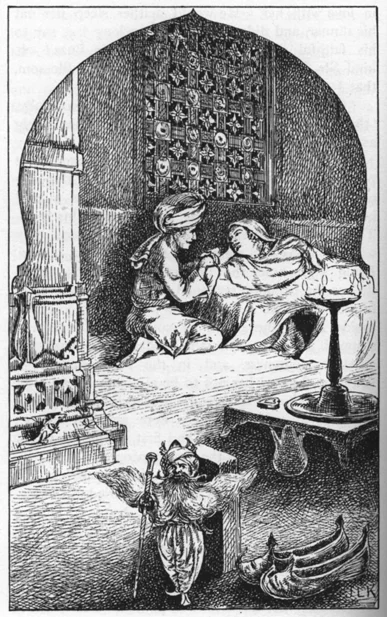
Having instructed her foster parents to leave her flower-covered body in a walled wilderness enclosure, Aubergine revives each night when the queen removes the necklace and dies again each morning. A king visits her during the day; a boy appears whom she identifies as his son. The child ultimately recovers the necklace and places it on her, ending the repeated deaths. Before marrying the king she demands that the murderous queen be buried alive among snakes and scorpions. These severe acts belong to this particular fairy heroine’s story.
Origins & earliest records
Punjabi storytelling collected and adapted in colonial British India
Records & interpretation
Complete named tale and Temple’s corresponding notes read; university-hosted 1894 text compared in full.
Selected bibliography
Documented works and useful reading. This is not a list of every appearance.
- 01
Tales of the Punjab, Told by the People
Princess Aubergine and corresponding notes; J. Lockwood Kipling illustrations
Family & connections
A source-supported family tree or inspiration record has not yet been compiled for this profile. Related reading below indicates a connection in subject matter, not a proven lineage or creative influence.
Primary records and illustrations
Flora Annie Steel, Tales of the Punjab, Told by the People (Macmillan, 1894); R. C. Temple notes
Princess Aubergine. Complete tale and titled notes; Gutenberg anchors id00422/id01678; UPenn punjab-8
Complete narrative and corresponding notes read, with collection preface already read. Entire tale compared with UPenn 1894 transcription: over 99% token overlap; remaining punctuation, OCR and heading differences inspected. Fairy external life and Pepperina’s one-soul bird pair retained as separate story mechanisms.
References
Sources supporting this profile. Linked pages have their own scope and editorial standards.
- Historical collected folktaleSteel, Princess Aubergine, complete narrativeResearch access: 2026-10-05
- Collector’s linguistic and comparative notesTemple, Notes to Princess AubergineResearch access: 2026-10-05
- University-hosted historical primary textUniversity of Pennsylvania, 1894 edition transcriptionResearch access: 2026-10-05
Image credits
A sourced illustration has not yet been added. This gap is included in the coverage record.