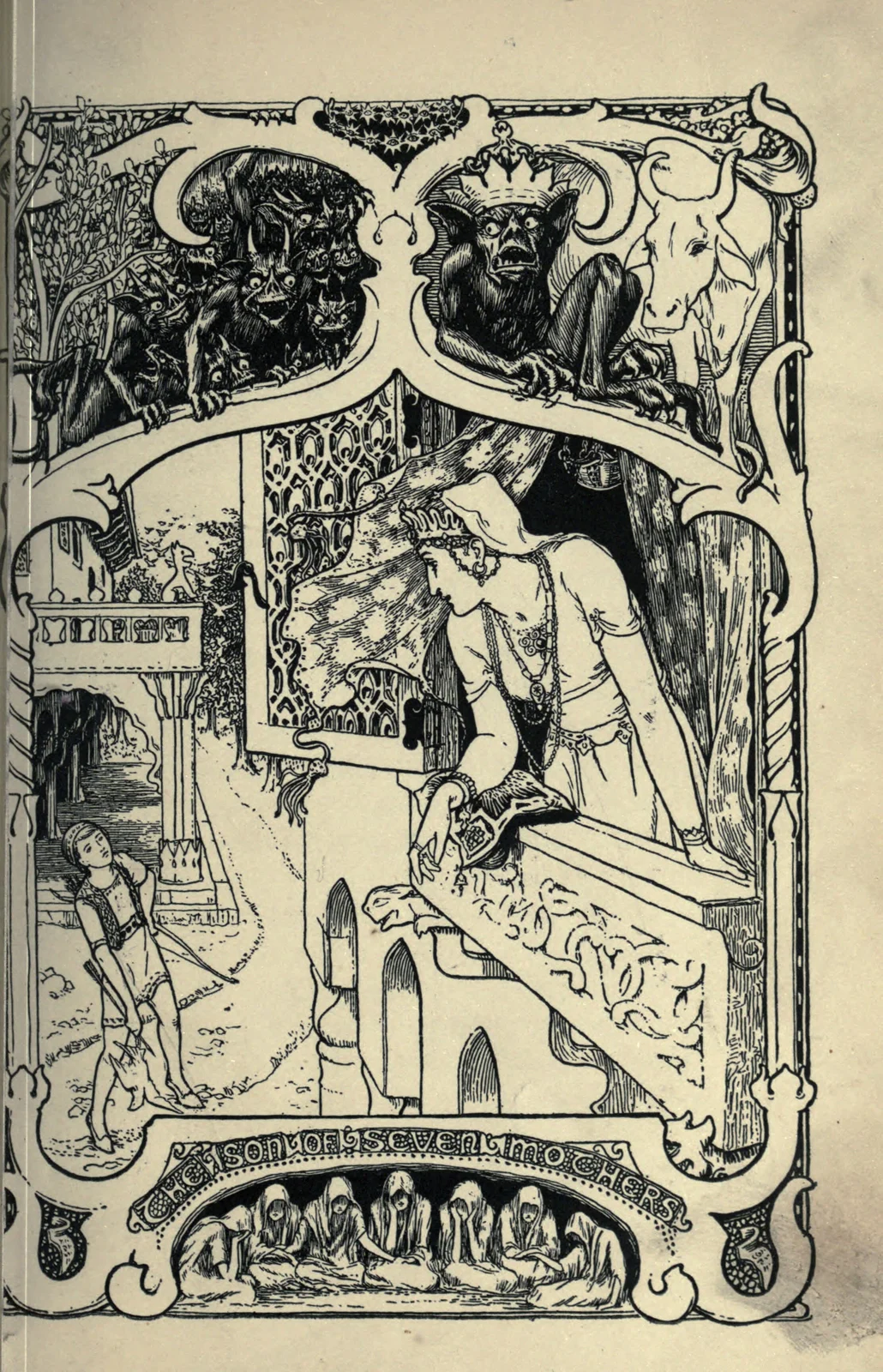
Batten: the son of seven mothers below the witch’s window
The boy appears at lower left beneath the white-hind witch’s window. Batten combines several parts of the tale in one framed illustration; Jacobs calls his adaptation The Son of Seven Queens and identifies Steel and Temple as its source.
Overview
The youngest of seven imprisoned queens saves her newborn by reserving her shares of the six elder queens’ children, whom the starving women have eaten. Her son almost immediately scrapes through the dungeon wall and brings food back. All seven come to regard him as their son; his title expresses collective mothering, not seven biological mothers.
Later he recovers thirteen of their stolen eyes, a cow with an inexhaustible stream of milk and rice that multiplies and ripens overnight. His success depends on a learned princess who secretly replaces the white hind witch’s written death orders. In the rice field he disobeys a warning not to look back and turns to ashes; the witch’s mother reconstructs and revives him using water, her blood and breath. The princess eventually marries him and secures recognition from his royal father. This is a distinct Punjabi witness from Day’s Bengali seven-mothers narrative.
Origins & earliest records
Punjabi storytelling collected and adapted in colonial British India
Records & interpretation
Complete named tale and Temple’s corresponding notes read; university-hosted 1894 text compared in full.
Selected bibliography
Documented works and useful reading. This is not a list of every appearance.
- 01
Tales of the Punjab, Told by the People
The Son of Seven Mothers and corresponding Temple notes; illustrations J. Lockwood Kipling
Family, evolution & connections
Birth parents of the son of seven mothers
The Son of Seven Mothers in Steel’s 1894 collection.
Scroll sideways to see all branches. With a keyboard, focus the tree and use the arrow keys.
- Unnamed king and youngest queen (joint birth parents)
Explicit childbirth, kinship and family recognition in the named tale. The other six queens are additional caring mothers, not additional birth mothers. Their six murdered babies are paternal half-brothers; no individual names are supplied.
Youngest queen in The Son of Seven Mothers
The youngest queen gives birth to the surviving hero. She saves his life using her untouched portions of the other babies; the title does not describe seven simultaneous biological mothers.
Six elder queens in The Son of Seven Mothers
The six elder queens eventually treat the boy as their son, and he calls all seven his mothers. These are caregiving relationships; only the youngest queen births him.
Unnamed king in The Son of Seven Mothers
The tale repeatedly identifies the boy as the king’s son; its ending brings father and child together and exposes the white-hind witch’s deception.
Unnamed clever princess in The Son of Seven Mothers
The princess replaces the murderous messages with protective ones. After recovering the queens’ eyes and other treasures, the hero marries her; she later reunites him with his father.
Six murdered princes in The Son of Seven Mothers
Each elder queen bears a son before the youngest queen’s childbirth. The starving imprisoned queens kill the six infants; they are distinct siblings, not earlier lives of the surviving boy.
White hind witch in The Son of Seven Mothers
The white-hind witch marries the hero’s father and seeks to destroy the boy. This stepfamily connection does not make her his birth mother.
Primary records and illustrations
Flora Annie Steel, Tales of the Punjab, Told by the People (Macmillan, 1894); R. C. Temple notes
The Son of Seven Mothers. Complete tale and titled notes; Gutenberg id00496/id01684; UPenn punjab-10
Complete tale and all corresponding Temple notes read. Full 1894 UPenn comparison exceeds 98% token overlap; every remaining difference inspected. Narrated events, family relationships and landscape personification distinguished from comparative commentary.
References
Sources supporting this profile. Linked pages have their own scope and editorial standards.
- Historical collected folktaleSteel, The Son of Seven Mothers, complete narrativeResearch access: 2026-10-05
- Collector’s linguistic and comparative notesTemple, Notes to The Son of Seven MothersResearch access: 2026-10-05
- University-hosted historical primary textUniversity of Pennsylvania, 1894 edition transcriptionResearch access: 2026-10-05
Image credits
Historical illustrationBatten: the son of seven mothers below the witch’s window
The boy appears at lower left beneath the white-hind witch’s window. Batten combines several parts of the tale in one framed illustration; Jacobs calls his adaptation The Son of Seven Queens and identifies Steel and Temple as its source.