A sourced illustration has not yet been added. This gap is included in the coverage record.
Overview
A bulbul eats a coveted green pepper in a Jinn’s garden and lays an emerald-green egg. The Jinn cares for it, and a green-clad girl wearing a pepper-shaped emerald emerges and calls herself Pepperina. Temple gives Shâhzâdî Mirchâ or Filfil Shâhzâdî. Her bird parents and her adoptive Jinn father are distinct relationships.
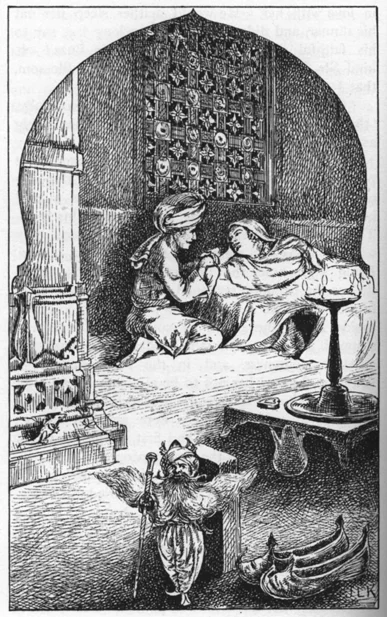
After marrying a king she is protected by an emerald that speaks whenever it hears a lie. Jealous palace women exploit the moment when she leaves it in the bathroom: they murder her child and place his remains and blood beside her to accuse her of being an ogress. The king orders her death. Her body becomes a marble wall, her eyes pools, her green mantle grass, her hair creepers, and her mouth and teeth flowers; her soul becomes a sheldrake and its mate. The text assigns both birds to her single soul, not one to the king.
The king later hears the birds explain the crime and the means of restoration. He must behead both simultaneously while they are together. Pepperina returns to human form, but the garden remains. She chooses to live there, and her Jinn foster father eventually builds a palace for the couple and himself. Temple identifies the birds as chakwâ and chakwî and adds a separate traditional account of lovers condemned to nightly separation; that comparative legend is not the origin given for Pepperina’s pair.
Origins & earliest records
Punjabi storytelling collected and adapted in colonial British India
Records & interpretation
Complete named tale and Temple’s corresponding notes read; university-hosted 1894 text compared in full.
Selected bibliography
Documented works and useful reading. This is not a list of every appearance.
- 01
Tales of the Punjab, Told by the People
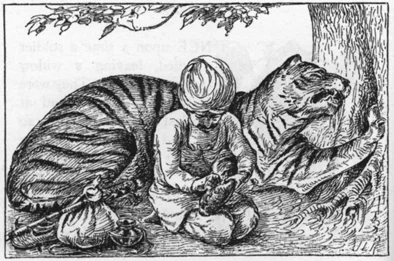
Princess Pepperina and corresponding notes; J. Lockwood Kipling illustrations
Family, evolution & connections
Pepperina’s narrated egg origin and child
Princess Pepperina in Steel’s 1894 collection.
Scroll sideways to see all branches. With a keyboard, focus the tree and use the arrow keys.
- Unnamed female bulbul (lays the egg)
- Unnamed infant prince (after marriage to the king)
Explicit egg emergence and later childbirth in the named tale. The bulbul’s mate is not represented as a father. The magical origin is narrative parentage, not a biological human–bird phylogeny. The murdered infant is not described as restored.
The Jinn’s fostering of Pepperina
Princess Pepperina in Steel’s 1894 collection.
Scroll sideways to see all branches. With a keyboard, focus the tree and use the arrow keys.
The Jinn’s explicit care from egg sheltering through marriage consent. This represents guardianship and fostering, not birth descent. Later bird forms of the Jinn and Pepperina are transformations, not additional family members.
Unnamed female bulbul
The female bulbul lays the emerald egg from which Pepperina emerges. This is the tale’s origin mechanism, not ordinary human reproduction; her mate is not independently identified as the girl’s father.
Unnamed young king in Princess Pepperina
The young king marries Pepperina with her guardian’s consent. Her soul later takes both sheldrake forms; the two birds are not separately the king and queen.
Unnamed infant prince in Princess Pepperina
Pepperina bears a prince after marriage. Jealous palace women murder him and falsely accuse his mother; the narrative does not describe her eating her child.
Primary records and illustrations
Flora Annie Steel, Tales of the Punjab, Told by the People (Macmillan, 1894); R. C. Temple notes
Princess Pepperina. Complete tale and titled notes; Gutenberg anchors id00833/id01754; UPenn punjab-19
Complete narrative and corresponding notes read, with collection preface already read. Entire tale compared with UPenn 1894 transcription: over 99% token overlap; remaining punctuation, OCR and heading differences inspected. Fairy external life and Pepperina’s one-soul bird pair retained as separate story mechanisms.
References
Sources supporting this profile. Linked pages have their own scope and editorial standards.
- Historical collected folktaleSteel, Princess Pepperina, complete narrativeResearch access: 2026-10-05
- Collector’s linguistic and comparative notesTemple, Notes to Princess PepperinaResearch access: 2026-10-05
- University-hosted historical primary textUniversity of Pennsylvania, 1894 edition transcriptionResearch access: 2026-10-05
Image credits
A sourced illustration has not yet been added. This gap is included in the coverage record.