A sourced illustration has not yet been added. This gap is included in the coverage record.
Overview
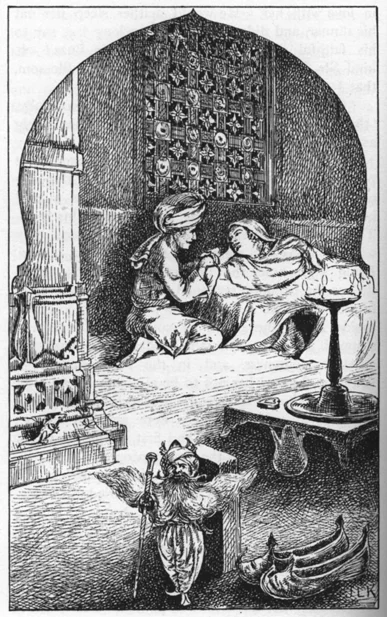
The Jinn keeps a secluded garden and sleeps for twelve years after each twelve-year waking period. He discovers the green egg laid by a bulbul, carefully shelters it, and lovingly raises the girl who emerges. Pepperina warns a visiting king that he sometimes eats men, and he can smell the hidden human; his protective conduct therefore does not establish universal harmlessness.
Persuaded to approve Pepperina’s marriage, he follows her in the successive forms of a dove, hawk and eagle to make sure she is safe before finally sleeping. When he wakes twelve years later, he finds her restored after a wrongful execution and builds a magnificent palace in her surviving enchanted garden. His role is foster father and benefactor; the story supplies no biological descent from him and no fixed giant, horned or smoky anatomy.
Origins & earliest records
Punjabi storytelling collected and adapted in colonial British India
Records & interpretation
Complete named tale and Temple’s corresponding notes read; university-hosted 1894 text compared in full.
Selected bibliography
Documented works and useful reading. This is not a list of every appearance.
- 01
Tales of the Punjab, Told by the People
Princess Pepperina and corresponding notes; J. Lockwood Kipling illustrations
Family, evolution & connections
The Jinn’s fostering of Pepperina
Princess Pepperina in Steel’s 1894 collection.
Scroll sideways to see all branches. With a keyboard, focus the tree and use the arrow keys.
The Jinn’s explicit care from egg sheltering through marriage consent. This represents guardianship and fostering, not birth descent. Later bird forms of the Jinn and Pepperina are transformations, not additional family members.
Princess Pepperina (Shâhzâdî Mirchâ)
The Jinn shelters the egg, raises Pepperina and consents to her marriage. His paternal care is distinct from the female bulbul’s egg-laying.
Primary records and illustrations
Flora Annie Steel, Tales of the Punjab, Told by the People (Macmillan, 1894); R. C. Temple notes
Princess Pepperina. Complete tale and titled notes; Gutenberg anchors id00833/id01754; UPenn punjab-19
Complete narrative and corresponding notes read, with collection preface already read. Entire tale compared with UPenn 1894 transcription: over 99% token overlap; remaining punctuation, OCR and heading differences inspected. Fairy external life and Pepperina’s one-soul bird pair retained as separate story mechanisms.
References
Sources supporting this profile. Linked pages have their own scope and editorial standards.
- Historical collected folktaleSteel, Princess Pepperina, complete narrativeResearch access: 2026-10-05
- Collector’s linguistic and comparative notesTemple, Notes to Princess PepperinaResearch access: 2026-10-05
- University-hosted historical primary textUniversity of Pennsylvania, 1894 edition transcriptionResearch access: 2026-10-05
Image credits
A sourced illustration has not yet been added. This gap is included in the coverage record.