A sourced illustration has not yet been added. This gap is included in the coverage record.
Overview
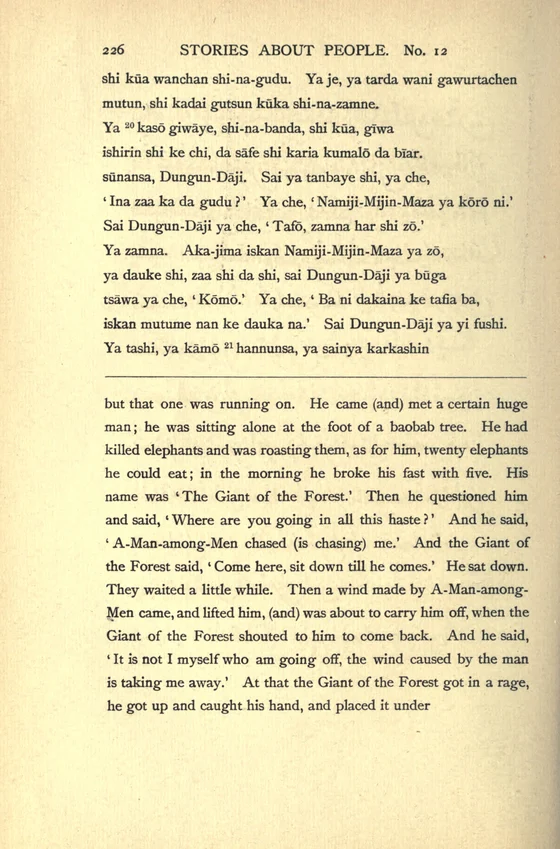
Before dying, Chief Kurungu-the-bad-fish asks how his children will commemorate him. The eldest promises a lion, while the youngest promises a hyena. The youngest eventually fulfills his undertaking after repeated trapping attempts, leaving the eldest’s promise outstanding. That son takes an anvil into the forest and works metal. A talking lion approaches as a friend and offers to operate his bellows.
The smith conceals leaves between his legs and heats tongs in the fire. Pretending to treat an irritation, he presses the hot metal among the leaves. The lion mistakes the burning vegetation for the man’s flesh and marvels at his endurance. He requests the same handling for himself. The smith actually applies the heated tongs to him until he faints, then summons his younger brothers to drag the unconscious lion home.
When the lion revives among the gathered people, the smith claims he merely brought him home to pour water over his weary body. The lion rejects this explanation, leaps on him, tramples him and tears him apart. The narrative states that the breaking produces many feet and explains the spider as formerly this smith. His imitated endurance is therefore an ordinary concealment trick within the story, while the final fragmentation into an animal is the extraordinary origin event.
Origins & earliest records
Malam Shaihu supplies the written Hausa material translated and transliterated by R. Sutherland Rattray. The compiler’s Author’s Note describes a mixed written and Arabic-manuscript mediation process; this tale is not labeled a verbatim oral field transcription by a separately named narrator.
Records & interpretation
Shaihu/Rattray, Hausa Folk-Lore, Customs, Proverbs, etc., Volume I (1913), tale 6, complete pp. 108–128; smith/lion episode pp. 122–128; compiler methodology p. xii.
Selected bibliography
Documented works and useful reading. This is not a list of every appearance.
- 01
Hausa Folk-Lore, Customs, Proverbs, etc., Volume I
Shaihu/Rattray, Hausa Folk-Lore, Customs, Proverbs, etc., Volume I (1913), tale 6, complete pp. 108–128; smith/lion episode pp. 122–128; compiler methodology p. xii.
Family & connections
A source-supported family tree or inspiration record has not yet been compiled for this profile. Related reading below indicates a connection in subject matter, not a proven lineage or creative influence.
References
Sources supporting this profile. Linked pages have their own scope and editorial standards.
- Bilingual manuscript tale; digitized primary OCRShaihu/Rattray 1913 — Smith Who Became the Spider in Shaihu’s TaleResearch access: 2026-10-05
- Compiler methodologyAuthor’s NoteResearch access: 2026-10-05
Image credits
A sourced illustration has not yet been added. This gap is included in the coverage record.