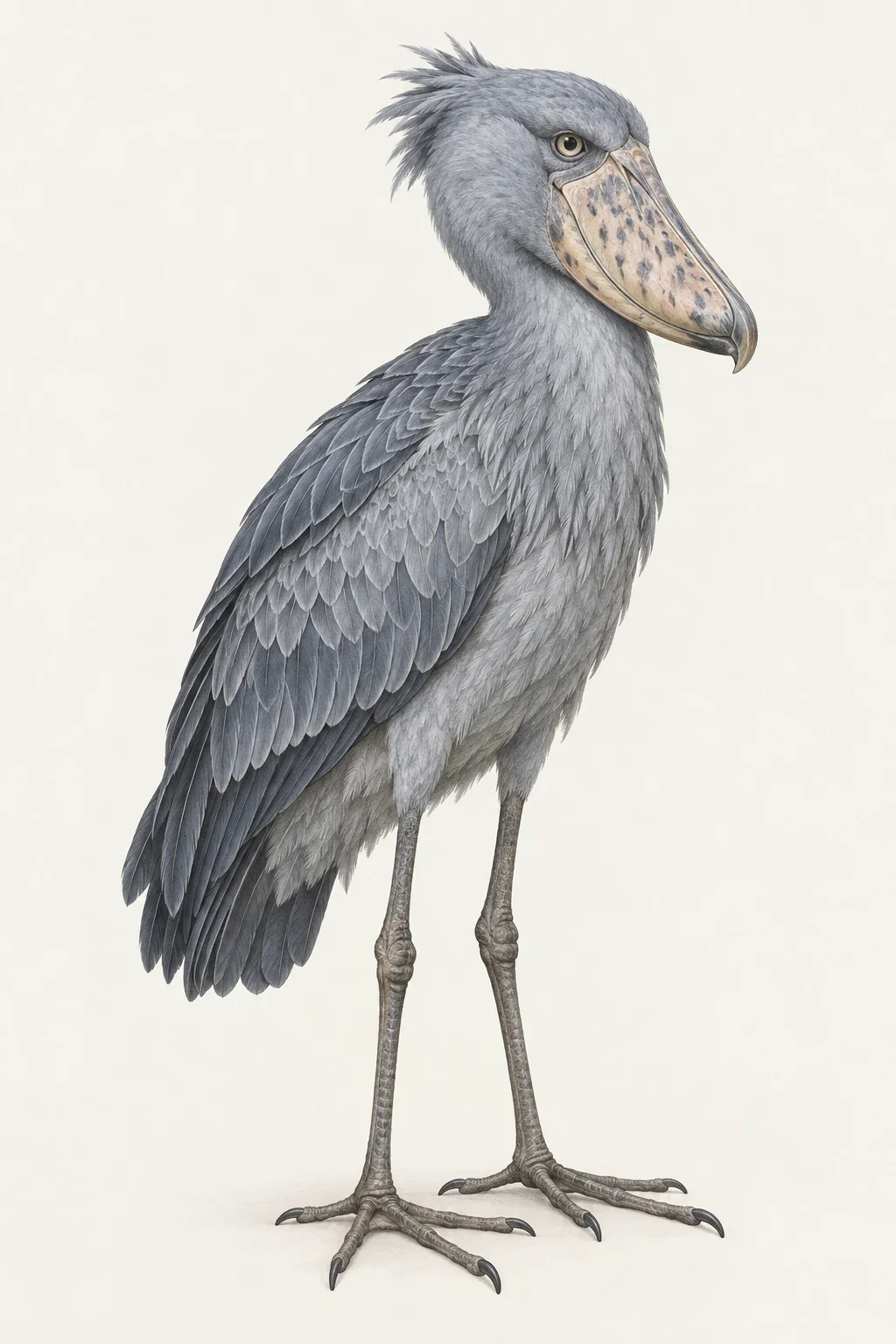
Shoebill - AI-generated scientific interpretation.
Modern AI-generated scientific illustration. Diagnostic external features follow the selected sources; pose, individual pattern and fine details are interpretive. Not photography or independent anatomical evidence.
Overview
The shoebill has a sturdy grey body, a small shaggy crest and an exceptionally broad, deep bill. The upper bill ends in a sharp terminal nail. Long legs and elongated toes support movement over soft wetland surfaces. This combination differs from a heron's narrow spear-shaped bill even when both birds stand still beside water.
The bill is more than an unusual silhouette. Institutional accounts describe grasping fish, separating vegetation caught with prey, bill clapping and carrying water to cool eggs or chicks. These functions connect structure to feeding and parental behaviour; they do not turn the bird into a reptile because observers call it prehistoric-looking.
Shoebills may wait almost motionless before lunging at prey, a strategy described as freeze and seize. Slow movement at one moment therefore does not indicate incapacity for rapid action. The 2019 zoo account names regional lungfish among the foods, but the profile does not present a single fish as a universal exclusive diet.
Older common names call it a stork. Current institutional taxonomy places it in its own family, Balaenicipitidae, within Pelecaniformes. Similarities among wetland birds require care because both common ancestry and comparable feeding demands can influence anatomy. The profile states the accepted ranks without inferring an exact sister lineage from bill shape alone.
Origins & earliest records
Balaeniceps rex is the living shoebill. Stork-like common names reflect an earlier classification history and do not override its present family placement.
Evidence & interpretation
The San Diego zoological account documents morphology and classification, while a separately authored 2019 institutional account details bill use and ambush feeding. No new phylogenetic analysis or current population estimate is implied.
Selected bibliography
Documented works and useful reading. This is not a list of every appearance.
- 01
Shoebill
Selected bibliography; bounded evidence and study-specific limitations retained.
- 02
7 Revealing Facts about Shoebills
Selected bibliography; bounded evidence and study-specific limitations retained.
Family, evolution & connections
Taxonomic classification
A hierarchy of classified groups, not a chain of direct ancestors.
Source note: The family is Balaenicipitidae; the stork label in common names is historical. Bill resemblance is not independently used to resolve phylogenetic relationships.
- kingdomAnimalia
- phylumChordata
- classAves
- orderPelecaniformes
- familyBalaenicipitidae
- genusBalaeniceps
- speciesBalaeniceps rex
References
Sources supporting this profile. Linked pages have their own scope and editorial standards.
- InstitutionalShoebillResearch access: 2026-10-10
- Institutional7 Revealing Facts about ShoebillsResearch access: 2026-10-10
Image credits
AI-generated scientific interpretationShoebill - AI-generated scientific interpretation.
Modern AI-generated scientific illustration. Diagnostic external features follow the selected sources; pose, individual pattern and fine details are interpretive. Not photography or independent anatomical evidence.