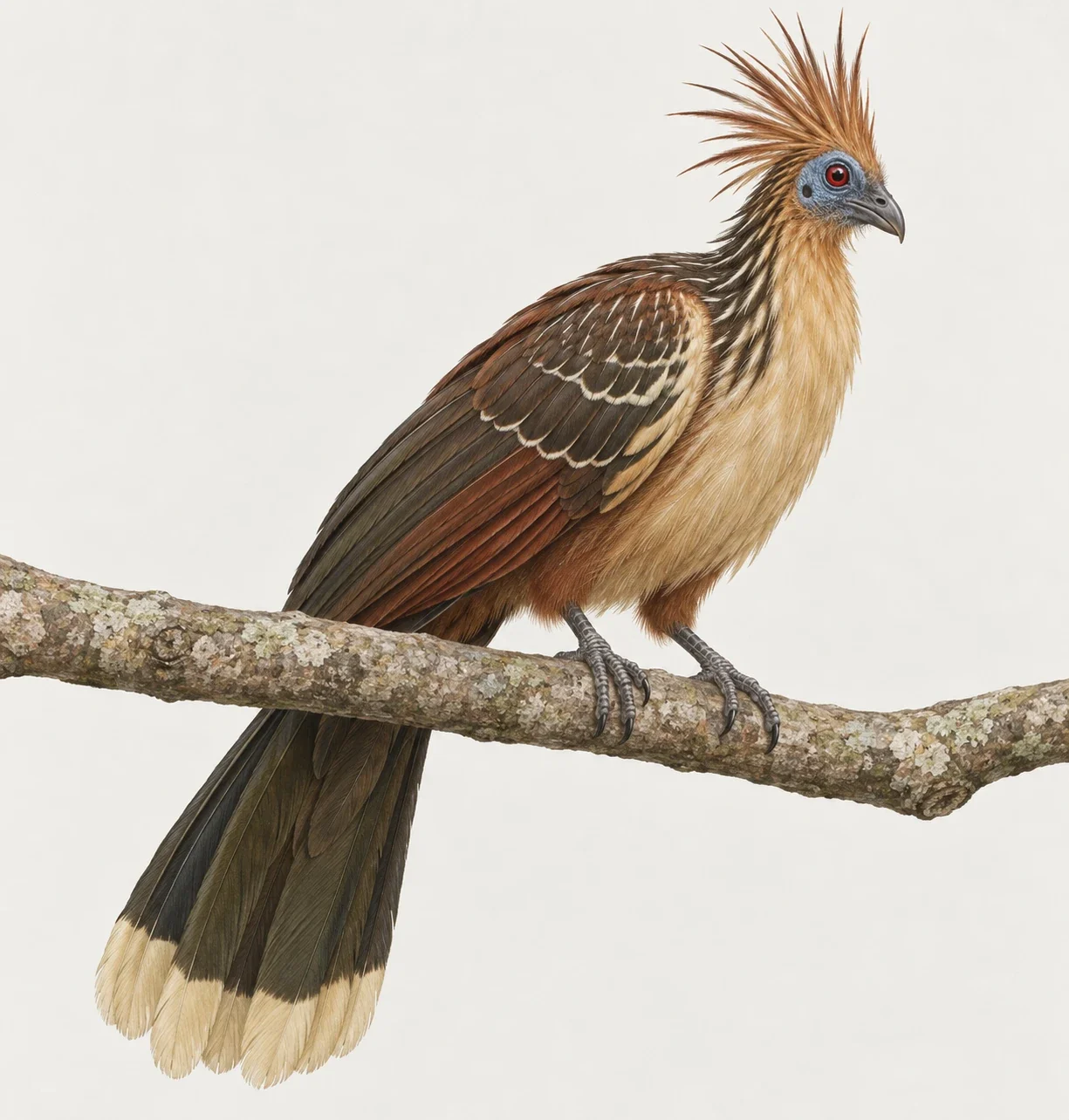
Hoatzin - AI-generated scientific interpretation.
Modern AI-generated scientific illustration. Diagnostic external features follow the selected sources; pose, individual pattern and fine details are interpretive. Not photography or independent anatomical evidence.
Overview
The adult hoatzin has a reddish-brown crest, bare blue facial skin, red eyes and chestnut-toned plumage with a long tail. It inhabits waterside vegetation in tropical South America. Functional wing claws occur in young birds and should not be attached to an ordinary adult illustration merely to make it look more dinosaur-like.
Leaf feeding depends on an unusual digestive arrangement. Grajal and colleagues reported active foregut fermentation in 1989, connecting the enlarged crop and associated structures with microbial processing of plant food. This is a physiological finding, not a claim that the bird has literally acquired a cow's stomach.
A 2009 study examined crop samples from ten birds in Venezuela using sequence libraries and quantitative molecular methods. Methanogen sequences clustered near known rumen-associated groups, offering a microbial comparison for convergent fermentation systems. Sequence similarity and proposed novel microbial phylotypes are not equivalent to culturing and formally describing every organism detected.
The hoatzin's placement within living birds has long been difficult. A 2024 Natural History Museum account explains how rapid ancient diversification complicates resolution of such branches. This profile retains Opisthocomiformes and avoids declaring one of the old cuckoo or turaco hypotheses settled on the basis of an older general species page.
Origins & earliest records
Opisthocomus hoazin is a living bird with specialized leaf digestion. Ancient uncertainty about its nearest avian relatives does not make it an unchanged fossil or outside the evolutionary history of birds.
Evidence & interpretation
The university account documents form and age-specific wing claws. Primary physiological and microbial studies support fermentation; the 2009 samples represent ten Venezuelan birds. The museum's modern account supplies the phylogenetic caution.
Selected bibliography
Documented works and useful reading. This is not a list of every appearance.
- 01
Opisthocomus hoazin
Selected bibliography; bounded evidence and study-specific limitations retained.
- 02
Foregut fermentation in the hoatzin, a neotropical leaf-eating bird
Selected bibliography; bounded evidence and study-specific limitations retained.
- 03
Rumen-like methanogens identified from the crop of the folivorous South American bird, the hoatzin
Selected bibliography; bounded evidence and study-specific limitations retained.
- 04
Most detailed bird evolutionary tree reveals new and surprising relationships
Selected bibliography; bounded evidence and study-specific limitations retained.
Family, evolution & connections
Taxonomic classification
A hierarchy of classified groups, not a chain of direct ancestors.
Source note: The selected conventional ranks do not resolve its exact sister lineage. Old general-page statements assigning a closest cuckoo or turaco relationship are not copied as a current conclusion.
- kingdomAnimalia
- phylumChordata
- classAves
- orderOpisthocomiformes
- familyOpisthocomidae
- genusOpisthocomus
- speciesOpisthocomus hoazin
References
Sources supporting this profile. Linked pages have their own scope and editorial standards.
- InstitutionalOpisthocomus hoazinResearch access: 2026-10-10
- ResearchForegut fermentation in the hoatzin, a neotropical leaf-eating birdResearch access: 2026-10-10
- ResearchRumen-like methanogens identified from the crop of the folivorous South American bird, the hoatzinResearch access: 2026-10-10
- InstitutionalMost detailed bird evolutionary tree reveals new and surprising relationshipsResearch access: 2026-10-10
Image credits
AI-generated scientific interpretationHoatzin - AI-generated scientific interpretation.
Modern AI-generated scientific illustration. Diagnostic external features follow the selected sources; pose, individual pattern and fine details are interpretive. Not photography or independent anatomical evidence.