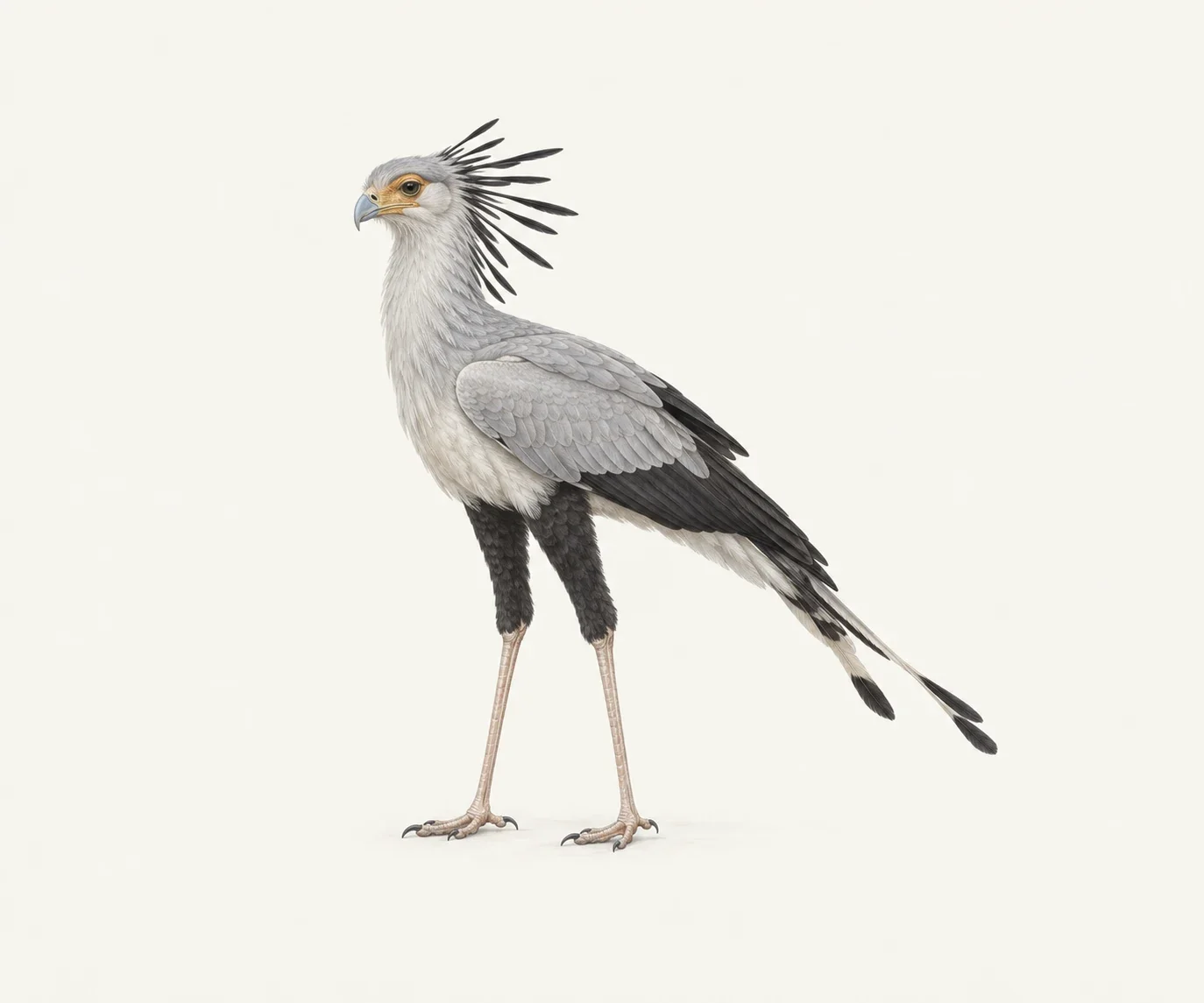
Secretarybird - AI-generated scientific interpretation.
Modern AI-generated scientific illustration. Diagnostic external features follow the selected sources; pose, individual pattern and fine details are interpretive. Not photography or independent anatomical evidence.
Overview
The secretarybird combines a grey body and wings, black thigh feathers and long dark head plumes with unusually long walking legs. Its feet are adapted to terrestrial movement and differ in use from the grasping feet of many other raptors. It can fly and roost or nest in trees, so spending much of the day on the ground does not make it a flightless bird.
The bird searches open African grassland for varied animal prey. Snakes are conspicuous in accounts of its hunting, but they are not the only food and do not need to appear in every illustration. External proportions should show a raptor's hooked bill and a feathered body rather than a crane's or stork's long spear-like bill.
A 2016 biomechanics study measured the strikes of a trained male attacking a rubber snake. The research team's report identifies the animal and experimental situation, making the distinction between a force measurement and an anecdote about wild hunting explicit. Rapid contact and high force help explain how a kick can disable prey, but one trained bird is not a species-wide performance census.
Classification also requires a dated source. ITIS places Sagittarius in Sagittariidae within Accipitriformes, while an older zoo page retains Falconiformes. The profile uses the former placement and keeps the visible head plumes as anatomy without endorsing an untested story about the origin of the English name.
Origins & earliest records
The living species is Sagittarius serpentarius. The selected current taxonomic record places it among accipitriform raptors; its terrestrial hunting is a specialization within that lineage, not an origin outside flying birds.
Evidence & interpretation
Zoo anatomy and behaviour accounts are supplemented by the 2016 primary biomechanics paper and the research team's explanation of its trained-bird experiment. Current order placement follows ITIS; old population and conservation statements are excluded.
Selected bibliography
Documented works and useful reading. This is not a list of every appearance.
- 01
Sagittarius serpentarius
Selected bibliography; bounded evidence and study-specific limitations retained.
- 02
Secretary Bird
Selected bibliography; bounded evidence and study-specific limitations retained.
- 03
The fast and forceful kicking strike of the secretary bird
Selected bibliography; bounded evidence and study-specific limitations retained.
- 04
Secretary Birds can kick a snake to death in the blink of an eye
Selected bibliography; bounded evidence and study-specific limitations retained.
Family, evolution & connections
Taxonomic classification
A hierarchy of classified groups, not a chain of direct ancestors.
Source note: ITIS current order/family placement is used rather than old broad Falconiformes. A shared raptor ancestry does not imply the same foot use as a hawk.
- kingdomAnimalia
- phylumChordata
- classAves
- orderAccipitriformes
- familySagittariidae
- genusSagittarius
- speciesSagittarius serpentarius
References
Sources supporting this profile. Linked pages have their own scope and editorial standards.
- InstitutionalSagittarius serpentariusResearch access: 2026-10-10
- InstitutionalSecretary BirdResearch access: 2026-10-10
- ResearchThe fast and forceful kicking strike of the secretary birdResearch access: 2026-10-10
- InstitutionalSecretary Birds can kick a snake to death in the blink of an eyeResearch access: 2026-10-10
Image credits
AI-generated scientific interpretationSecretarybird - AI-generated scientific interpretation.
Modern AI-generated scientific illustration. Diagnostic external features follow the selected sources; pose, individual pattern and fine details are interpretive. Not photography or independent anatomical evidence.