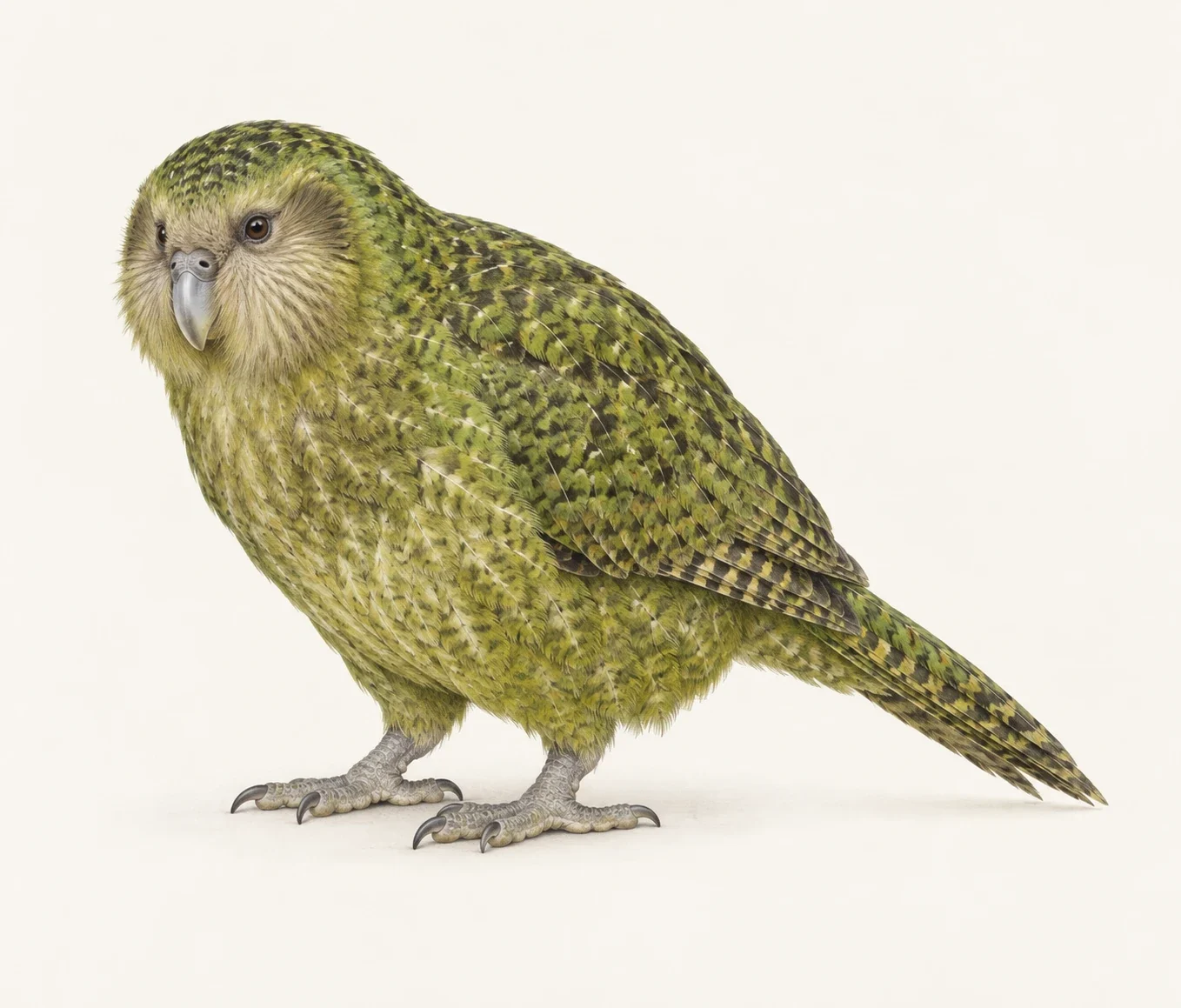
Kākāpō - AI-generated scientific interpretation.
Modern AI-generated scientific illustration. Diagnostic external features follow the selected sources; pose, individual pattern and fine details are interpretive. Not photography or independent anatomical evidence.
Overview
The kākāpō is a bulky moss-green parrot, mottled yellow and black, with a pale owl-like face and a grey hooked bill. Its legs and feet are grey. Folded wings remain present even though the species cannot sustain powered flight. An owl-like face describes convergent appearance rather than membership of the owl lineage.
It feeds on plant material, moves along the ground and can climb trees. The New Zealand Birds Online account links these traits to a nocturnal and generally solitary adult life. Its old broad range and current managed distribution must be kept separate: historic remains and observations do not establish a surviving population at every former locality.
Males use track-and-bowl systems for lek displays, producing low booming calls to attract females. Females undertake incubation and chick care. The conservation agency connects breeding at southern sites with episodic rimu fruiting; this food relationship does not guarantee that every year or every site follows an identical schedule.
Conservation has involved predator-free sites, monitoring and intervention. These management records provide valuable evidence but do not define an untouched wild baseline. A 2006 primary breeding account covers offshore sanctuaries during 1990–2002, so its dates and sample setting remain explicit rather than being presented as a current population census.
Origins & earliest records
Strigops habroptilus was named by G. R. Gray in 1845, according to the New Zealand species account. The naming date is distinct from earlier Māori knowledge and from the species' evolutionary history.
Evidence & interpretation
New Zealand Birds Online supplies identification and current taxonomic spelling. Department of Conservation accounts supply observed breeding behaviour and management context. The indexed primary sanctuary study is bounded to its historical study interval.
Selected bibliography
Documented works and useful reading. This is not a list of every appearance.
- 01
Kākāpō | Kakapo
Selected bibliography; bounded evidence and study-specific limitations retained.
- 02
Behaviour: Kākāpō
Selected bibliography; bounded evidence and study-specific limitations retained.
- 03
Breeding biology of kakapo on offshore island sanctuaries, 1990–2002
Selected bibliography; bounded evidence and study-specific limitations retained.
Family, evolution & connections
Taxonomic classification
A hierarchy of classified groups, not a chain of direct ancestors.
Source note: Spelling and family follow New Zealand Birds Online. Owl-like appearance does not make this parrot an owl; managed-site breeding observations are distinguished from historical distribution.
- kingdomAnimalia
- phylumChordata
- classAves
- orderPsittaciformes
- familyStrigopidae
- genusStrigops
- speciesStrigops habroptilus
References
Sources supporting this profile. Linked pages have their own scope and editorial standards.
- InstitutionalKākāpō | KakapoResearch access: 2026-10-10
- InstitutionalBehaviour: KākāpōResearch access: 2026-10-10
- ResearchBreeding biology of kakapo on offshore island sanctuaries, 1990–2002Research access: 2026-10-10
Image credits
AI-generated scientific interpretationKākāpō - AI-generated scientific interpretation.
Modern AI-generated scientific illustration. Diagnostic external features follow the selected sources; pose, individual pattern and fine details are interpretive. Not photography or independent anatomical evidence.