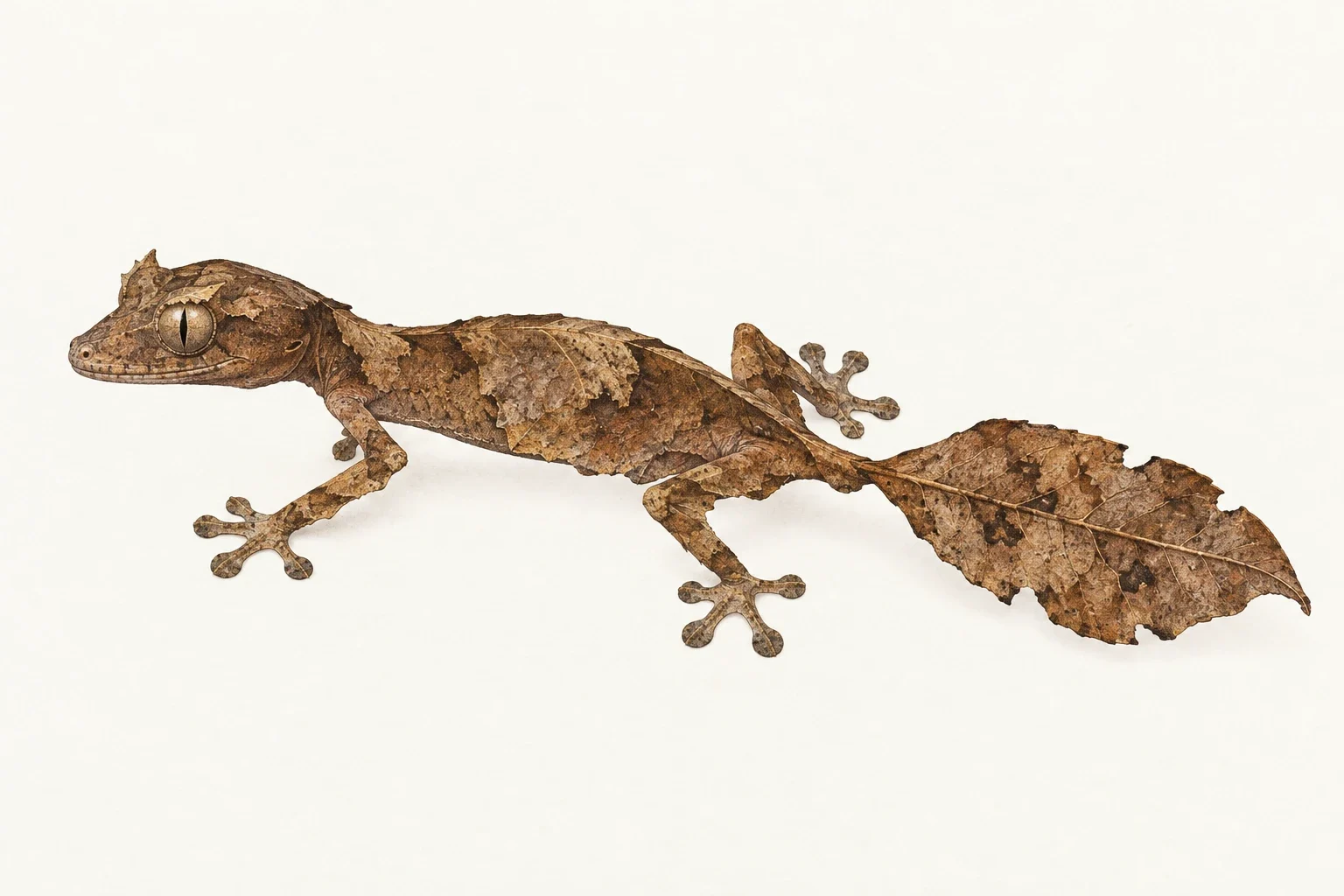
Satanic leaf-tailed gecko - AI-generated scientific interpretation.
Modern AI-generated scientific illustration. Diagnostic features follow the selected zoological sources; pose, individual pattern and fine details are interpretive. Not specimen photography or independent evidence.
Overview
The satanic leaf-tailed gecko is a small forest lizard endemic to Madagascar. Its body is laterally compressed, with a rounded snout and a tail whose flattened, irregular outline resembles a dead leaf. Brown patterns and small projections contribute to the resemblance. The colourful common name is not evidence of aggression or supernatural significance.
Its form should be distinguished from other leaf-tailed geckos. The selected primary account explicitly notes that the head is not flattened and that the species is relatively small. A reconstruction with the broad, flattened head of a different Uroplatus species would erase that distinction. Fine mottling and individual tail notches remain variable and interpretive in the generated plate.
Marushchak and colleagues studied reproduction in a controlled breeding population at the BION Terrarium Center. Their observations included captive and wild-origin parent animals, interclutch intervals and incubation outcomes. These results contribute to ex situ knowledge; they are not measurements of reproductive timing across Madagascar’s forests.
Species identity and provenance are essential when comparing reproductive studies. The reptile database records the taxonomic authority and bibliography, while the primary account identifies gaps in reproductive knowledge. This profile keeps controlled observations separate from wild ecological claims and does not convert the breeding study into animal-care instructions.
Origins & earliest records
Uroplatus phantasticus is attributed to Boulenger, 1888. Leaf resemblance is an evolved external form; the taxonomic date records scientific description rather than the first appearance of the adaptation.
Evidence & interpretation
A 2022 primary reproductive account supports the bounded body description and controlled breeding context. The Reptile Database supplies species authority and taxonomic references. Neither source establishes a single invariant colour pattern or wild breeding timetable.
Selected bibliography
Documented works and useful reading. This is not a list of every appearance.
- 01
Uroplatus phantasticus
Selected bibliography; bounded source account, not exhaustive coverage.
- 02
Data on the Reproductive Biology of the Satanic Leaf-tailed Gecko, Uroplatus phantasticus, at BION Terrarium Center as a Contribution to Ex Situ Offspring Programs
Selected bibliography; bounded source account, not exhaustive coverage.
Family, evolution & connections
Taxonomic classification
A hierarchy of classified groups, not a chain of direct ancestors.
Source note: The species is retained separately from superficially similar Uroplatus taxa. Captive reproduction findings are not used as species-wide wild constants.
- kingdomAnimalia
- phylumChordata
- classReptilia
- orderSquamata
- familyGekkonidae
- genusUroplatus
- speciesUroplatus phantasticus
References
Sources supporting this profile. Linked pages have their own scope and editorial standards.
- InstitutionalUroplatus phantasticusResearch access: 2026-10-10
- ResearchData on the Reproductive Biology of the Satanic Leaf-tailed Gecko, Uroplatus phantasticus, at BION Terrarium Center as a Contribution to Ex Situ Offspring ProgramsResearch access: 2026-10-10
Image credits
AI-generated scientific interpretationSatanic leaf-tailed gecko - AI-generated scientific interpretation.
Modern AI-generated scientific illustration. Diagnostic features follow the selected zoological sources; pose, individual pattern and fine details are interpretive. Not specimen photography or independent evidence.