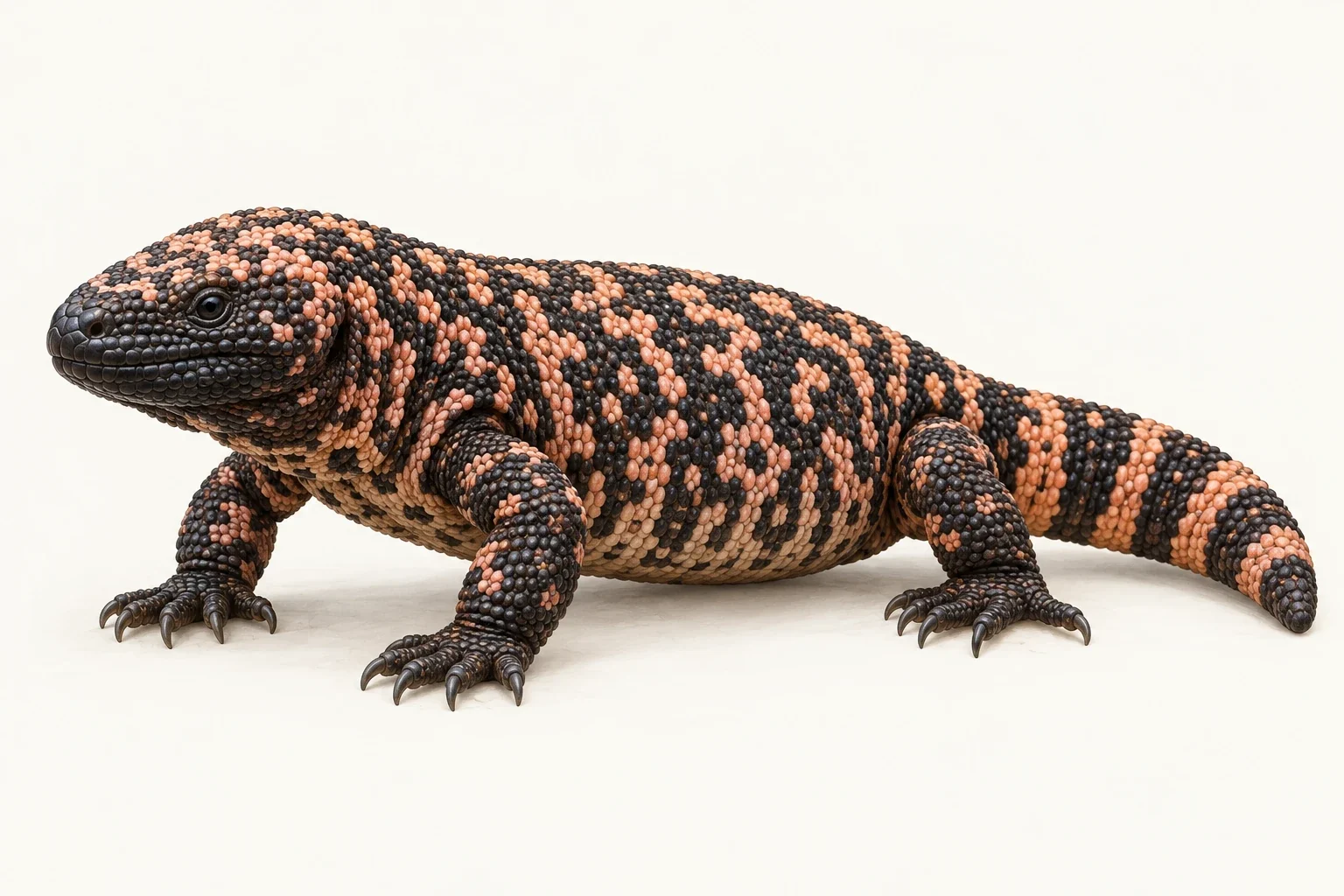
Gila monster - AI-generated scientific interpretation.
Modern AI-generated scientific illustration. Diagnostic external features follow the selected sources; pose, individual pattern and fine details are interpretive. Not photography or independent anatomical evidence.
Overview
The Gila monster has a broad head, robust legs and a thick tail. Black upper surfaces carry contrasting pink or orange markings and conspicuous beadlike scales. Pattern varies: reticulated and banded forms in the Smithsonian account should not be collapsed into one exact arrangement of coloured patches.
It spends much of its time below ground and stores energy in the tail and body. Eggs and small animals contribute to its diet. Activity changes with environmental conditions, so a lizard hidden during a hot period cannot be assumed to spend every season inactive.
Venom glands in the lower jaw connect to enlarged grooved teeth. This differs from injecting venom through the hollow fangs of a snake, and the species does not sting with its tongue or emit poisonous breath. An older zoo page's assertion that only two lizard species are venomous is not retained; it conflates a familiar pair with the broader current evidence.
Christel and DeNardo investigated exendin-4 release in 2006 using treatments that separated biting from other aspects of feeding. Plasma levels increased in groups involving substantial biting, supporting mechanical stimulation as a release mechanism. The authors still called for work on the peptide's role in the lizard, so its occurrence does not alone establish a settled metabolic function.
Origins & earliest records
Heloderma suspectum belongs to Helodermatidae with the beaded lizards. This profile concerns the living species and uses no fixed lineage-origin date inferred from a venom assay.
Evidence & interpretation
Institutional accounts document form, habitat and venom delivery. The primary comparative experiment's accessible abstract documents treatment logic and peptide response. Human drug applications do not substitute for evidence about function in the animal itself.
Selected bibliography
Documented works and useful reading. This is not a list of every appearance.
- 01
Gila monster
Selected bibliography; bounded evidence and study-specific limitations retained.
- 02
Gila Monster
Selected bibliography; bounded evidence and study-specific limitations retained.
- 03
Release of exendin-4 is controlled by mechanical action in Gila monsters, Heloderma suspectum
Selected bibliography; bounded evidence and study-specific limitations retained.
Family, evolution & connections
Taxonomic classification
A hierarchy of classified groups, not a chain of direct ancestors.
Source note: Broad venomous-lizard counts from older public accounts are excluded. Individual markings do not independently identify a subspecies in the selected general illustration.
- kingdomAnimalia
- phylumChordata
- classReptilia
- orderSquamata
- familyHelodermatidae
- genusHeloderma
- speciesHeloderma suspectum
References
Sources supporting this profile. Linked pages have their own scope and editorial standards.
- InstitutionalGila monsterResearch access: 2026-10-10
- InstitutionalGila MonsterResearch access: 2026-10-10
- ResearchRelease of exendin-4 is controlled by mechanical action in Gila monsters, Heloderma suspectumResearch access: 2026-10-10
Image credits
AI-generated scientific interpretationGila monster - AI-generated scientific interpretation.
Modern AI-generated scientific illustration. Diagnostic external features follow the selected sources; pose, individual pattern and fine details are interpretive. Not photography or independent anatomical evidence.