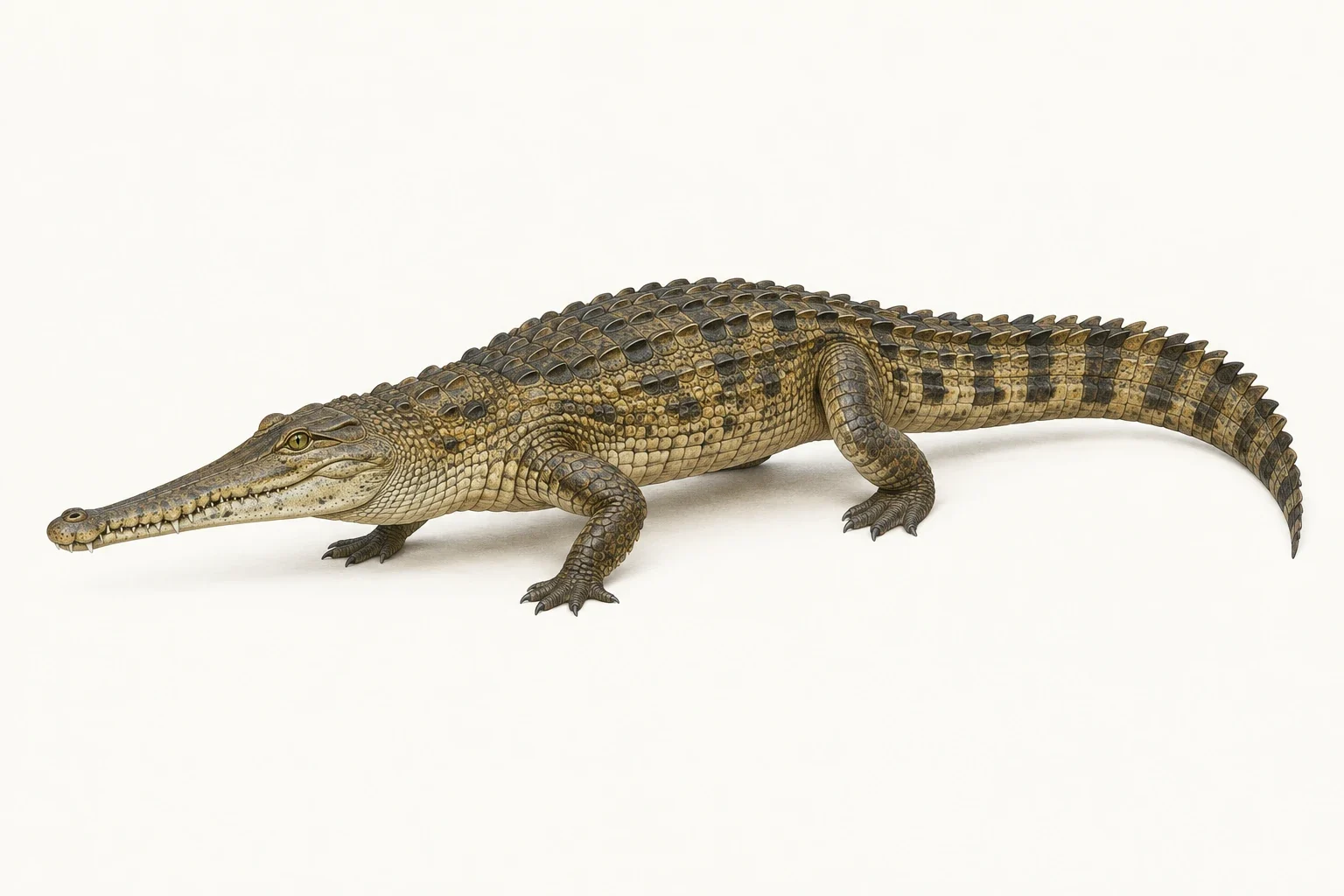
Freshwater crocodile - AI-generated scientific interpretation.
Modern AI-generated scientific illustration. Diagnostic features follow the selected zoological sources; pose, individual pattern and fine details are interpretive. Not specimen photography or independent evidence.
Overview
The freshwater crocodile has a long narrow snout, an armoured back and a muscular swimming tail. It is generally smaller and more slender than the saltwater crocodile with which it shares parts of northern Australia. Four short limbs support movement on land; scutes belong to the skin’s armour rather than forming a turtle-like continuous shell.
Freshwater habitats include rivers, billabongs and other northern wetlands. The common name is an ecological guide rather than an infallible identification rule: finding a crocodile in fresh water does not establish its species. Snout shape, proportions and other features must be considered together, especially where two crocodile species occur.
Museum research also bears on the species’ name. Shea, Beatson and Sadlier revisited the type specimen, photographs and original correspondence in 2016. They reconstructed the relationship between the skin and associated skeleton and corrected the locality from Cardwell to Cashmere on the Herbert River. The historical evidence matters because the naming specimen’s preparation and subsequent history complicated its interpretation.
This is a case in which archival documents supplement an animal specimen. A catalogue statement can be corrected when its provenance is traced; repeating an old locality without the reassessment would carry an avoidable error forward. The generated illustration is a living animal interpretation and supplies no evidence about the type’s missing head or the historical specimen’s condition.
Origins & earliest records
The species is attributed to Krefft, 1873. The nomenclatural history involves original spelling and later corrections; this profile uses Crocodylus johnstoni as in the museum reassessment.
Evidence & interpretation
The Australian Museum account supplies external form and habitat. The 2016 primary paper uses specimens, photographs and correspondence to resolve the type’s history and locality; those records are separate from observations of living populations.
Selected bibliography
Documented works and useful reading. This is not a list of every appearance.
- 01
Freshwater Crocodile
Selected bibliography; bounded source account, not exhaustive coverage.
- 02
The nomenclature and type material of Crocodylus johnstoni Krefft, 1873
Selected bibliography; bounded source account, not exhaustive coverage.
Family, evolution & connections
Taxonomic classification
A hierarchy of classified groups, not a chain of direct ancestors.
Source note: Conventional reptile ranks are used. The selected primary reassessment establishes nomenclatural and specimen history, not a new species or a current population estimate.
- kingdomAnimalia
- phylumChordata
- classReptilia
- orderCrocodylia
- familyCrocodylidae
- genusCrocodylus
- speciesCrocodylus johnstoni
References
Sources supporting this profile. Linked pages have their own scope and editorial standards.
- InstitutionalFreshwater CrocodileResearch access: 2026-10-10
- ResearchThe nomenclature and type material of Crocodylus johnstoni Krefft, 1873Research access: 2026-10-10
Image credits
AI-generated scientific interpretationFreshwater crocodile - AI-generated scientific interpretation.
Modern AI-generated scientific illustration. Diagnostic features follow the selected zoological sources; pose, individual pattern and fine details are interpretive. Not specimen photography or independent evidence.