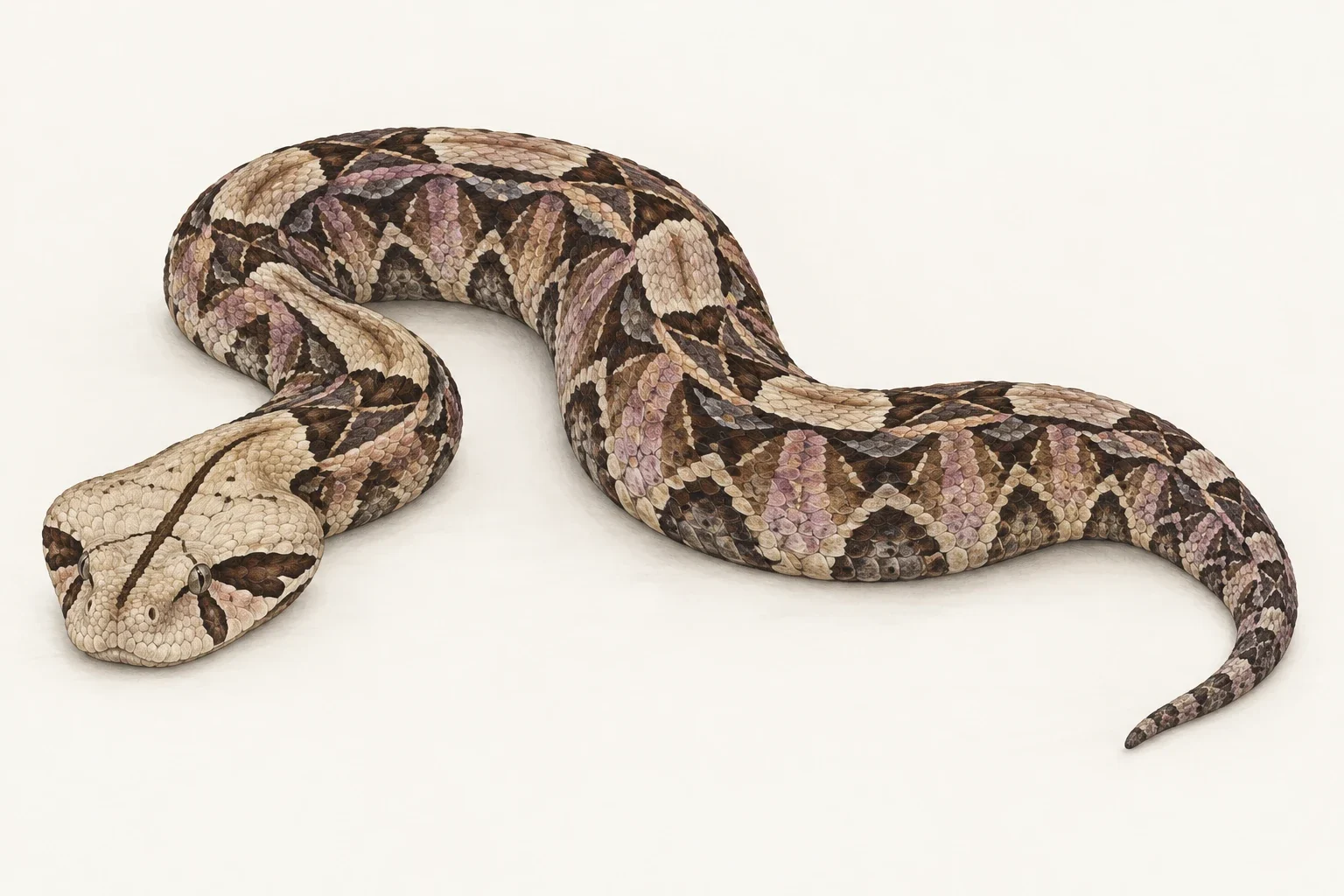
Gaboon viper - AI-generated scientific interpretation.
Modern AI-generated scientific illustration. Diagnostic external features follow the selected sources; pose, individual pattern and fine details are interpretive. Not photography or independent anatomical evidence.
Overview
The Gaboon viper has a stout body, narrow neck and broad leaf-shaped head. Light and dark brown, pinkish and purplish areas form a complex geometric pattern. The Smithsonian account notes a fine central head line and radiating facial marks that connect its appearance with fallen leaves.
Ambush feeding involves remaining concealed until prey enters striking range. Small and medium-sized animals occur in the institutional account. A calm resting posture does not alter the animal's venomous biology, and a closed-mouth illustration should not invent visible fangs projecting through the lips.
Species scope matters because older descriptions of Gaboon vipers include the western form now recognized as Bitis rhinoceros. The Reptile Database records that elevation to species status, while SANBI and the African Snakebite Institute identify B. gabonica in southern African records. This profile does not transfer every old West African locality to the modern species.
The specialist institute describes a robust southern African animal and forest-edge behaviour; those regional observations are not a complete continental occurrence audit. Similarly, a map of specimen points establishes records at particular places rather than abundance between them. Pattern and exact scale arrangement in the generated interpretation are not used to authenticate a locality or identify an individual specimen.
Origins & earliest records
Bitis gabonica is attributed to Duméril, Bibron and Duméril, 1854 in the taxonomic database. The former western subspecies B. gabonica rhinoceros is treated as a different species and is excluded.
Evidence & interpretation
Smithsonian morphology is supplemented by current taxonomic metadata and regional institutional records. Restricted detailed diagnoses on the Reptile Database were not accessed or reconstructed; no precise scale-count diagnosis or current range completeness is claimed.
Selected bibliography
Documented works and useful reading. This is not a list of every appearance.
- 01
Bitis gabonica
Selected bibliography; bounded evidence and study-specific limitations retained.
- 02
Gaboon viper
Selected bibliography; bounded evidence and study-specific limitations retained.
- 03
Bitis gabonica
Selected bibliography; bounded evidence and study-specific limitations retained.
- 04
Gaboon Adder
Selected bibliography; bounded evidence and study-specific limitations retained.
Family, evolution & connections
Taxonomic classification
A hierarchy of classified groups, not a chain of direct ancestors.
Source note: Bitis rhinoceros is kept separate. Regional and older combined accounts are not used to erase modern boundaries; taxonomic authority spelling differences are retained in the bibliography.
References
Sources supporting this profile. Linked pages have their own scope and editorial standards.
- InstitutionalBitis gabonicaResearch access: 2026-10-10
- InstitutionalGaboon viperResearch access: 2026-10-10
- InstitutionalBitis gabonicaResearch access: 2026-10-10
- InstitutionalGaboon AdderResearch access: 2026-10-10
Image credits
AI-generated scientific interpretationGaboon viper - AI-generated scientific interpretation.
Modern AI-generated scientific illustration. Diagnostic external features follow the selected sources; pose, individual pattern and fine details are interpretive. Not photography or independent anatomical evidence.