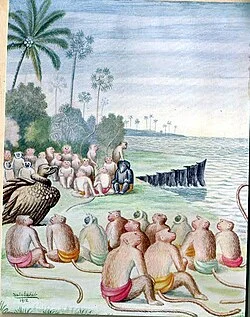
Sampati addresses Rama’s search party, Chitra Ramayana,1916
Actual large vulture at left addresses seated monkey searchers; exact named Sampati plate, distinct from Jatayus battle.
Overview
Sampāti recalls flying with Jaṭāyu toward the sun in youthful pride. When his brother faltered, he spread his own wings to shield him. The heat consumed Sampāti’s pinions, and he fell onto the Vindhya mountain. His son Supārśva later sustained him with food and reported seeing Rāvaṇa carrying away a woman identified as Sītā.
The wingless bird relays this information to the vānara searchers. He also remembers a sage’s instruction to remain alive until he could help Rāma. After his account, new wings grow before the searchers’ eyes and his strength returns. He tests them in flight and urges the party onward, making his bodily restoration part of the narrative’s renewed hope.
The account preserves an important chain of testimony. Sampāti is not represented as personally having fought the abductor: Supārśva reports the airborne sighting and the identification made by heavenly witnesses. Sampāti’s separate firsthand recollection concerns the earlier journey toward the sun and the loss of his own wings. The sage’s promise gave him a reason to survive that disability until Rāma’s mission brought the searchers. His restoration happens after the advice, in their presence, joining the old injury, the son’s report and the predicted service without treating them as one eyewitness event.
Origins & earliest records
South Asian Rāmāyaṇa narrative tradition
Records & interpretation
Primary-text translation directly read by identified book/canto.
Selected bibliography
Documented works and useful reading. This is not a list of every appearance.
- 01
The Rámáyan of Válmíki
Title page gives translation span 1870–1874. Book IV LIX–LXIII, pp. 388–391. Selected historical verse witness.
Family & connections
A source-supported family tree or inspiration record has not yet been compiled for this profile. Related reading below indicates a connection in subject matter, not a proven lineage or creative influence.
Primary records and illustrations
The Rámáyan of Válmíki
Book IV. IV LIX–LXIII, pp. 388–391
Actual translated primary passages directly read. Checked HTML canto anchor. No new image bytes inspected.
The account preserves an important chain of testimony. Sampāti is not represented as personally having fought the abductor: Supārśva reports the airborne sighting and the identification made by heavenly witnesses. Sampāti’s separate firsthand recollection concerns the earlier journey toward the sun and the loss of his own wings. The sage’s promise gave him a reason to survive that disability until Rāma’s mission brought the searchers. His restoration happens after the advice, in their presence, joining the old injury, the son’s report and the predicted service without treating them as one eyewitness event.
References
Sources supporting this profile. Linked pages have their own scope and editorial standards.
- Historical primary-text translationGriffith Rāmāyaṇa — Book IV LIX–LXIII, pp. 388–391Research access: 2026-10-05
Image credits
Historical illustrationSampati addresses Rama’s search party, Chitra Ramayana,1916
Actual large vulture at left addresses seated monkey searchers; exact named Sampati plate, distinct from Jatayus battle.