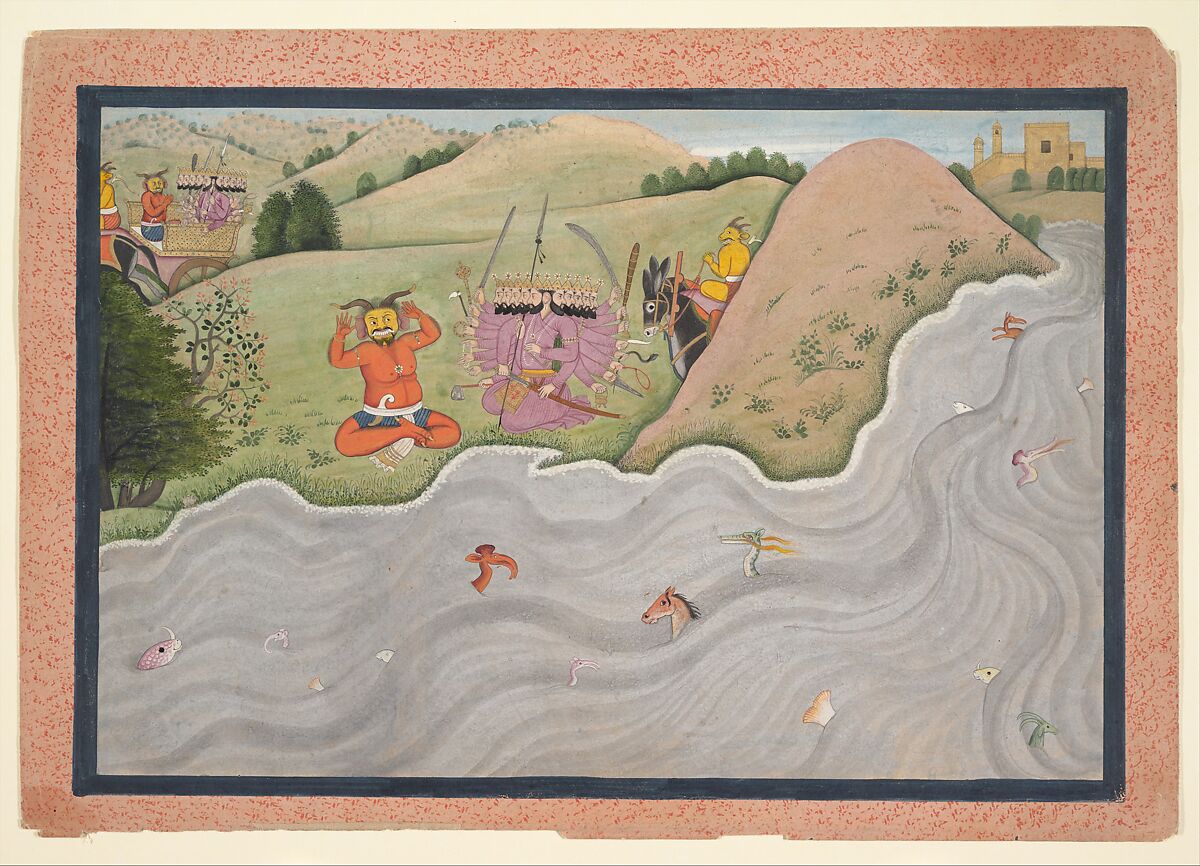
Maricha, seated red-orange demon at left, trying to dissuade the many-headed Ravana, Kangra painting ca.1780
Maricha is the seated red-orange, single-headed figure at left, raising his hands beside the purple many-headed Ravana. His horns, face and colours belong to this Kangra representation. The fantastic creatures in the ocean are not individually identified.
Overview
Mārīca first appears with Subāhu, descending in magic darkness and raining blood over Viśvāmitra’s sacrifice. Rāma’s weapon carries him far into the sea without killing him. His survival matters to his later fear of confronting the prince again.
Under Rāvaṇa’s pressure he takes a dazzling deer form near the forest cottage. Griffith describes gem-like horns, ears, neck and hooves, silver markings and a rainbow-coloured tail. He alternately approaches and retreats to attract Sītā. Ordinary deer investigate, scent him and flee; he suppresses his predatory urge so the disguise will remain convincing.
The deception continues through a long chase in Book III XLIV. The deer repeatedly appears and disappears among the trees, allowing Rāma glimpses of its brilliance while drawing him away from the cottage. When Rāma finally shoots it, Mārīca abandons the animal form but performs one last part of Rāvaṇa’s plan: he calls to Sītā and Lakṣmaṇa in an imitation of Rāma’s voice. The death scene thus distinguishes the visual disguise from a separate vocal impersonation. Rāma recognises the rākṣasa and immediately fears what the cry may cause at home.
Origins & earliest records
South Asian Rāmāyaṇa narrative tradition
Records & interpretation
Historical primary-text translation directly read by book and canto.
Selected bibliography
Documented works and useful reading. This is not a list of every appearance.
- 01
The Rámáyan of Válmíki
Translation title page gives 1870–1874; Book I XXXII, pp. 44–45; III XLII, pp. 277–278. English verse wording attributed to Griffith. Also Book III XLIV, pp. 280–281, final cry and resumed form.
Family, evolution & connections
Suketu, Tāṭakā and Mārīca in Dutt’s translation
The explicit paternal and maternal chain in Bālakāndam XXV.
Scroll sideways to see all branches. With a keyboard, focus the tree and use the arrow keys.
- Suketu (Yaksha)
The passage names Suketu’s daughter Tārakā and her son Māricha. Historical translation spellings Tārakā/Māricha correspond to the local Tāṭakā/Mārīca profiles. Sunda is explicitly her husband; the displayed maternal chain does not infer another parent from marriage alone. The curse changes appearance/status in the narrative, not biological evolution.
Suketu
Suketu is Tārakā’s father and Māricha is her son in the same account. The relation is derived from those explicit adjacent parent statements.
Primary records and illustrations
The Rámáyan of Válmíki
Book I. I XXXII, pp. 44–45; III XLII, pp. 277–278
Actual Griffith translation downloaded and passages read. Book/canto anchors checked in HTML; no illustration claim.
The deception continues through a long chase in Book III XLIV. The deer repeatedly appears and disappears among the trees, allowing Rāma glimpses of its brilliance while drawing him away from the cottage. When Rāma finally shoots it, Mārīca abandons the animal form but performs one last part of Rāvaṇa’s plan: he calls to Sītā and Lakṣmaṇa in an imitation of Rāma’s voice. The death scene thus distinguishes the visual disguise from a separate vocal impersonation. Rāma recognises the rākṣasa and immediately fears what the cry may cause at home.
References
Sources supporting this profile. Linked pages have their own scope and editorial standards.
- Historical primary-text translationGriffith Rāmāyaṇa — Book I XXXII, pp. 44–45; III XLII, pp. 277–278Research access: 2026-10-05
Image credits
Historical illustrationMaricha, seated red-orange demon at left, trying to dissuade the many-headed Ravana, Kangra painting ca.1780
Maricha is the seated red-orange, single-headed figure at left, raising his hands beside the purple many-headed Ravana. His horns, face and colours belong to this Kangra representation. The fantastic creatures in the ocean are not individually identified.