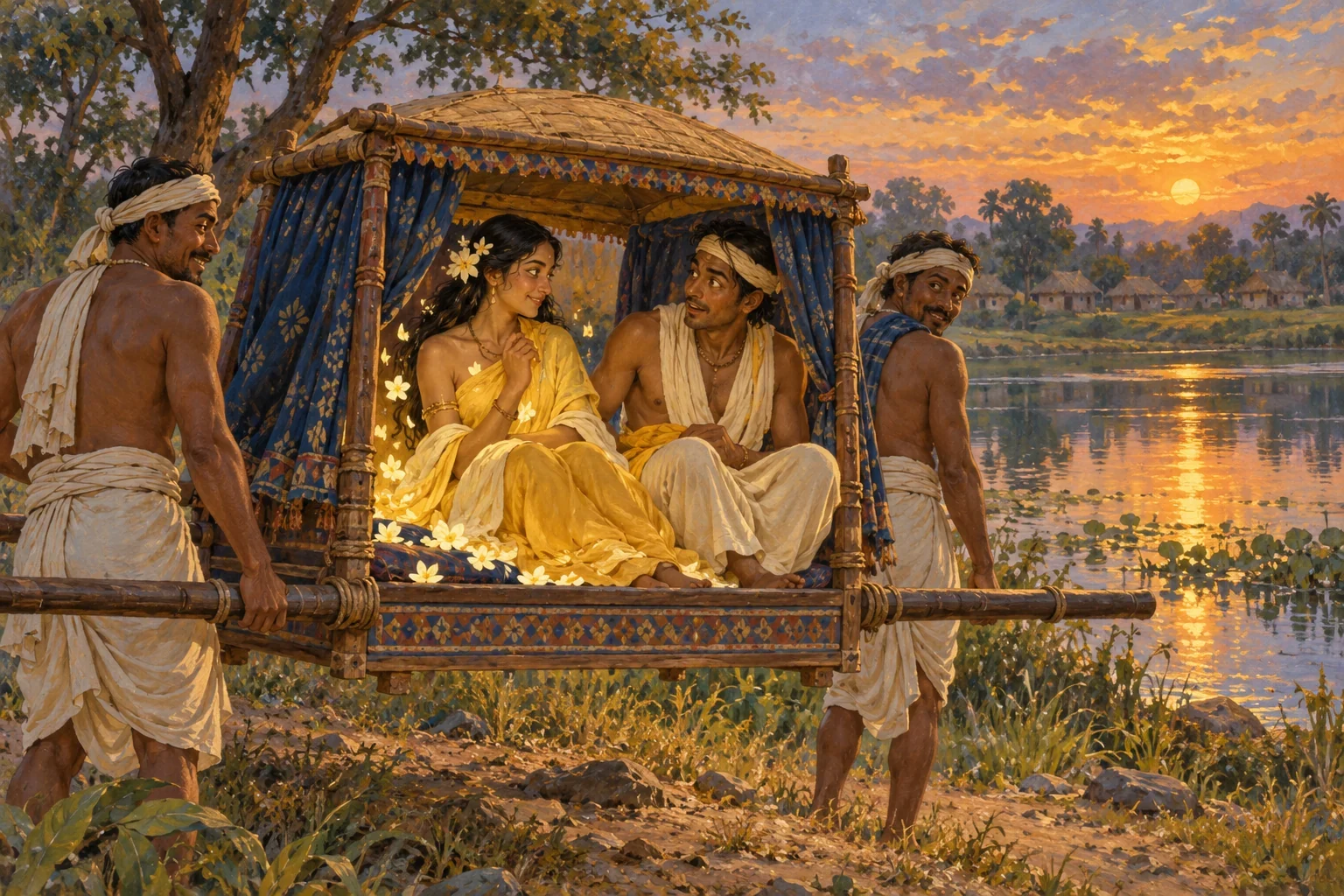
AI-generated interpretation of the restored bride in yellow beside her bridegroom in a palanquin. Blossom shapes, luminous petals, clothing, ornaments, palanquin construction, bearers and setting are artistic choices; no flower species or Santal costume reconstruction is asserted.
AI-generated interpretation of the restored bride in yellow beside her bridegroom in a palanquin. Blossom shapes, luminous petals, clothing, ornaments, palanquin construction, bearers and setting are artistic choices; no flower species or Santal costume reconstruction is asserted.
Overview
In How Sabai Grass Grew, seven brothers excavate a tank but cannot make it hold water. A passing jogi tells them to sacrifice their only sister. They arrange for her to bring their midday meal dressed in her best clothes and jewellery, then send her to draw water from the empty excavation. Water rises as she approaches. Her new pot refuses to fill while the rising water reaches her ankles, knees, waist and neck. She repeatedly sings to her brothers about what is happening. Only after the water covers her head does the pot fill; the narrator says that she drowns and the tank remains full.
Her wedding is already arranged. When the bridegroom’s party arrives, the brothers offer excuses for her absence until the visitors leave angrily. Passing the tank, they notice a beautiful flower in its centre. It evades the drummers who try to pluck it and speaks about taking the flower without breaking the branch. When the bridegroom approaches, it floats towards him of its own accord. He pulls it up by the roots and carries it into his palanquin. Soon the bearers feel an unexpected weight: the bride is sitting beside him in yellow garments. The narrator expressly identifies the flower as the drowned girl, and the party takes the reunited couple home.
The story continues after her restoration. Her brothers fall into poverty and arrive selling leaves and sticks. She recognises them and weeps, first concealing the reason from her new household. Once she identifies them, they receive bathing oil, clean clothes and a feast. After they have eaten, she confronts them with having sacrificed the sister on whom they now depend. In shame they look for escape; the earth opens and they run into the chasm. She tries to pull the youngest back by his hair, asking him to return and help carry her baby, but the hair comes away in her hand and all seven disappear.
She plants the severed hair in a corner of the garden, and the account says that sabai grass originated from it. The bride’s flower-form, her recovery and the final grass origin are consecutive parts of one family narrative, not independent species or verified botanical transformations. The girl is unnamed, and the text does not identify the flower botanically. Her brothers’ actions belong to this particular narrated plot; they are not evidence that human sacrifice was a customary practice of the community that transmitted the story.
Origins & earliest records
Bompas’s preface credits Rev. O. Bodding with collecting the stories and says most were written in Santali, principally by Sagram Murmu. It does not identify the individual teller of this unit. Bompas describes his translation as somewhat condensed.
Records & interpretation
Complete selected unit, ending and collection preface read from retained PG11938. No attached unit footnotes; Santali written original not independently collated.
Selected bibliography
Documented works and useful reading. This is not a list of every appearance.
- 01
Folklore of the Santal Parganas, XXV
Complete selected tale, pp.102–106; complete preface read. No individually named oral teller established.
Family & connections
A source-supported family tree or inspiration record has not yet been compiled for this profile. Related reading below indicates a connection in subject matter, not a proven lineage or creative influence.
References
Sources supporting this profile. Linked pages have their own scope and editorial standards.
- Historical primary folklore translationBompas1909 XXV complete narrativeResearch access: 2026-10-27
Image credits
AI-generated illustrationAI-generated interpretation of the restored bride in yellow beside her bridegroom in a palanquin. Blossom shapes, luminous petals, clothing, ornaments, palanquin construction, bearers and setting are artistic choices; no flower species or Santal costume reconstruction is asserted.
AI-generated interpretation of the restored bride in yellow beside her bridegroom in a palanquin. Blossom shapes, luminous petals, clothing, ornaments, palanquin construction, bearers and setting are artistic choices; no flower species or Santal costume reconstruction is asserted.