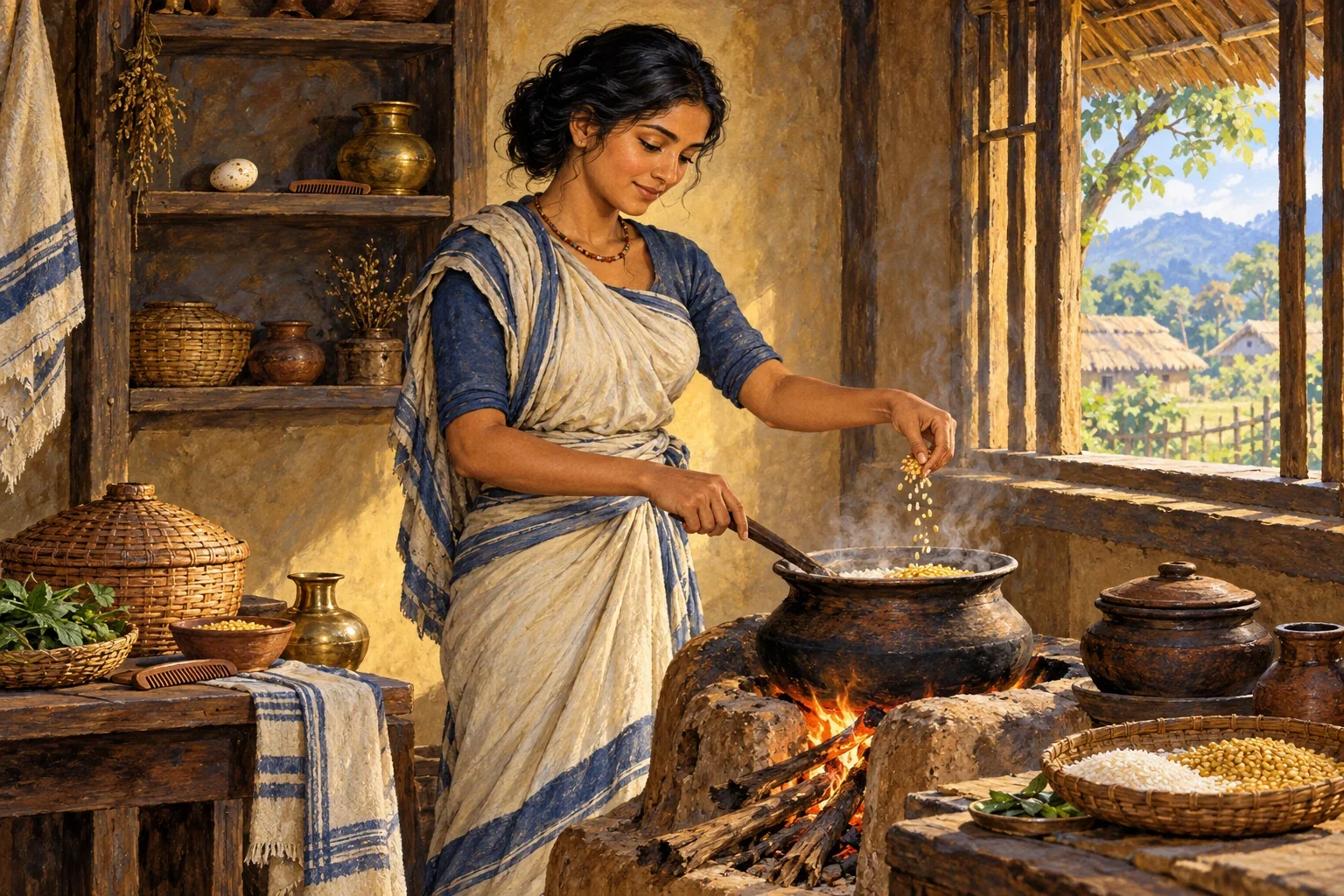
AI-generated interpretation of the bonga woman preparing the replacement meal after emerging from the egg. Her adult appearance, clothing, ornaments, egg coloration, cookware and house are artistic choices, not a reconstruction of Santal costume or ritual.
AI-generated interpretation of the bonga woman preparing the replacement meal after emerging from the egg. Her adult appearance, clothing, ornaments, egg coloration, cookware and house are artistic choices, not a reconstruction of Santal costume or ritual.
Overview
In The Flycatcher’s Egg, a herd boy brings home an egg and asks his mother to cook it. She puts it on a shelf and forgets it. While the household is empty, a bonga woman comes out of the egg, eats the rice left for the boy and replaces it with rice cooked with pulse. After eating some of the new meal, she combs her hair and returns to the egg. The boy notices that his meals differ from what his mother says she prepared. He hides on the rafters, watches the visitor and catches her before she can return. He declares that they are husband and wife, and the narrator proceeds to their married life.
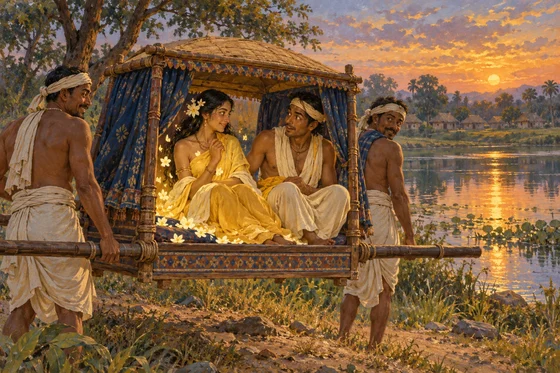
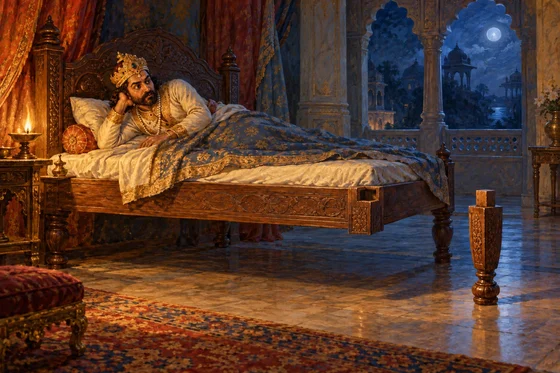
The husband forbids her to leave the house and gives her mustard seeds over which he has spoken incantations. When a begging jugi refuses alms offered through the window, she throws the seeds at him and he becomes ashes. He immediately restores himself by stronger magic and again insists that she come outside. After seeing her, he tells the Raja about her beauty. The ruler visits as a fly, returns in the same form and carries her away on his back. He keeps her weeping in a furnished room on the palace roof. Her egg-origin and the Raja’s fly-transformation belong to different characters.
The husband searches in a jugi’s clothing. At the palace he hears her voice and refuses money offered to silence his lament. The Raja sends his dogs Rauta and Paika to kill him. His wife obtains permission to attend the cremation, saying that she has never seen a jugi’s funeral. Through successive songs she directs the same dogs to build the pyre, split more wood and light it. She then distracts them by telling them to look at stars in daylight, throws salt into their eyes and enters the flames on her husband’s body. The narrator ends with her death; there is no revival or escape to another home.
The account calls her a bonga and does not give her a personal name or explain why she inhabits this particular egg. No bird wings, beak or change into an adult flycatcher is described. Its forced seizure, captivity and final death are parts of a specific mediated narrative, not an endorsement of those acts or evidence for a universal marital or funerary practice among Santal communities.
Origins & earliest records
Bompas’s preface credits O. Bodding with collecting the stories and says most were written in Santali, principally by Sagram Murmu. No individual teller is identified for this unit. Bompas acknowledges condensation; the original Santali text has not been independently collated.
Records & interpretation
Complete selected unit, ending and collection preface read from retained PG11938. Historical literary witness, not verified supernatural events or present-day ethnography.
Selected bibliography
Documented works and useful reading. This is not a list of every appearance.
- 01
Folklore of the Santal Parganas, XXVII: The Flycatcher’s Egg
Complete tale, pp.111–113, including ending; no attached unit footnotes. Complete collection preface read.
Family & connections
A source-supported family tree or inspiration record has not yet been compiled for this profile. Related reading below indicates a connection in subject matter, not a proven lineage or creative influence.
References
Sources supporting this profile. Linked pages have their own scope and editorial standards.
- Historical primary folklore translationBompas1909 XXVII, complete narrativeResearch access: 2026-10-27
Image credits
AI-generated illustrationAI-generated interpretation of the bonga woman preparing the replacement meal after emerging from the egg. Her adult appearance, clothing, ornaments, egg coloration, cookware and house are artistic choices, not a reconstruction of Santal costume or ritual.
AI-generated interpretation of the bonga woman preparing the replacement meal after emerging from the egg. Her adult appearance, clothing, ornaments, egg coloration, cookware and house are artistic choices, not a reconstruction of Santal costume or ritual.