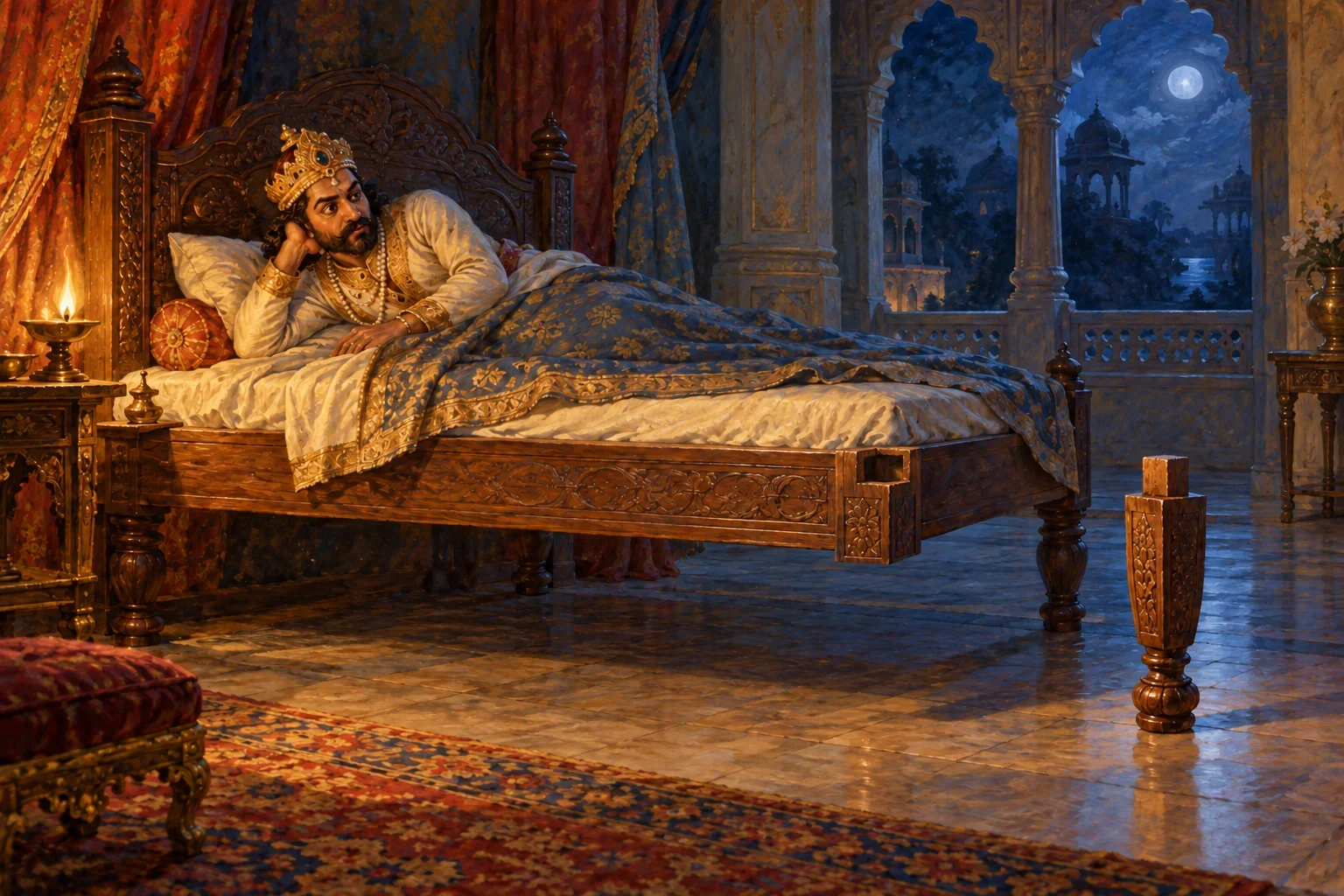
AI-generated interpretation of the Raja listening as a detached guardian leg returns to the bedstead. The bed design, decoration, royal clothes, palace and moonlight are artistic choices; the wooden leg has no invented face or human limbs.
AI-generated interpretation of the Raja listening as a detached guardian leg returns to the bedstead. The bed design, decoration, royal clothes, palace and moonlight are artistic choices; the wooden leg has no invented face or human limbs.
Overview
The Magic Bedstead begins when a carpenter hears the four legs of a newly made bed talking on his verandah. They promise to save the life of anyone sleeping on it and protect that person from enemies. He therefore asks a hundred rupees for an object the Raja judges worth only a few annas. The ruler buys it on the condition that the money will be returned if its promised protection proves false. The carpenter makes the bed, but the story supplies no spell or origin for its awareness.
One night the Raja lies awake and hears the legs discussing his danger. The first detaches itself, kills a tiger outside and fastens itself back into place. The second leaves and kills a leopard and a bear. The third finds four burglars digging through the palace wall and breaks their legs. Each guardian returns before the next goes out, so the episode concerns successive independent excursions by parts of one object, rather than a procession of four complete beds.
The fourth leg provides information instead of attacking an enemy. Outside, it hears a voice in the sky threaten to send a snake into the Raja’s shoe. After the legs tell one another what happened, the listening ruler waits until dawn and has his servants inspect the grounds. They find the dead animals and injured burglars. Taking the remaining warning seriously, he orders all his shoes burned before he gets up. The narrative does not identify the voice or show the snake arriving, and it does not say that the fourth leg killed one.
The ending changes the bed’s use. The Raja orders it carefully guarded and threatens death to anyone who sits on it. He no longer sleeps in it himself, but keeps it in his bedroom for protection. Thus the bed’s initial offer of safety to a sleeper leads to its preservation as a guardian that its owner will not use normally. No faces, human hands, separate names or continuing adventures are supplied for its four legs.
Origins & earliest records
Bompas’s preface credits O. Bodding with collecting the stories and says most were written in Santali, principally by Sagram Murmu. No individual teller is identified for this unit. Bompas acknowledges condensation; the original Santali text has not been independently collated.
Records & interpretation
Complete selected unit, ending and collection preface read from retained PG11938. Historical literary witness, not verified supernatural events or present-day ethnography.
Selected bibliography
Documented works and useful reading. This is not a list of every appearance.
- 01
Folklore of the Santal Parganas, XXXIV: The Magic Bedstead
Complete tale, pp.131–132, including ending; no attached unit footnotes. Complete collection preface read.
Family & connections
A source-supported family tree or inspiration record has not yet been compiled for this profile. Related reading below indicates a connection in subject matter, not a proven lineage or creative influence.
References
Sources supporting this profile. Linked pages have their own scope and editorial standards.
- Historical primary folklore translationBompas1909 XXXIV, complete narrativeResearch access: 2026-10-27
Image credits
AI-generated illustrationAI-generated interpretation of the Raja listening as a detached guardian leg returns to the bedstead. The bed design, decoration, royal clothes, palace and moonlight are artistic choices; the wooden leg has no invented face or human limbs.
AI-generated interpretation of the Raja listening as a detached guardian leg returns to the bedstead. The bed design, decoration, royal clothes, palace and moonlight are artistic choices; the wooden leg has no invented face or human limbs.