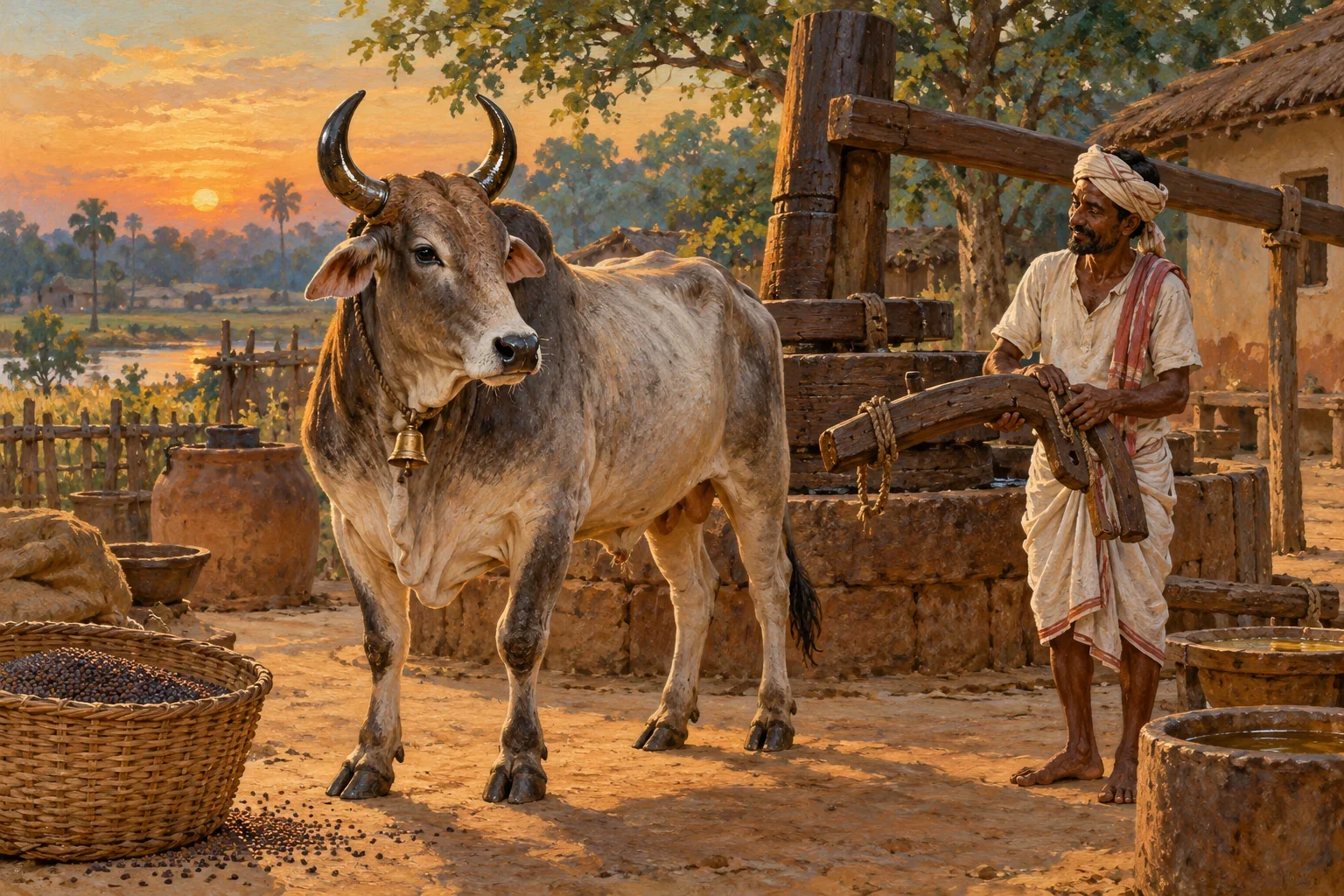
AI-generated interpretation of the oilman's bullock released from mill work. The bell and oiled horns follow the story; coat, mill design, clothing, sunset and the depicted removal of a yoke are artistic choices, not a documentary reconstruction.
AI-generated interpretation of the oilman's bullock released from mill work. The bell and oiled horns follow the story; coat, mill design, clothing, sunset and the depicted removal of a yoke are artistic choices, not a documentary reconstruction.
Overview
The old bullock in The Oilman’s Bullock has helped an industrious oilman turn a hand-built mill into a prosperous business. When one of the owner’s cart animals dies, the surviving younger bullock joins him in the stable. A passing villager overhears the two speaking about their treatment and obligations. The old animal says that he must remain until he has paid his owner five hundred rupees. The younger expects to clear his own debt through two years of work. The story gives no earlier human lives or explanation of how either debt arose.
The old bullock proposes a quicker settlement: if matched against the Raja’s elephant for the required sum, he will win. The overheard conversation brings the village together, although the oilman fears that challenging the ruler will provoke punishment. His neighbours promise financial support and send two elders to arrange the match. Before the contest the owner feeds the bullock meal and oilcake, oils his horns and ties a bell around his neck. The preparation is ordinary husbandry around an extraordinary prediction, rather than the grant of a new magical weapon.
At the field near the palace, the oilman insists that the elephant’s rider dismount because nobody will ride the bullock. The elephant advances, but turns and runs when the bullock stands firm and stamps. The bullock pursues and gores it, and the oilman receives the five hundred rupees. He then releases the victorious animal from mill work, feeds him well and leaves him free to wander. The bullock stays with him for one month and dies. This ending fulfils the promised discharge through winning rather than through years of labour; it does not describe a bodily transformation or disclose the animal’s fate after death.
Origins & earliest records
Bompas’s preface credits Rev. O. Bodding with collecting the stories and says most were written in Santali, principally by Sagram Murmu. It does not identify the individual teller of this unit. Bompas describes his translation as somewhat condensed.
Records & interpretation
Complete selected unit, ending and collection preface read from retained PG11938. No attached unit footnotes; Santali written original not independently collated.
Selected bibliography
Documented works and useful reading. This is not a list of every appearance.
- 01
Folklore of the Santal Parganas, XXIV
Complete selected tale, pp.100–102; complete preface read. No individually named oral teller established.
Family & connections
A source-supported family tree or inspiration record has not yet been compiled for this profile. Related reading below indicates a connection in subject matter, not a proven lineage or creative influence.
References
Sources supporting this profile. Linked pages have their own scope and editorial standards.
- Historical primary folklore translationBompas1909 XXIV complete narrativeResearch access: 2026-10-27
Image credits
AI-generated illustrationAI-generated interpretation of the oilman's bullock released from mill work. The bell and oiled horns follow the story; coat, mill design, clothing, sunset and the depicted removal of a yoke are artistic choices, not a documentary reconstruction.
AI-generated interpretation of the oilman's bullock released from mill work. The bell and oiled horns follow the story; coat, mill design, clothing, sunset and the depicted removal of a yoke are artistic choices, not a documentary reconstruction.