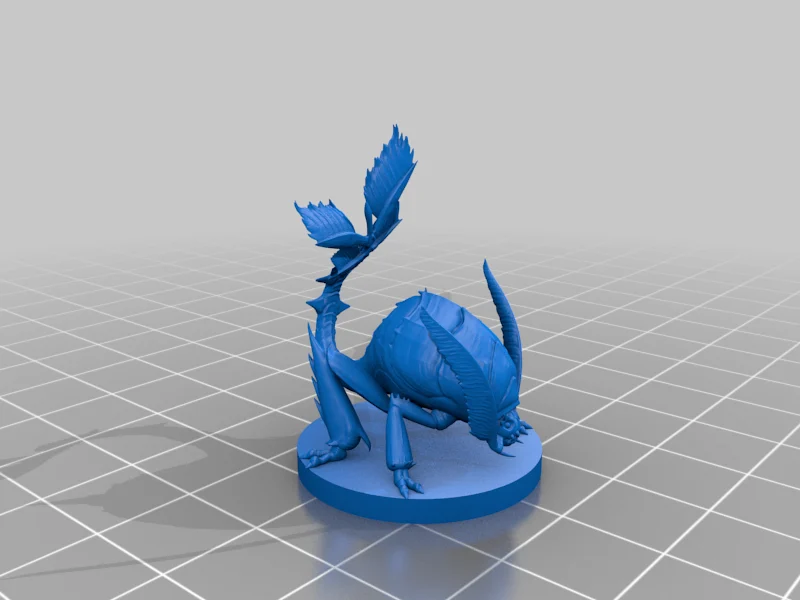
Blue rendered rust monster miniature with rounded segmented body, four legs, two long forward antennae and raised fan-ended tail, standing on a circular base over a grey grid.
mz4250’s Rust Monster model. The whole supplied render is unchanged; this is fan-made tabletop illustration rather than official franchise artwork.
Overview
The rust monster makes equipment, rather than only bodily injury, the central danger of an encounter. The 2014 profile distinguishes an ordinary bite from antennae that corrode nonmagical ferrous objects. Iron scent locates such metal nearby, giving the creature a reason to approach an armored traveler independently of hunting flesh. A nonmagical metal weapon striking its body deteriorates, accumulating a penalty to damage until it becomes unusable. Metal ammunition is destroyed after dealing its damage. The antennae also threaten carried protection: a failed saving throw can reduce armor's effectiveness, while the selected legacy procedure explicitly includes shields. These effects do not automatically extend to magical equipment or every substance that resembles metal.
The revised manual preserves an Underdark creature whose antennae make close contact consequential, but redistributes its actions. A turn can combine a bite with two uses of Antennae, and an attack hitting the monster can trigger another use as a reaction. Revised corrosion reduces a weapon's attack rolls rather than the legacy damage rolls; armor still loses protection. Mending can remove the revised penalty, an express repair provision that should not be read as reconstructing an object already destroyed. Uncarried metal receives a separate destruction action. Iron detection still concerns ferrous metal, while the revised equipment-targeting text says nonmagical metal armor or weapons. These specific procedures distinguish two published encounters without inventing a new biological species for each rules change.
First appearances & development
The bibliography selects third-edition and two fifth-edition treatments rather than claiming an exhaustive debut history. The revised book belongs to the 2024 rules family but was published in 2025. Corrosion, repair and reaction details here refer to their named manuals; the 2000 volume remains a historical witness rather than the source of either fifth-edition procedure.
Canon & continuity
Official legacy and revised profiles supply the compared object rules, senses and habitat. The publisher's release listing establishes the revised volume's publication year. The apparent contrast between finding iron and targeting metal equipment is preserved as printed wording, without adopting reader comments about shields, constructs or magical physiology as official adjudication.
Selected bibliography
Documented works and useful reading. This is not a list of every appearance.
- 01
Monster Manual (2014)
Legacy fifth-edition rust monster: passive weapon deterioration and ferrous-object antennae rules.
- 02
Monster Manual (2000)
Third-edition creature treatment; included for historical comparison, not as the source of fifth-edition mechanics.
- 03
Monster Manual (revised fifth edition)
Revised rust monster: repeated antennae uses, reactive corrosion and Mending repair provision.
Family, evolution & connections
Small plastic monster toys in Gygax’s early gaming
In the interview, Gygax explicitly describes using plastic monsters and naming one the Rust Monster. This supports toy-based early representation and naming, without identifying a manufacturer, exact natural model or sole later rules author.
References
Sources supporting this profile. Linked pages have their own scope and editorial standards.
- OfficialRust Monster (Dungeons & Dragons) — official franchise guideResearch access: 2026-10-05
- OfficialRust Monster — revised profileResearch access: 2026-10-05
- OfficialRevised Monster Manual — publisher release listingResearch access: 2026-10-05
Image credits
Creator-made rust monster miniature renderBlue rendered rust monster miniature with rounded segmented body, four legs, two long forward antennae and raised fan-ended tail, standing on a circular base over a grey grid.
mz4250’s Rust Monster model. The whole supplied render is unchanged; this is fan-made tabletop illustration rather than official franchise artwork.