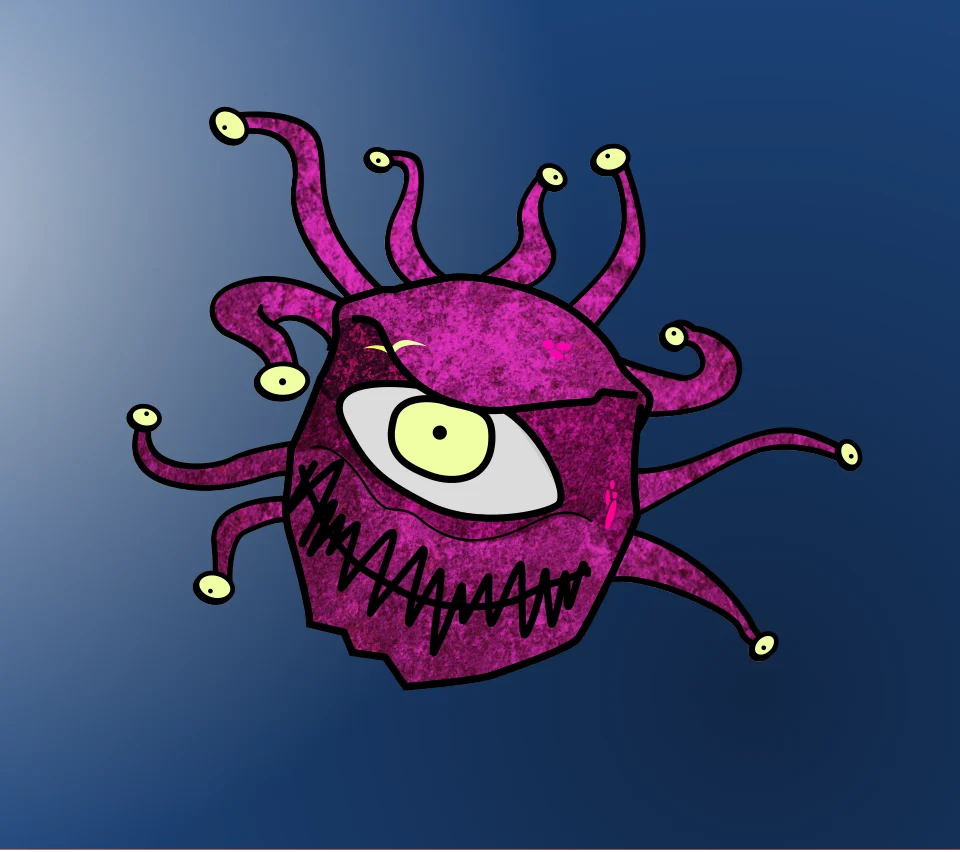
Original fan illustration of a beholder
Original illustration by Commons contributor; not official D&D art.
Overview
A beholder's levitating body, central eye and smaller eyestalks make its silhouette immediately recognizable, but its decisions are as important as its shape. In the legacy fifth-edition treatment, the central eye suppresses magic in a cone, including the beholder's own eye rays there. Its victim-controlling and destructive rays consequently require different lines of attack from that central eye. The 2018 publisher tactics article explains these limits while proposing optional changes to run a more calculating antagonist; those proposed contingencies and freely selected rays are advice, not additional powers in the ordinary Monster Manual stat block. Volo's Guide to Monsters develops the connection between levitation and habitat: inaccessible chambers keep servants from reaching the beholder, while floor traps obstruct intruders without obstructing their floating master. Its paranoid preparation turns the surrounding architecture into part of the encounter.
Volo's 2016 account makes rare dreams capable of producing a fully formed beholder nearby. The dreamer and the new creature usually try to kill each other; a rare hive instead comprises similar individuals whose goals align, without being a literal shared mind. Eye tyrants can lead mixed communities by controlling some of their usual suspicion, although that does not make them benevolent rulers. Xanathar's criminal organization illustrates this more socially involved antagonist. In Mike Mearls's 2018 interview, the beholder tries to decode reality while fearing its dangers and can dream creatures into existence. His suggestions of a vast cosmic dreamer or an unexplained disruption of divine creation remain speculation, rather than a confirmed creator god or established origin for every setting. Dream birth, individual eccentricity and magical geometry therefore belong to identified fifth-edition sources rather than a timeless account of every edition.
First appearances & development
The existing bibliography identifies Supplement I: Greyhawk in 1975 as an early published treatment. The expanded account is anchored to the 2014 fifth-edition framework, Volo's Guide to Monsters in 2016 and two publisher discussions in 2018. The early source is retained as historical context, not claimed as freshly collated text.
Canon & continuity
The official Volo's chapter and both publisher articles were inspected directly. The chapter supplies dream birth, hive limits and spatial tactics; the tactics article distinguishes legacy mechanics from its optional proposals. Mearls's interview supports the retained designer interpretation. No revised 2025 stat block is silently substituted for these legacy accounts.
Selected bibliography
Documented works and useful reading. This is not a list of every appearance.
- 01
Supplement I: Greyhawk
Earlier bibliographic witness; complete original text not reread in this expansion.
- 02
Monster Manual (2014)
Legacy fifth-edition framework discussed in the publisher's tactics article.
- 03
Volo's Guide to Monsters
Official online Beholders chapter: dream birth, rare hives, eye tyrants and tactical habitat.
- 04
Beholders in Dungeons & Dragons and why they are Iconic
Attributed designer interpretation; cosmic origin suggestions remain speculative.
- 05
How to Play a Beholder like a Paranoid Mastermind
Legacy mechanics with clearly identified optional encounter advice.
Family, evolution & connections
Goat, gecko and octopus pupil shapes in Beholder-kin artwork
DiTerlizzi identifies goat, gecko and octopus pupils as references for his 1993 Beholder-kin plate, assigning the octopus to Eye of the Deep. This is artwork-specific, not biological kinship.
Encyclopedia background
An additional attributed reference, separate from the editorial profile above.
Read the open encyclopedia overview
The beholder is a fictional monster in the Dungeons & Dragons fantasy role-playing game. It is depicted as a floating orb of flesh with a large mouth, single central eye, and many smaller eyestalks on top with powerful magical abilities.
The beholder is among the Dungeons & Dragons monsters that have appeared in every edition of the game since 1975. Beholders are one of the few classic Dungeons & Dragons monsters that Wizards of the Coast claims as Product Identity and as such was not released under its Open Game License. Beholders have been used on the cover of different Dungeons & Dragons handbooks, including the fifth edition Monster Manual.
Text from Wikipedia contributors, “Beholder (Dungeons & Dragons)”. CC BY-SA 4.0. Extracted introduction; formatting changed. Retrieved 5 October 2026. The source article may have changed since retrieval.
References
Sources supporting this profile. Linked pages have their own scope and editorial standards.
- ReferenceBeholder (Dungeons & Dragons) — reference guideResearch access: 2026-10-05
- Primary workVolo's Guide to Monsters: BeholdersResearch access: 2026-10-05
- OfficialMike Mearls and Todd Kenreck: Beholders in Dungeons & Dragons and why they are IconicResearch access: 2026-10-05
- OfficialD&D Beyond: How to Play a Beholder like a Paranoid MastermindResearch access: 2026-10-05
Image credits
Exact subjectOriginal fan illustration of a beholder
Original illustration by Commons contributor; not official D&D art.