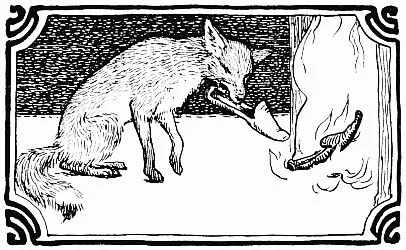
Batten: Master Rory burns the hunter’s shoes
Exact Russet Dog fable scene: the speaking fox puts shoes into the hearth to force the hunter away from the exit. Not an ordinary wildlife photograph. Selected title-page edition1895; John Dickson Batten1860–1932 credited illustrator; Joseph Jacobs compiler/editor.
Overview
The chapter begins with the fox obtaining food through calculated imitation and distraction. He floats among ducks concealed in heather, identifies the oldest wren by flattering his threshing stroke and escapes a hunter’s hut by burning increasingly valuable belongings until the man moves from the exit. Speech, clothing and household action make him a fable character rather than an ordinary fox with unusually intelligent hunting habits. His confidence sometimes fails: a captured cock persuades him to speak and escapes from his opened mouth.
Master Rory tricks the wolf into freezing its tail to the ice while guarding supposed cheese reflected by the moon. He steals their shared butter under pretended invitations to baptisms, then falsely incriminates the wolf. Later crop bargains award the wolf oat roots and potato tops while the fox keeps the edible portions. A living little bonnach initially resists entering his mouth but finally trusts his swimming excuse and is eaten. The cycle ends when a hunter takes the fox’s boast about a bullet literally and shoots him. These collected adventures share a narrative protagonist in Jacobs’s arrangement, not a claimed single untouched traditional biography.
Origins & earliest records
Jacobs says he made up this Celtic Reynard from Campbell’s Fables in volume I and The Keg of Butter and The Fox and the little Bonnach in volume III, tales lxv and lxvi. The selected 1895 edition preserves that admission. Similarities to wider animal-fable cycles do not by themselves prove a route of transmission.
Records & interpretation
The dialogue and sequence of plots provide literary evidence for an adapted animal trickster. The wolf’s lost tail and the fox’s flea-removal technique belong to fable explanations and claims, not established zoological accounts. The named cycle is kept separate from Grimm’s transformed royal fox.
In the literature
“the Russet Dog, the Fox”
The Russet Dog, pp125–135; p125; opening identification
Rory tricks the wary speaking bonnach into his mouth, eats it, then eats a duck. His boast about a bullet fitting his full side prompts a nearby hunter to shoot and kill him. The fox’s final defeat is explicit and follows, rather than reverses, the cake’s death.
Selected bibliography
Documented works and useful reading. This is not a list of every appearance.
- 01
More Celtic Fairy Tales: The Russet Dog, pp. 125–134; note XXXVIII
Selected episode and relevant source note inspected. Earlier works named by Jacobs are attributed references, not falsely claimed as independently collated texts.
- 02
More Celtic Fairy Tales
Joseph Jacobs, More Celtic Fairy Tales, selected1895 Nutt/Putnam edition, PG34453. Complete selected tale and respective compiler-note paragraph independently read.
Family & connections
A source-supported family tree or inspiration record has not yet been compiled for this profile. Related reading below indicates a connection in subject matter, not a proven lineage or creative influence.
Located primary passages
Specific passages supporting details in this entry, grouped by their published witness.
More Celtic Fairy Tales
Joseph Jacobs, More Celtic Fairy Tales, selected1895 Nutt/Putnam edition, PG34453. Complete selected tale and respective compiler-note paragraph independently read.
- Russet Dog, fox, Reynard and Master Rory label the same narrative trickster. The compiled sequence gives flea removal, duck and wren hunting, escape from a tod-hunter, a cock’s counter-trick, repeated wolf deceptions, and theft framed as baptism visits. These are fable episodes, not verified fox behaviour.
The Russet Dog, pp125–135; A fox under successive comic aliases
- Rory tricks the wary speaking bonnach into his mouth, eats it, then eats a duck. His boast about a bullet fitting his full side prompts a nearby hunter to shoot and kill him. The fox’s final defeat is explicit and follows, rather than reverses, the cake’s death.
The Russet Dog, pp125–135; Success against speaking cake, followed by death
Named narrative actions and compiler interpretations distinguished. No verse, prayer or ritual formula excerpts; no real-animal behavioural proof implied.
Primary source witness
Joseph Jacobs, More Celtic Fairy Tales, selected1895 Nutt/Putnam edition, PG34453. Complete selected tale and respective compiler-note paragraph independently read.
- Jacobs explicitly constructs his Celtic Reynard from several Campbell fables, Keg of Butter and Fox and Little Bonnach. Comparative Reynard/Aesop parallels and speculative native origins are compiler comments, not independent proof of a single oral performance.
No independent collation of the cited underlying editions claimed.
References
Sources supporting this profile. Linked pages have their own scope and editorial standards.
- Primary textMore Celtic Fairy Tales, selected 1895 edition: The Russet Dog, pp. 125–134; note XXXVIIIResearch access: 2026-10-05
Image credits
Historical illustrationBatten: Master Rory burns the hunter’s shoes
Exact Russet Dog fable scene: the speaking fox puts shoes into the hearth to force the hunter away from the exit. Not an ordinary wildlife photograph. Selected title-page edition1895; John Dickson Batten1860–1932 credited illustrator; Joseph Jacobs compiler/editor.